


The first Vethrak missile refused to fit through Defiant’s magazine hatch.
The loading exoskeleton held six metric tons of captured ordnance twenty centimeters above the bay floor while two technicians argued over a tolerance nobody had included in the manifest. Amber work lights washed across the missile’s bone-pale casing. A human adapter collar wrapped its forward third, all square brackets and dark crysteel against curves grown for another species’ launch tube.
David Rivera stood beneath the suspended weapon with a datapad in one hand.
“Measurement.”
“Adapter collar is inside spec,” the ordnance chief said. “Hatch frame lost nine millimeters when Engineering replaced the blast liner.”
“Can we rotate it?”
“Four degrees clockwise. Maybe five.”
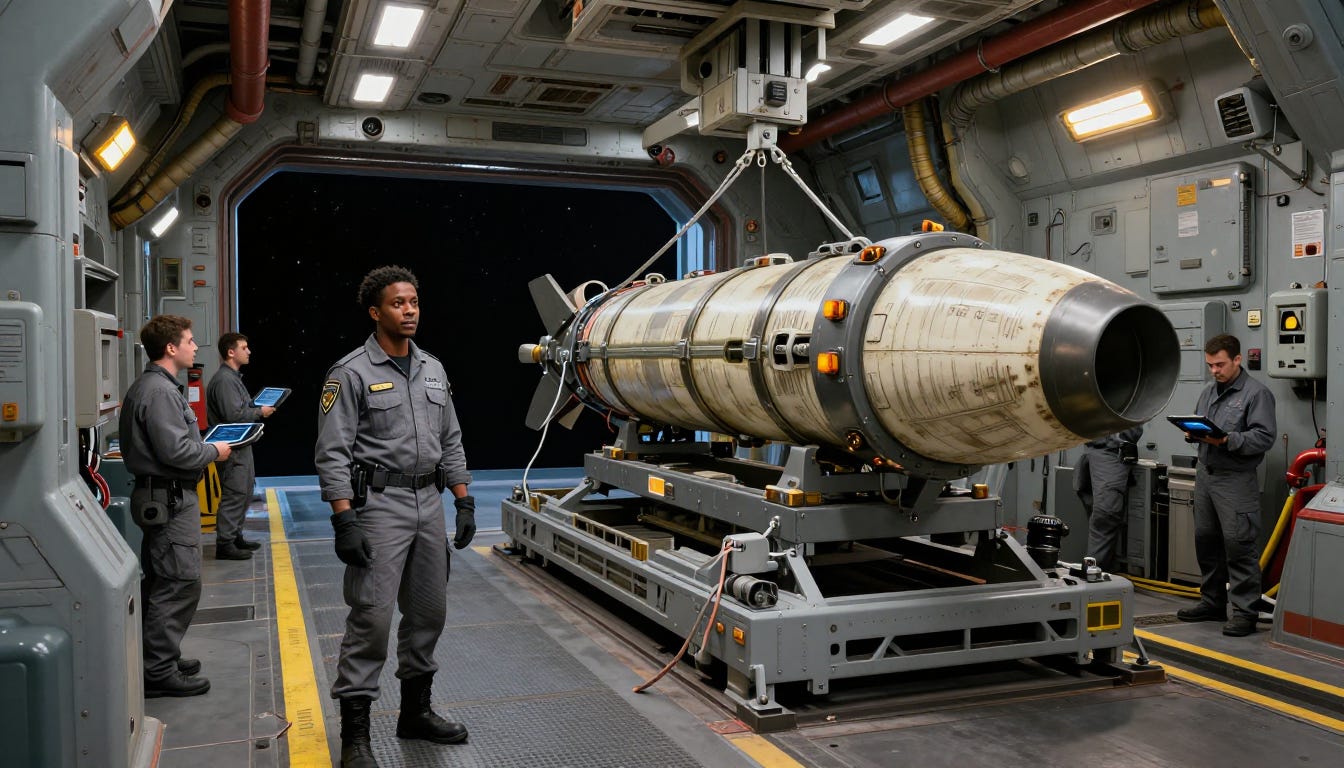
The exoskeleton operator shifted her stance. Hydraulic servos answered with a low whine. Crew at the guide lines took up slack, boots planted outside the yellow exclusion marks.
“Four,” David said. “Slow.”
The missile rolled. Its Vethrak control ridges passed the hatch with three millimeters to spare. Nobody cheered. The ordnance team moved with the concentration of people handling a weapon designed to cross thousands of kilometers and erase whatever waited at the far end.
The tail cleared.
“Log the liner variance,” David said. “Check every hatch before the next lift.”
“Aye, Captain.”
Cargo Bay Two had been empty during the shakedown. Now it held eleven sealed racks, forty-eight adapted missiles, and enough kinetic warheads to change Defiant’s mass distribution by a measurable fraction. Exoskeletons moved between marked lanes. Inventory officers scanned each serial against the depot manifest. Engineering teams locked adapter buses into human fire-control ports and ran dry handshakes without waking the guidance cores.
Organized chaos, reduced to columns.
David checked the load plan again. Port magazine: sixty-two percent. Starboard: fifty-nine. Reserve racks amidships, balanced within point zero four percent around the thrust axis. A bad distribution would turn every maneuver into wasted correction and every correction into fuel they might need on the way home.
The next crate came down from the transfer lift.
Its side carried two labels. The first was a Vethrak inventory pattern translated from Kaath-Seven’s archive. The second was human, printed twelve hours ago at Prometheus.
CAPTURED ORDNANCE. KINETIC IMPACTORS. SAFE CONDITION VERIFIED.
The words made the crate look ordinary.
It was not ordinary. Kaath-Seven had held 230,000 missiles, 4.2 million kinetic warheads, and thirty years of manufacturing capacity. The alliance had taken the depot whole, then paid to keep it. Five dead aboard Defiant. Eleven aboard Hope. A Keraneth escort took two of five torpedoes meant for Revenant while its Fold Drive cooled. Sixty-nine dead or wounded across the fleet.
No crate in this bay was free.
David stepped onto the loading lane and caught the rear guide line as the exoskeleton brought the crate around. The line tugged hard through his gloves. He leaned his weight into it until the load stopped rotating.
“Captain, we have this,” the ordnance chief said.
“I know. Bring the nose left.”
They moved it together. Ten meters to the rack. Half a meter down. Locking pins engaged in sequence, four metal impacts under the hum of ventilation.
David released the line.
A smear of dark residue crossed his right glove where the depot casing had rubbed against it. Fourteen years ago, his father had come home from the Mars ore processors with dust packed into every seam of his hands. He had still set the table before sitting down. Work completed first. Meaning came later, if it came at all.
The manifest advanced one line.
“Rack seven secure,” the chief said.
David signed the acceptance field. “Run the interface test.”
The technician connected the rack to Defiant’s fire-control bus. Human status lights stepped from red to amber. The captured guidance architecture answered through Thomas Okonkwo’s coupling standard, alien signals translated across three interface geometries into numbers a weapons officer could use.
One missile returned an error.
GUIDANCE PACK IDENTITY MISMATCH.
“Safing circuit held,” the technician said. “No core activation.”
“Pull it. Quarantine rack twelve.”
“That puts us one below the strike-group allotment.”
“Then we leave one below.”
The technician acknowledged the order and tagged the missile red. No hesitation. No appeal to the schedule. Defiant had survived men who treated margins as insults. David would not rebuild that habit one exception at a time.
The exoskeleton lifted the rejected weapon from its collar. Its original Vethrak markings passed beneath the work lights: functional grooves pressed into a surface the enemy had grown around a purpose. This weapon had entered inventory for a harvest fleet. Its target category had been human.
Now a red human tag hung from its casing because David Rivera would not trust it enough to send it home.
Justice did not live in the reversal. A missile had no allegiance. It carried instructions, mass, and consequence. The choice belonged to the people who aimed it.
David looked across the bay.
Crew moved through the last checks. Rack seals. Thermal monitors. Restraint loads. Fire-control isolation. Forty-seven captured missiles sat behind Defiant’s armor, each one adapted to a human command bus and assigned to a target the Dominion had built to feed its next campaign.
The Keraneth escort at Kaath-Seven had survived. Scorched and venting atmosphere, it had held formation long enough to take two torpedoes meant for Revenant. Defiant’s five had not survived. Their names occupied the memorial chapel one level above the bay. Every launch in the coming campaign would carry both facts.
Use the weapons well. Bring the people home.
The final standard crate settled into rack eleven at 0314. Locking pins engaged. Green status lights spread across the inventory board until only the quarantined slot remained red.
“Physical count complete,” the ordnance chief said. “Forty-seven missiles accepted. Twelve kinetic batteries. Point defense allocation complete. All racks within thermal and mass limits.”
David compared the board against his manifest. Every serial. Every rack. Every variance. The point zero four imbalance had dropped to point zero two after the rejected missile came out.
“Seal magazines one through four. Maintain quarantine on twelve. Transfer the rejected unit back to Prometheus under armed protocol.”
“Aye, Captain.”
He entered his command code.
The manifest asked for final acceptance. Beneath the number sat a line most officers would skip: SOURCE, KAATH-SEVEN DEPOT. RECOVERY COST, SIXTY-NINE CASUALTIES.
David placed his thumb against the authorization pad.
ACCEPTED FOR COMBAT LOAD.
The bay shifted from amber work lighting to steady white. Exoskeletons powered down along the wall. Crew gathered guide lines, closed tool cases, and cleared the lanes. Mundane work, completed without ceremony.
Defiant carried forty-seven weapons the Vethrak had manufactured for conquest. She carried five empty stations from the price of taking them. David signed for both.
The last magazine door closed.
Defiant was combat-loaded.
If you enjoyed this story, you can follow the main story arc in The Exodus Rush, the first book in The Vethrak Requiem series.