


The chapel niche was on the lower ring of Mimas Station, in a corridor most of the traffic walked past without slowing.
Anya had walked past it for three years.
She slowed today. Davit was at her left shoulder. Bero was at her right, half a step behind because he was nineteen and still arranged himself around her without thinking about it. Neither of them spoke. They had not spoken much since she had told them, in the storage bay an hour ago, what she meant to do this afternoon. Davit had nodded once and gone to put on his good coat. Bero had stood in the doorway a moment too long, then gone to wash his hands.
The corridor was warm. The desalination plant vented two corridors over, and the deck plates between here and the chapel always ran a little above ambient. The station had grown a small geography of warmth around its memorial wall, the way a body keeps blood near a wound, and the people who had chosen this niche for this purpose had probably chosen it for that reason.
Her hand was in her chest pocket. The fragment was where it had been for three years. Hull plating off the Polaris. Three centimeters by five. The serial stamp half-eroded by whatever had killed the colony ship in transit to Mars. She had run her thumb over the stamp so many times that the ridges of the lettering had worn smoother than the metal around them. The fragment had her thumbprint sunk into it now, the way old wooden banisters have the hand of the family that lived with them.
The niche door was open.
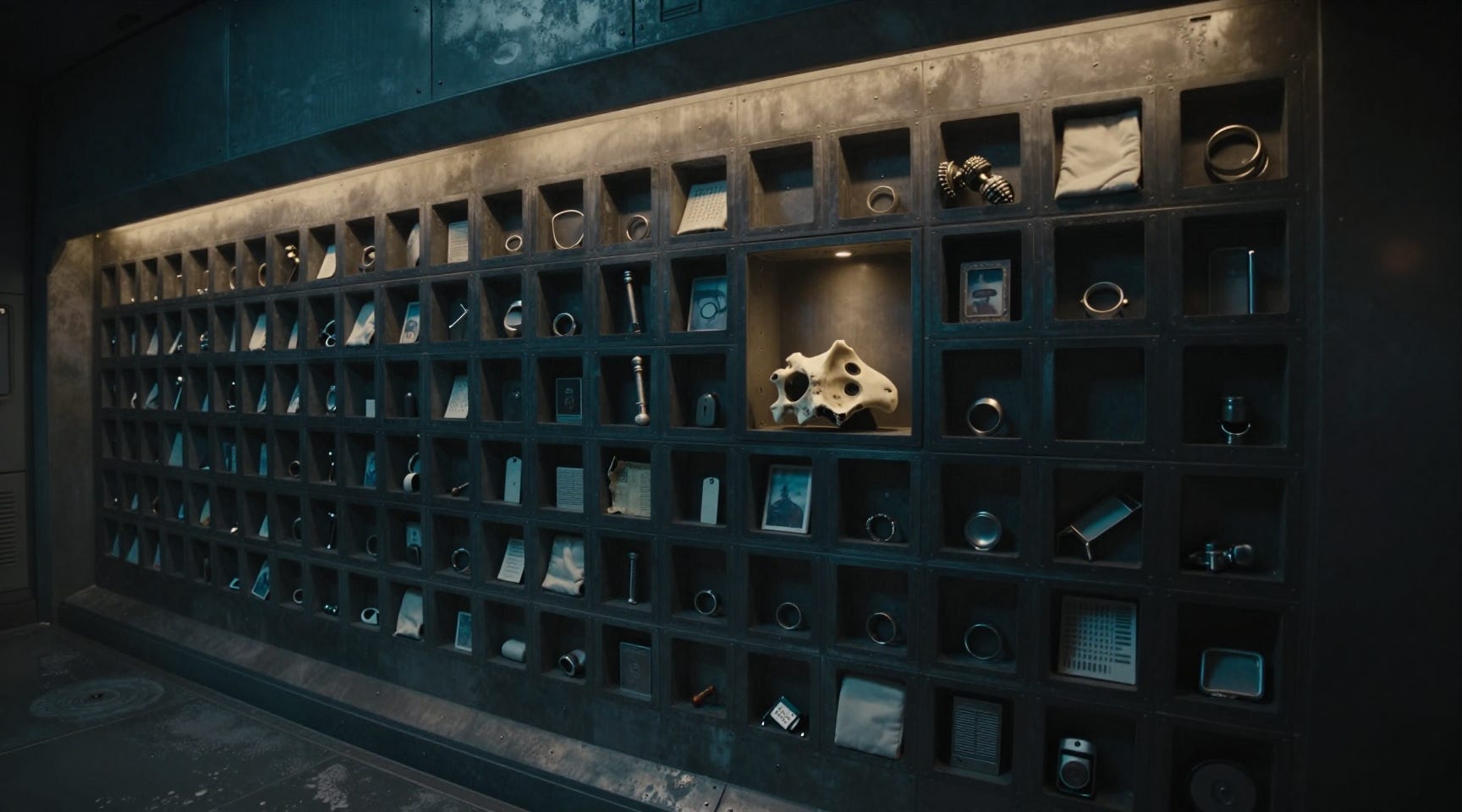
It was always open. That was the point. No liturgy. No clergy. A wall, and the wall had a thousand small recessed slots cut into it, and the slots held what the bereaved had brought. Hull fragments. Service tags. A child’s earring. A wedding band on monofilament. A folded square of cloth that had been a uniform sleeve. A laminated photograph so faded the face was only the suggestion of a face.
She had been in this corridor twice before. Once for Maren, two and a half years ago, when the wall had been less than half full and Maren’s name had been the third Iron Wake name on it. Once for a courier killed on the Pallas run, whose mother had asked her to come because the boy had spoken of her once.
She had not come for her brother. Not once.
The first eighteen months she had told herself it was because the Polaris had no recovered remains, and the niche-wall asked for something physical. Then she had recovered the hull fragment from the wreck in the outer ring and that excuse had broken. She had simply not come. The fragment had stayed in her chest pocket and the wall had grown without her.
Maren was on the wall. Maren had been on the wall the whole time. Her slot held a small piece of EVA welding rod, scavenged from her toolkit by the crew that recovered her, given to the wall by Anya in a private hour she did not let herself think about. Third row, four panels in, second from the corridor side.
She went in now.
The chapel was a small room. Six meters by four. The wall took up the long side. Two benches along the opposite wall, both empty. A station drone had been keeping the deck swept. The air smelled the way Mimas Station always smelled, recycled, faintly metallic, the back-note of warm water from the plant beyond the partition. The fluorescents were on low. Someone had set them that way and nobody had ever turned them back up.
Davit and Bero stopped at the threshold. She had said on the walk over that she wanted to do the placement alone. They had agreed without making a thing of it. Davit had his hands clasped in front of him the way he did at funerals. Bero had his hands at his sides because he had not yet learned what to do with hands at a moment like this. He would. The Iron Wake would teach him. She did not know yet whether that was a thing to be glad of.
She walked to the wall.
Maren’s slot was where her body knew it was. The welding-rod fragment caught the warmer strip of light. Anya touched two fingers to the edge of the panel beside it, not to the fragment, that was Maren’s and only Maren’s now. The metal was warm. The desalination plant vented its small constant offering through the deck two corridors away.
I brought him, she thought. She did not say it aloud. He’s going to be near you.
She moved one slot down. The slot she had been thinking about for three years. There had been three slots open beside Maren when she had placed the welding rod. Two of them had been filled since. The one closest to Maren was still empty.
She took the fragment out of her chest pocket.
The metal was warm from her body. It was warm in a way that nothing on this wall would ever be again, after today. She held it between her thumb and her forefinger and looked at the serial stamp her thumb had worn smooth. POL-447. The letters and the number she had memorized before she could read sentences, because the Polaris had been the ship her brother served on and her brother had been six years older than her, and she had drawn the letters in her schoolwork all through her childhood the way other children drew the names of their pets.
She set the fragment in the slot.
Stamp-side out, because the stamp was the thing that named him, and the wall was for naming. Carefully, the way she would have set a recovery into a cataloging tray, because the discipline of the careful motion was the only thing keeping her hand from shaking. She did not let her hand shake. She would not let her hand shake. She had carried this for three years and she would set it down properly.
She drew her hand back.
She stood in front of the slot for a long moment with nothing in her chest pocket. The absence was a weight. The absence was heavier than the fragment. She looked at the small piece of her brother’s ship sitting in the wall beside Maren’s welding rod, and she did not weep. She had spent three years not weeping for this. She had become a person who did not, and the discipline of that was also a kind of grief, and she would not break it here.
She turned around.
Davit was looking at the deck. Bero was looking at her. His face had the small adjustment it did when he was working out what a thing meant and not asking for help with it.
She walked to them. She did not stop walking. She passed between them and out into the warm corridor, and they fell in beside her.
They were halfway back to the storage bay before Bero spoke.
“His name was Ilya,” he said. It was not a question. He had read it off the serial stamp database in the bay slabs at some point in the last year, the way he read everything in the slabs at some point.
“Yes.”
“He was your older brother.”
“Yes.”
Bero walked another six steps. Then he said, “The wall holds him now.”
“Yes.”
He touched her elbow. He did not say anything else. The touch was light and brief and he took his hand away as soon as it had landed, the way a person touches something hot. He was learning. He would keep learning. The Iron Wake would teach him, and he would teach the next one. Her brother’s hull fragment would be on the wall for all of it, and the wall would still be there when none of them were.
She did not say any of that. She kept walking. The deck plates ran warm under her boots all the way back to the bay.
At the door Davit hung back. “There’s tea, if you want it.”
“In a little while,” she said.
He nodded. He went inside. Bero hesitated at the threshold and then went in after him.
Anya stood alone in the corridor for a moment with her hand in her empty chest pocket. The pocket was lighter than it had been in three years. The fragment was on the wall beside Maren. The Iron Wake ledger was waiting on her desk inside, two and a half meters from where she was standing. Tomorrow she would open it and add a line on the People page, in her own hand: a name and a date and a ship she had not, until today, let herself write down.
She took her hand out of the pocket.
She went inside.
If you enjoyed this story, you can follow the main story arc in The Exodus Rush, the first book in The Vethrak Requiem series.