


The course adjustment was small. A six-degree heading change, three minutes’ burn, a quiet drift onto a vector that did not match anything on her current registration log.
Maren’s voice came through the cabin speaker from the cargo bay.
“You taking us off route?”
“Sensor calibration loop.” Anya kept her hand on the helm yoke. “Long sweep. Four hours out, four back.”
The pause was the length of a breath. Maren had been on the Underweight for four months now. One of the things she had brought aboard was the habit of not asking.
“All right. I’ll run the manifest cleanup.”
“Take the bunk after if you want.”
“I will.”
The line went quiet.
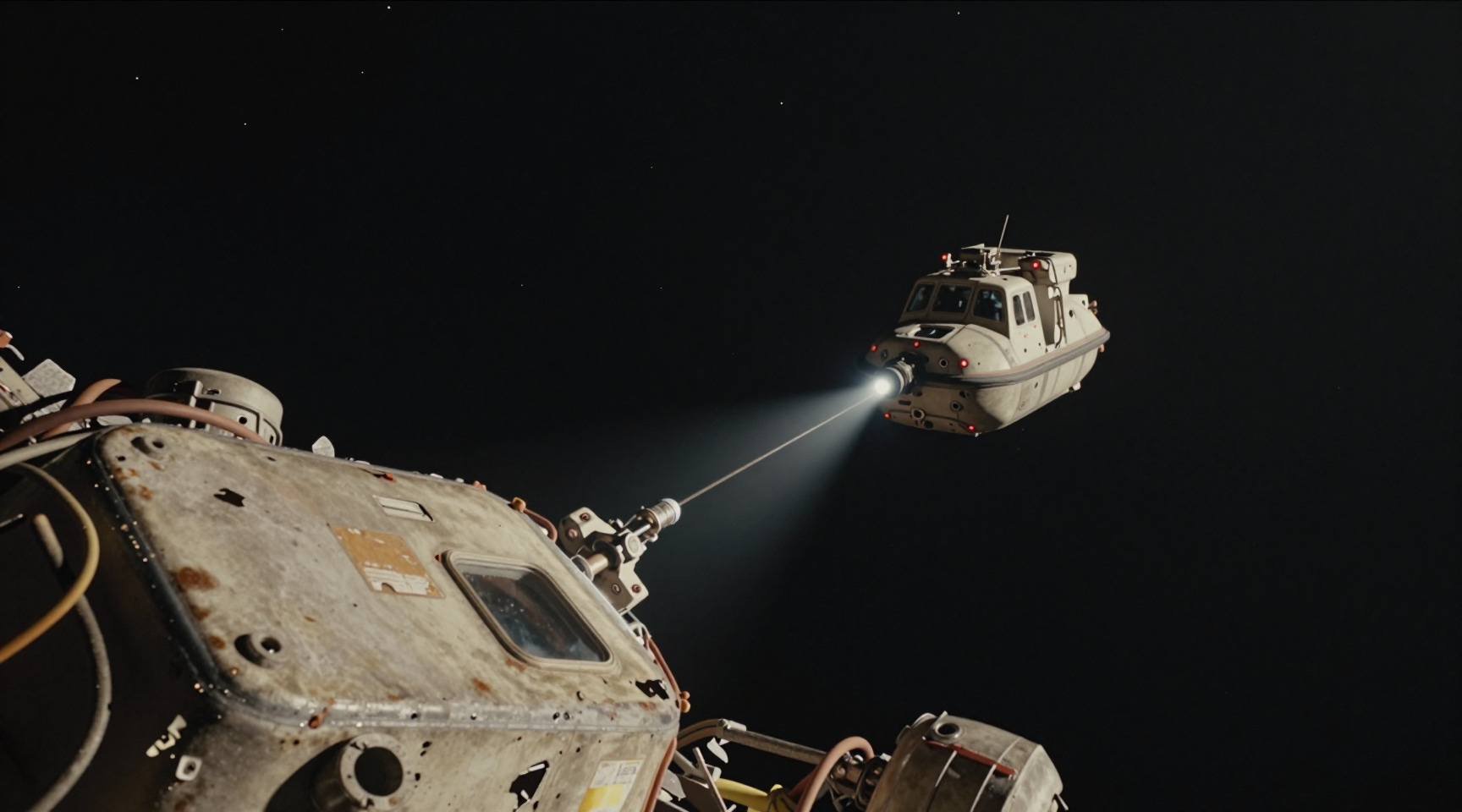
Anya keyed the autopilot, set the burn, and watched the Underweight‘s drift signature fall onto the new heading. The vector was one she had memorized at sixteen, when she had stood in her father’s apartment in Stockholm and watched a UEN evacuation officer point at a wall display and say the Polaris was here, on this trajectory, and we lost contact with her here, and we have not been able to recover her. The officer had used the word recover the way bureaucrats used it. Anya had filed the coordinate set the way she filed everything that mattered: in the part of her head that did not need light to find again.
She had not flown the vector for ten years.
The Underweight‘s thrusters cycled. The skiff slid onto the heading. The Saturn rings drifted off her starboard quarter and the empty corridor between the ring plane and the inner system opened ahead of her in a long black absence of anything.
The debris field came up on her scope at hour three.
It was not large. The Polaris had been a colony freighter, mid-tonnage, ten thousand registered souls in cold storage and another four hundred crew awake. The Vethrak interception had been a single fold-cusp engagement somewhere in the orbital corridor between Saturn and the inner system, and the debris had spread along the freighter’s last vector for a decade. Most of it was out of the corridor by now and tumbling along its own slow drift. The remaining concentration was small. A few hundred fragments, scattered in a loose halo, the kind of cluster a Vethrak-hunter would not bother with.
The kind of cluster that read clearly to a salvager who had been trained to read what hulls said about the ships they had been.
She killed the autopilot and ran the Underweight in on thrusters. Her gloves were already on. Her helmet sat on the console at her elbow. The cabin was quiet.
She read the field.
The first piece her scope tagged was a section of outer plating, perhaps a meter across, drifting end-over-end with its inboard surface periodically catching the distant sun. The plating’s pattern of micrometeor scoring was older than the invasion, layered, a decade of ring-belt service. Civilian construction. Standard Polaris-class cladding. She did not need the scanner to confirm. She confirmed it anyway.
The second piece was a fragment of internal bulkhead. The third was a section of cabin paneling, smaller than her hand, the inboard side painted the soft cream of crew habitation deck. The fourth was a piece of one of the freighter’s sublight thruster fairings, blackened along one edge in a way that did not come from atmospheric reentry. Vethrak ordnance. The kind of cut a fold-cusp lance left when it caught a hull at speed.
She did not think about that.
She put the helmet on. She ran the EVA pre-check. She cycled the airlock.
The skiff’s exterior light came up as she crossed the threshold and the rings of Saturn made a wide pale curve below her boots. She was upside down to the planet, the way ring-belt natives instinctively oriented, and the field hung around her in a slow tumble of small bright shapes against the black.
She tethered the closest fragment first.
The work was the work. It was the same work she had been doing for sixteen months now. Anchor the fragment with the magnetic clamp, stabilize the spin with a thruster pulse, run the recovery line, draw it in. The motions were so deeply trained that her body did them without her watching. Somewhere underneath the motions, the part of her that did not have hands was doing something else.
She cataloged each piece as she brought it aboard.
The cabin paneling came in fourth. The soft cream paint. The corner of a maintenance sticker stuck to its inboard face, half torn, the rest peeled away by a decade of vacuum and a long tumble through cold. She knew the sticker. She knew it the way she knew the coordinate. Ilya had peeled half of one off a wall in their parents’ apartment when he was sixteen because he had been bored and the corner had been loose and he had picked at it without thinking. Their father had walked in and looked at him and said one quiet sentence about furniture not being a habit-breaker and Ilya had nodded and never picked at a sticker again. Anya had been twelve. She remembered the sentence. She remembered Ilya’s face when their father said it. She remembered the half-peeled sticker on the kitchen wall, which had stayed half-peeled until the apartment had been emptied for the relocation, and which her mother had never replaced.
The piece of paneling in her hand had a different sticker. Standard freighter maintenance log, half torn the same way, vacuum-dried, paper edges curled. The serial-prefix on the printed strip below the tear matched the Polaris‘s registry block. She read the prefix three times.
She put the paneling in the recovery bin.
She did not weep.
The tether went out. The next fragment came in. She cataloged it. The fragment after that. She cataloged it. She did the work the way the work was done. Her breath in the helmet was even. Her hands did not shake. The chest pocket of her undersuit pressed the Polaris hull fragment against her sternum, the small piece her uncle had pulled from a relay-station debris cloud six years ago and given her without saying what he was giving her, and the pressure of it was the only part of her that was not pretending.
She filled three bins.
She did not pull in the rest of the field. She left the small bright shapes drifting in their loose halo and she watched them through the cabin viewport for a long time before she closed the recovery bay.
She cataloged the entire recovery into the Underweight‘s manifest under a personal-effects designation. It was a category the salvage software allowed but did not encourage. Personal-effects recoveries were not taxable, not reportable to Salvage Protocol, not marketable. They were also not legally salvage. They were what they were.
She set the Underweight‘s heading back toward Mimas. She did not look at the field again.
The shadow-market message had been in her notification queue for six months.
She had not opened it. She had not deleted it. She had carried it the way she carried the Polaris fragment, in a place she did not look at. The handle had been a string of letters that was not a name. The five-word offer had been triple Salvage Protocol valuation. The price had been good then. The price was probably still good now. The price had nothing to do with anything.
She brought the Underweight through the Mimas approach lane on autopilot and watched the station’s running lights resolve out of the dark. Her undersuit was still damp from the EVA. The recovery bins in the cargo bay were sealed and labeled. The personal-effects designation in the manifest was clean. Maren was asleep on the bunk. The cabin was hers alone.
She opened the message.
She typed two words.
Talk price.
She sent it.
She did not feel the line cross. The line had crossed in the field, with her hand on a piece of cabin paneling and the corner of a maintenance sticker she remembered against her glove. The message was paperwork. The paperwork would catch up. It always did.
The Underweight came in to dock. The thrusters cycled. The cargo bay pressure equalized with the station umbilical and the manifest queued itself for offload. She unhooked her helmet. She set it on the console. She put one hand on her chest pocket and held it there for the time it took the airlock to cycle.
Then she stood up and went out to do the next thing.
Author’s note: Day Six of the Iron Wake Origins arc. Anya Rask routes the Underweight through the Polaris*’s last known coordinates for the first time in a decade. Her brother Ilya was aboard the freighter when the Vethrak intercepted it during the invasion, and the UEN never returned to recover the wreck. The work no one else was going to do, she does. She does not weep. She does the work. The recovery goes into the Underweight’s manifest under a personal-effects designation, which is a category the salvage software allows but does not encourage. On approach to Mimas, she opens the shadow-market message that has been sitting in her notification queue for six months and replies with two words. The line crossed in the field, with her hand on a piece of cabin paneling and the corner of a maintenance sticker she remembered. The two-word reply is paperwork. The paperwork will catch up. It always does. Year 1, Month 10. Tomorrow she meets the buyer.
If you enjoyed this story, you can follow the main story arc in The Exodus Rush, the first book in The Vethrak Requiem series.