


The cargo seal passed before Samrawit Assefa could learn where the plate had been made.
She hooked one boot into the receiving-lock restraint and brought the scanner against the first module. Its housing carried a one-time route code, a custody token, and nothing a person could turn into a journey. No departure port. No processing plant. No destination beyond this transfer.
The radiation sweep returned within limits. She matched the intact seal to the receipt, checked the pressure cycle, and countersigned the local custody field. Beyond the inner door, crane brakes caught with a vibration through her heel. Another shipment could enter the approach only after this one cleared the lock.
“Materials to receiving,” Foreman Cho said over her cuff. “Slip Two needs its rack before the torch window.”
“Receiving has it. Fabrication doesn’t.”
“How long?”
She turned the scanner toward the next seal. “Long enough to know what I am signing.”
He left the channel open without answering.
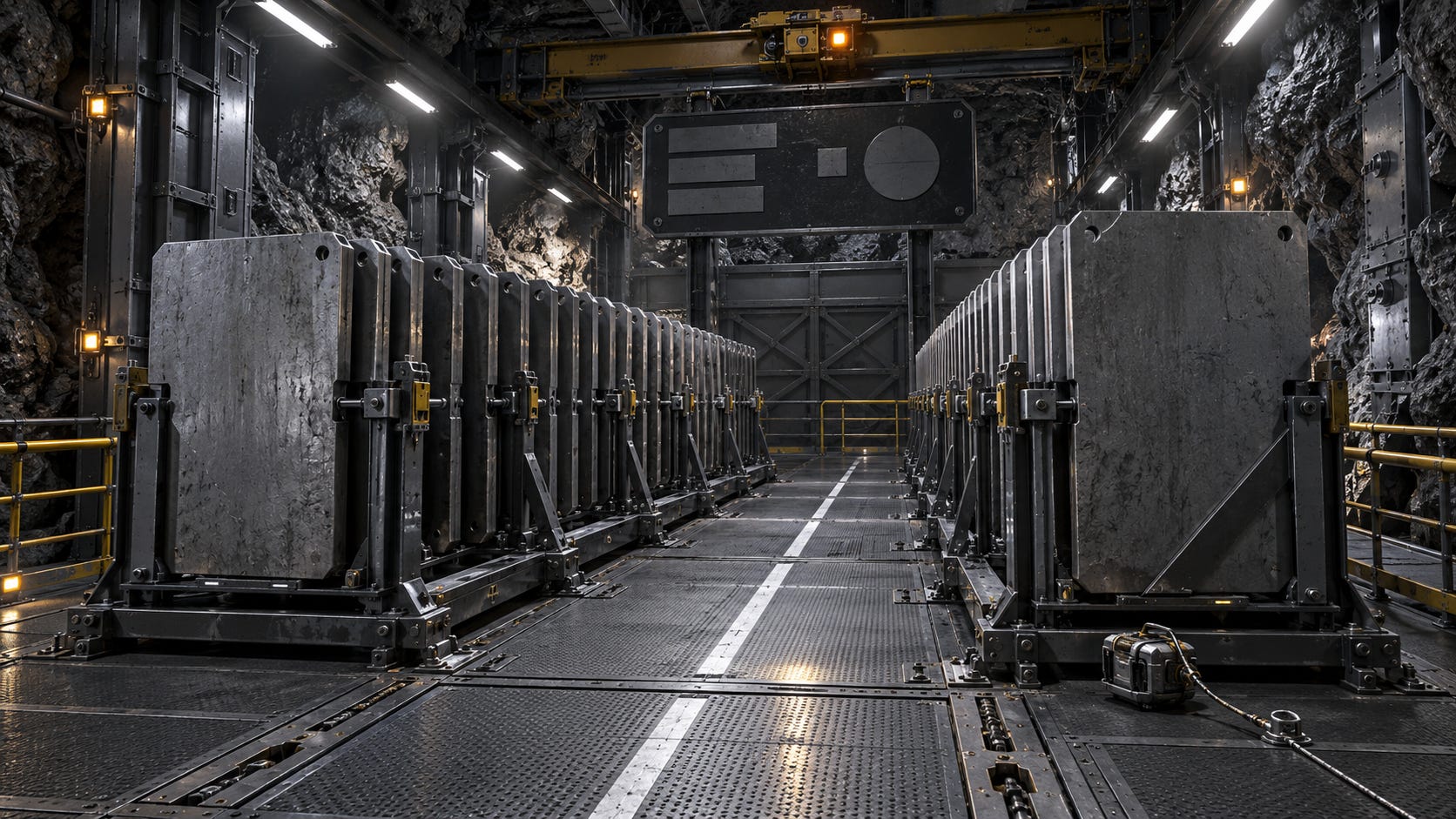
At Site Anvil, a hidden construction yard inside an unlisted asteroid, names mattered less than a current assignment. Her cuff called her Materials. The receiving technician had a shift number on his chest. The plate would acquire a local lot identifier before anyone unlatched its transport frame.
Nothing left with the yard’s name stamped into it. Nothing moved inside without a record.
The technician clipped the scanner to its bracket and entered the crane transfer. Samrawit compared the second module’s seal against its own receipt. The route codes differed. The material category did not.
Both modules carried structural plate for Article Four, the transition barrel taking shape in Slip Two. Eventually it would join two pressure-hull sections somewhere else. Here, it needed edges that fitted, joints that held, and a proof record Wanjiku Bett could sign. A blank exterior would not make the load disappear.
The inner door opened. Samrawit released her boot restraint, caught the guide rail, and followed the modules into the materials cage.
The crane moved them slowly. Mass remained mass without weight. A careless push could pin a hand between a transport frame and the rack long before anyone reached a stop control.
She waited for the frame clamps to engage before she reached inside.
The plate matched its manifest in every field the manifest offered.
Samrawit checked thickness at the specified points, then width, edge condition, and flatness. She compared the incoming assay against the allowed chemistry bands and ran the receiving analyzer over prepared surface patches. Iron, nickel, the other listed elements: no departure beyond the written limits. The technician entered each result under the instrument’s current calibration record.
Two upstream certificate hashes sat beneath the inspection status. Long strings, different from their first characters onward. She copied both complete hashes into the receiving worksheet and attached each to its own plate group.
The local category placed them together.
“Same grade,” the technician said.
“Same category. Keep the certificate links separate.”
He removed his hand from the merge control.
The plate surfaces offered no help. Both groups were gray beneath their protective film, their edges clean, their restraint points undamaged. She could have filled one rack and given Cho back his crane lane.
Instead, she secured a portable hardness tester to the first plate and checked its reference block. The fixture supplied the contact force. Her body could not supply reliable pressure while floating against a tether.
She prepared the test patch, took a reading, moved to the next specified position, and repeated. Each indentation left a small bright mark on the sacrificial edge allowance. The first group gathered toward the lower part of the receiving band.
The second gathered higher.
Every reading passed.
Samrawit exchanged the order of the checks, tested the reference again, and repeated on another plate from each group. The two clusters remained. She checked thickness correction and surface preparation. Neither explained the separation.
The technician held the tethered slate where she could reach it. “Do I enter a failure?”
“No. Enter the readings.”
“They are all green.”
“Leave them green.”
A hardness check measured resistance to a small indentation. It did not tell her how a restrained weld would behave after heating, cooling, and load. It could raise a question without answering one.
Her thumb rested over the acceptance field. Rejecting compliant stock would consume a shipment window, probably a query window too. Cho would have to explain the delay with numbers that did not support rejection. Accepting the groups as interchangeable would save the same time by burying a difference under one label.
The crane lane indicator changed to amber.
Cho’s channel opened again. “Can the rack take it?”
“Two rows. Keep them separate.”
“That occupies the coupon-stock position.”
“I need coupon stock from both.”
He asked for her worksheet. She sent the receiving results without adding a red warning to make them look worse.
The compartmentation terminal stood inside a narrow alcove beside the cage. Samrawit clipped to its rail and called up the two certificates. Nominal grade, chemistry band, dimensions, inspection status. The same four headings expanded over different hashes.
She searched for forming history.
No field.
Thermal condition produced the same empty result.
The origin partition returned a sealed-record acknowledgment. Data existed behind it. Her engineering access could verify the partition’s custody status, not open its contents.
Onur Tekin joined by voice from compartmentation.
“The origin records are retained,” he said. “They are outside your receiving scope.”
“I don’t need a port or a supplier name. I need to know what happened to these plates before they became this category.”
“Which receiving limit have they missed?”
“None.”
He waited.
“The hardness results separate by certificate,” she said. “I can’t establish interchangeability from what is visible.”
“The category has an accepted use.”
“Article Four puts different pieces through the same joint. I am checking that use.”
The terminal offered an origin-access request. She left it untouched. A broader request would ask a security officer to judge an engineering need he could not read in the four headings either.
“Record your technical question,” Onur said. “The sealed acknowledgment is not a process certificate.”
She attached the question to both hashes. No cause entered the field. No accusation. The work needed more information than the receipt had supplied.
Back at the cage, Cho had secured himself beside the rack control. The worksheet stayed open on his cuff.
“They meet receiving,” he said.
“Yes. I will accept custody into separate quarantine rows. Not release the mixed transition.”
“What can I give the next shift?”
“Verified dimensions. Separate lot records. Paired weld coupons ordered against the proposed transition procedure. The joint waits for review.”
Cho checked the power allocation. His finger moved one entry down the queue.
“Give me the coupon request now. I can put the preparation work inside this shift. The test slot is still open.”
Samrawit entered the order. She signed the split acceptance, attached the complete upstream hashes, and set the quarantine restraint tags. The technician moved each group into its assigned row under the crane’s slow control. No plate crossed from one certificate link to the other.
She caught the floor rail and locked both boots into the strip between the racks. From here the gray surfaces looked identical. Above them, one blind manifest still called them the same material.
Samrawit took a secured roll of removable white tape, fixed its end to the deck, and paid out a line between the two rows.
Author’s note: This story opens the Site Anvil arc in late Year 3, several weeks after the Ceres settlement. A portion of the convoy’s iron and nickel has reached the hidden yard after processing and blind transfers; its origin remains outside Samrawit’s engineering access.
New to The Vethrak Requiem? Start with The Exodus Rush, Book 1, where humanity fights for survival after an alien invasion using technology it barely understands. These short stories explore the wider universe; the novel begins the main story.