


Kabelo Petersen never opened the packages. That was the first rule, the only rule that mattered, and the reason the Ledger Line kept using him.
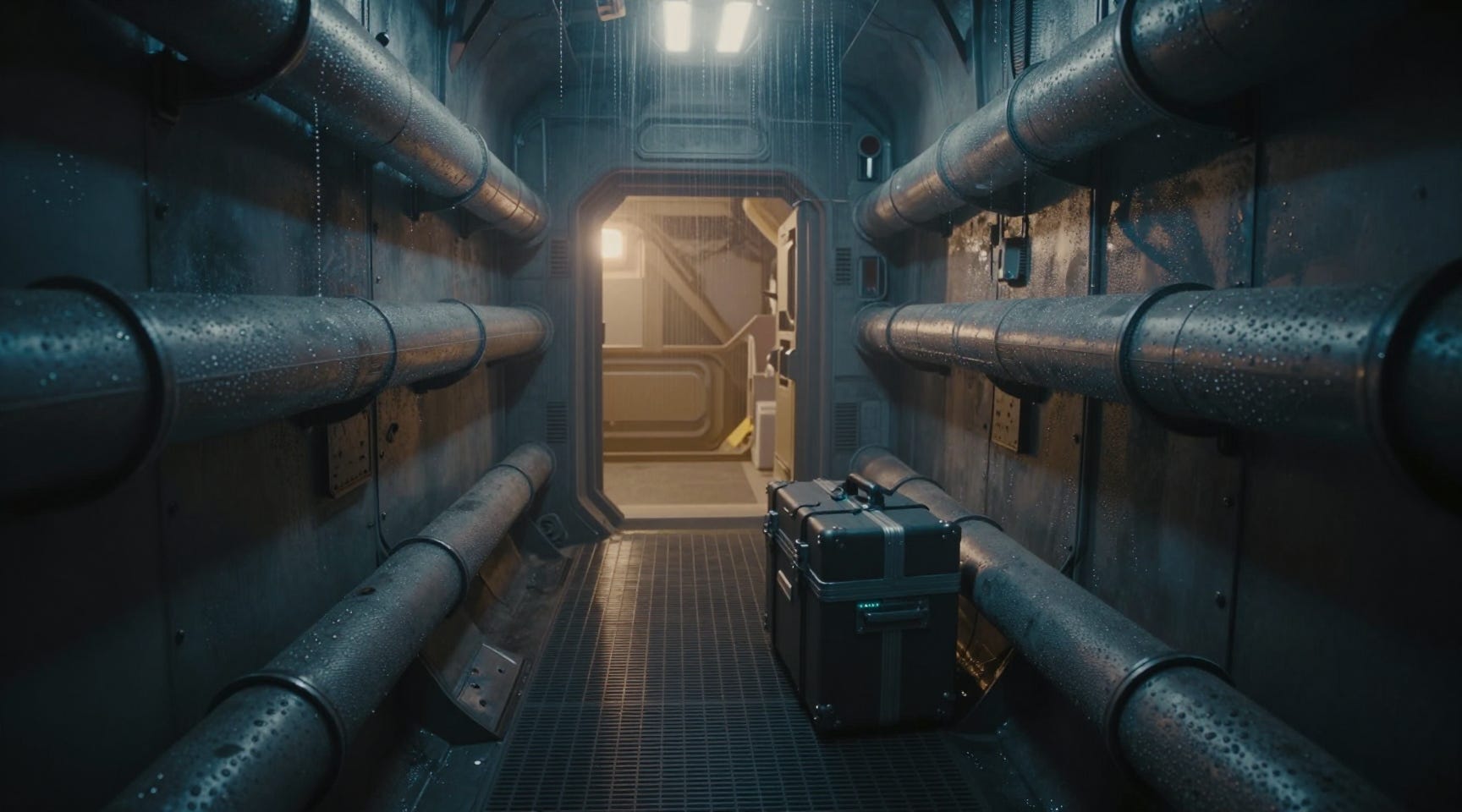
He collected the day’s carry from a storage locker on Hygiea Station’s cargo level, a compartment rented under a maintenance account that nobody audited because nobody wanted to audit maintenance accounts. The locker held a single padded case, matte gray, roughly the size of a meal tray. Sealed with a tamper strip along the upper edge. Standard. He’d carried dozens like it over the past seven months, each one collected from the same locker, each one delivered to the same contact in Sector 7.
This one hummed.
Kabelo held the case against his chest, arms crossed over it the way he always carried. Casual. A worker hauling personal equipment between shifts. The hum was faint, more vibration than sound, pulsing at a rhythm too steady to be mechanical rattle. Something inside the case was powered on.
His legitimate shift started in forty minutes. Waste reclamation, Sector 3, processing the organic slurry that the station’s hydroponic bays generated faster than the composting system could absorb. Eight hours of monitoring pump flow rates and clearing filter blockages. The kind of work that kept a station alive and kept the worker invisible, which was the point. Nobody looked twice at waste reclamation techs. Nobody wanted to.
The carry route from the cargo level to Sector 7 crossed through the central transit corridor, past two security stations staffed by officers who checked identification chips and occasionally ran handheld scanners over bags that looked suspicious. Kabelo’s cases had never looked suspicious. They were the right size, the right weight, the right color. Unremarkable. He’d walked past those officers dozens of times carrying products he’d never seen for purposes he’d never asked about.
A case that hummed was not unremarkable.
He stood in the cargo level corridor, feeling the pulse against his sternum, and calculated. The transit corridor route took twelve minutes. The maintenance crawlway that ran parallel to it, threading behind the station’s water reclamation pipes, took twenty-five. The crawlway had no security stations. It also had no witnesses, no cameras, and no easy explanation if someone found him there during a shift he wasn’t scheduled for.
Kabelo took the crawlway.
The pipes sweated condensation in the narrow passage, beading moisture on his jacket sleeves as he moved sideways through sections where the corridor pinched to shoulder width. The hum from the case stayed constant, vibrating against his ribs. He counted junctions. Third left, straight through the pump relay, second right at the thermal exchange, then up through the access hatch into Sector 7’s lower residential level.
The lower residential level of Sector 7 was not on the station’s public directory. The directory listed Sector 7 as containing eighty registered residents in forty-two housing units. The actual population was closer to three hundred. The additional two hundred and twenty people were refugees from the Interamnia consolidation who had arrived on Hygiea three years ago aboard a transport that the station’s intake system had processed at capacity. Eighty got registered. The rest got told to wait.
They were still waiting. The registration queue had not moved in nineteen months.
Unregistered residents existed in the spaces between systems. They didn’t appear on ration allocation rolls. They didn’t draw atmospheric credit through official channels. They lived because registered residents shared, because sympathetic supply clerks miscounted inventory, and because people like Kabelo carried cases through maintenance crawlways without asking what was inside.
His contact waited in a converted storage compartment at the end of the residential corridor. She went by Five. He didn’t know if that was a name, a number, or a position. She was tall, angular, with close-cropped hair and the kind of stillness that came from years of deciding when to move and when to stay perfectly quiet.
“You’re late,” she said.
“Crawlway route.”
Her eyes dropped to the case. “It’s humming?”
“Since pickup.”
Five took the case and set it on a workbench cluttered with cable spools and circuit boards. She broke the tamper strip and opened the lid.
Kabelo looked. He hadn’t meant to. Seven months of discipline, seven months of carrying without knowing, and the hum had undone him in a single delivery.
The case held atmospheric allocation chips. Forty of them, seated in a charging tray that explained the hum. Each chip was the size of a thumbnail, matte black, stamped with the Hygiea Station atmospheric services logo. They looked authentic. They looked authentic because someone with access to the station’s chip fabrication templates had built them to be indistinguishable from the real ones.
“Atmo chips,” he said.
Five glanced at him. The look was neither surprised nor concerned. “You’ve been carrying these for three months. Among other things.”
“I didn’t know.”
“That was the arrangement.” She lifted a chip from the tray and held it between her thumb and forefinger. “Each chip registers as a valid atmospheric credit on the station’s scrubber network. The scrubbers in this sector authorize air processing based on chip count. Eighty registered chips, eighty allocations of filtered air. The scrubbers don’t care who’s breathing. They care how many chips are pinging.”
Kabelo understood. The station’s atmospheric scrubbers processed air for the number of residents their allocation chips reported. Eighty chips meant the scrubbers filtered enough air for eighty people. Three hundred people breathing air filtered for eighty meant everyone in Sector 7 was breathing at twenty-seven percent of standard quality. Had been breathing at that level for three years.
“The forgery,” he said. “If the network detects duplicate chip signatures…”
“They’re not duplicates. Each chip carries a unique identifier generated from a compromised authentication seed. The station’s atmospheric management system reads them as new registrations. It increases scrubber output to match.” Five set the chip back in the tray. “Forty chips brings the sector’s allocation to a hundred and twenty. Still short of three hundred. Close enough that the filtration quality reaches survivable margins instead of the slow degradation that’s been putting children in the clinic with respiratory infections every six weeks.”
The clinic. Kabelo knew the clinic. An unauthorized medical station in Sector 7 staffed by a retired Navy medic who treated unregistered residents for conditions that the official medical system couldn’t treat because it didn’t acknowledge those residents existed.
“The Ledger Line has been building allocation in this sector for three months,” Five continued. “Forty chips per delivery. This is the third batch. A hundred and twenty supplemental allocations layered into the atmospheric system gradually enough that the station’s monitoring flags the increase as sensor drift rather than unauthorized registration.”
Sensor drift. The same camouflage that every syndicate operation used. Small enough changes, spread across enough time, hiding inside the tolerance bands that overworked monitoring systems classified as normal variance.
“What happens when someone audits the chip registry?” Kabelo asked.
“The same thing that happens when someone audits the maintenance accounts, the ration miscounts, the registration queue that hasn’t moved in nineteen months.” Five closed the case. “Someone decides whether to see a problem or a system that’s working.”
Kabelo stood in the storage compartment, surrounded by the infrastructure of unofficial survival. Cable spools and circuit boards and a charging tray full of forged chips that would let two hundred and twenty people breathe air that their own station’s bureaucracy had decided they didn’t deserve.
His shift started in eighteen minutes. He had to cross back through the crawlway, change into his reclamation coveralls, and spend eight hours monitoring pump flow rates for a composting system that processed waste from all three hundred residents of Sector 7 without distinguishing between the eighty who existed on paper and the two hundred and twenty who didn’t.
The composting system didn’t check allocation chips. It processed what arrived. The scrubbers needed to learn the same indifference.
“Same time Thursday?” he asked.
Five nodded.
He left through the crawlway, condensation soaking his sleeves, the ghost of the hum still vibrating in his chest like a second heartbeat. Behind him, forty chips began their quiet work of convincing the station’s atmosphere that more people deserved to breathe.
His waste reclamation shift that afternoon was uneventful. He cleared two filter blockages, adjusted a pump valve, and filed his end-of-shift report listing all systems within normal parameters.
Everything was within normal parameters. That was the trick of it. The station’s systems were designed to serve a registered population, and every unofficial modification, every forged chip, every miscounted ration, every unaudited maintenance account existed to close the distance between what the systems provided and what the people actually needed. The gap between those numbers was where the Ledger Line operated. Where Kabelo operated.
He walked home through the central corridor, past the security officers who didn’t scan him because he wasn’t carrying anything, past the transit hub where registered residents moved freely under lights powered by reactors that didn’t check identification, breathing air that the scrubbers filtered without prejudice.
The air tasted the same in every sector. Clean or not, allocated or not, it filled lungs that needed filling.
That was the part the allocation system kept forgetting.
Author’s Note: Hygiea Station, orbiting one of the largest bodies in the asteroid belt, was never designed for the population it absorbed after the Interamnia consolidation. The official registration system processed new arrivals at a rate calibrated for peacetime immigration, not mass refugee intake. Three years later, the queue remains frozen, and the people caught in it survive through a parallel economy of shared rations, miscounted supplies, and forged credentials that their station’s own infrastructure treats as legitimate. The Ledger Line fills the gap between bureaucratic capacity and human need, one carry at a time. Kabelo’s choice isn’t whether to participate. He made that decision seven months ago. His choice now is how much to know about what he carries, and whether knowing changes anything about the carrying.
If you enjoyed this story, you can follow the main story arc in The Exodus Rush, the first book in The Vethrak Requiem series.