


The cascade reactor on Juno Station ran at eighty-three percent capacity. Esteban Hofmann knew this the way he knew his own resting heart rate: through repetition, through habit, through the daily act of staring at numbers until they became as familiar as his own face.
Eighty-three percent was healthy. Not the ninety-plus readings the UEN Engineering Manual specified for a Class-Four orbital platform, not even close to optimal. The reactor fed life support, gravity spin, communications, and the agricultural lights in the hydroponic bay. It kept two thousand people alive on a station designed for eight hundred, half-destroyed during the invasion and patched with whatever materials the salvage teams could strip from the wreckage orbiting Jupiter.
The problem was the decimal.
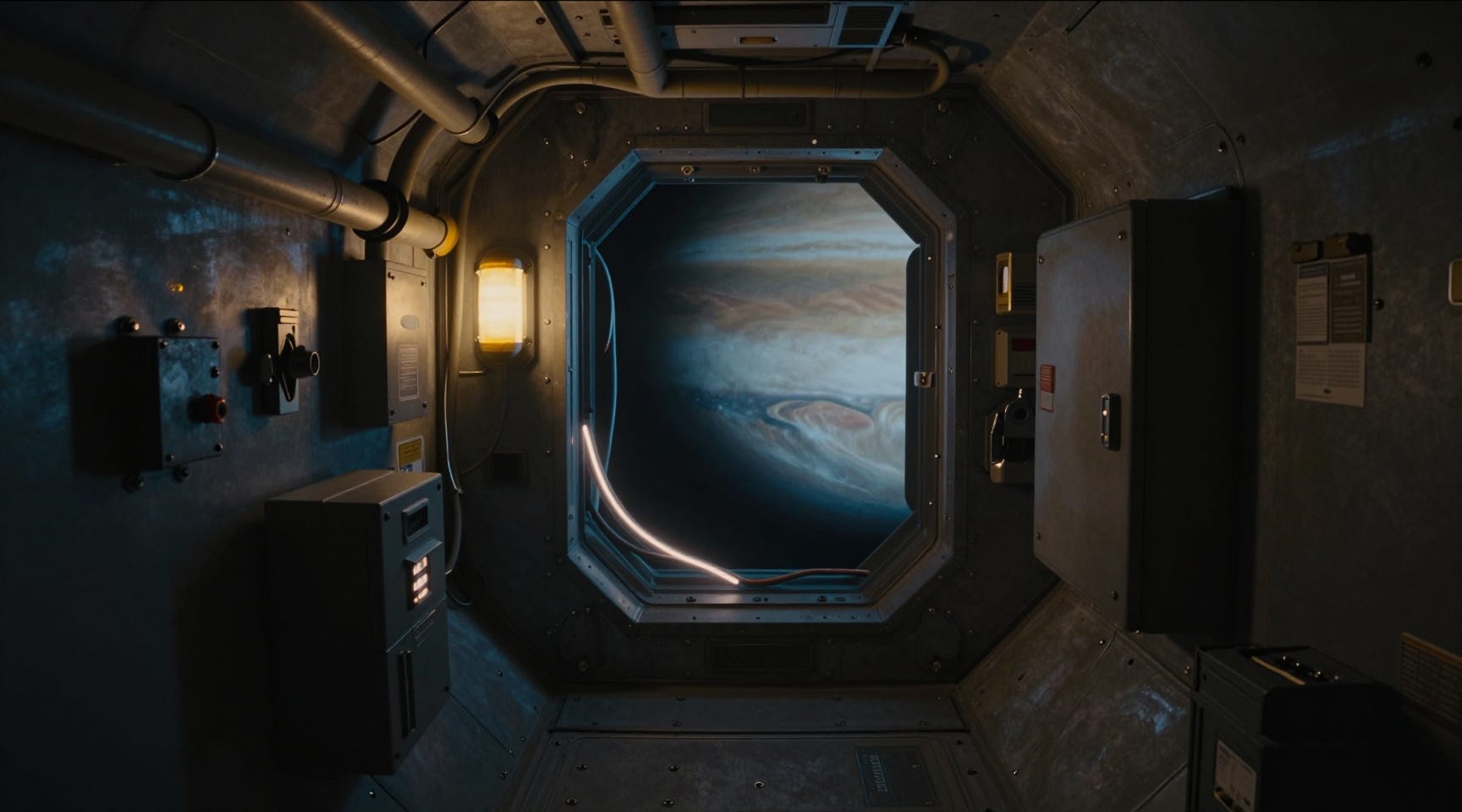
Eighty-three point four percent. That had been the reading yesterday. Today it read eighty-three point one. Three-tenths of a percent. Trivial. A rounding error in any functioning civilization. The reactor’s output hadn’t changed. The power draw from station systems hadn’t increased. The missing energy was going somewhere the monitoring software couldn’t see.
Esteban flagged the anomaly in his shift log and ran diagnostics. Core: nominal. Distribution circuits: clean. Thermal exhaust profiles: within expected values. Every system the software tracked was functioning inside normal parameters.
He found the source during his physical inspection of the secondary coolant loop, twenty meters below the main engineering deck. A junction box on the tertiary power conduit had been modified. The standard four-bolt cover plate had been replaced with a quick-release panel secured by magnetic clamps. Behind the panel, a bypass cable ran through a drilled channel in the bulkhead, connecting to a circuit that didn’t appear on any station schematic.
The cable was warm. Active.
He followed it.
The cable ran through maintenance crawlspaces and ventilation shafts for sixty meters before terminating at a fuel-transfer coupling on the station’s lower ring. The coupling connected to a docking port listed as “structural damage, sealed” since the invasion. The port was not sealed. The port was operational, its hatches manually restored with salvaged components, its approach lights disabled to avoid detection from the station’s external cameras.
A shuttle sat in the berth. Small, civilian-class, its hull scored with micrometeorite damage and patched with mismatched plating. Fuel lines connected to the coupling, drawing power from the cascade reactor to charge its propulsion cells.
Someone had been refueling here for months.
“You’re early.”
Esteban turned. A man stood in the corridor behind him, arms folded, expression neutral. He wore coveralls with no station insignia and boots that showed the wear of regular EVA work.
“Cem Radebe,” the man said. “Supply logistics. Unofficial.”
“You’re stealing reactor power.”
“Borrowing. The distinction matters.” Cem leaned against the bulkhead. “Point-three percent. I measured the margin myself. The reactor carries four percent headroom before life-support reserves start drawing down. I take less than one percent of that margin. Nobody suffers.”
“Two thousand people don’t know their reactor is being tapped.”
“Those two thousand people received four shipments of medical supplies from my shuttle in the last eight weeks. Antibiotics. Anti-radiation meds. Surgical kits.” Cem pulled a data pad from his pocket and held it out. “The UEN supply convoy visits this station once every eleven days, weather and debris permitting. I visit twice a week.”
Esteban looked at the screen. Manifests. Cargo logs. Delivery records for medical equipment, water filtration components, seed stock for the hydroponics bay. All timestamped. All originating from sources unaffiliated with the UEN.
“Where do you get these?”
“The Iron Wake has supply chains the UEN can’t match. Salvage depots. Decommissioned stations. Colony reserves abandoned during the evacuation. The materials exist. The official channels to distribute them died with eleven billion people.”
Esteban handed the pad back. The hydroponics bay had received new seed stock six weeks ago. The station administrator had mentioned it during the weekly briefing: unexpected shipment, no clear origin, catalogued and distributed without questions. People were hungry. Nobody interrogated food.
“What do you want from me?”
“Maintenance. The bypass cable needs recalibration every forty days. The junction box cover needs inspection to ensure the magnetic clamps haven’t degraded. Twenty minutes of work, twice a month.” Cem paused. “In exchange, your name goes on the priority distribution list. First access to medical supplies when they arrive.”
Esteban didn’t have a family on the station. He had a mother on Callisto Settlement and a brother he hadn’t heard from since the invasion. The priority list wouldn’t help either of them.
“I don’t need your list.”
“Everyone needs something.”
The shuttle’s fuel lines clicked as the charging cycle completed. A green indicator light blinked on the coupling, its reflection catching the scratched metal of the hull. Three years after the invasion, and the station’s official power grid was feeding an unauthorized supply network through stolen fuel.
Esteban looked at the junction box. His junction box now. The one he would either report to the station administrator or maintain in silence.
“Forty days?” he said.
Cem nodded.
Esteban pulled a multitool from his belt and opened the quick-release panel. The bypass cable hummed beneath his fingers. He checked the magnetic clamps, tested the conduit seals, confirmed the power draw. Point-three percent. Invisible, unless you knew where to look.
He closed the panel. “The clamps are holding. Check back in thirty-five. I’ll inspect before you arrive.”
Cem extended his hand. Esteban didn’t take it.
“I’m not joining anything,” he said. “I’m maintaining a power conduit. That’s my job.”
Cem lowered his hand without offense. “That’s enough.”
The man walked toward the shuttle, and Esteban climbed back through the maintenance crawlspace alone. The cable ran warm against the bulkhead beside him, carrying stolen power to a docking port that didn’t exist on any schematic, feeding a network that kept the station alive through channels the station would never acknowledge.
The reactor still read eighty-three point one percent.
Esteban stopped checking the decimal.
Author’s Note: Three years after the Vethrak invasion, humanity’s surviving stations ran on margins thin enough to measure in fractions of a percent. The UEN’s supply infrastructure covered the basics for most settlements, when convoys arrived on schedule and weren’t diverted by debris fields or piracy. In the gaps between shipments, networks like the Iron Wake filled the void, trading in salvaged materials and stolen energy to keep stations supplied with what the official channels couldn’t deliver. The cost was always the same: a little power, a little silence, and the quiet erosion of the line between maintaining a system and becoming part of one.
If you enjoyed this story, you can follow the main story arc in The Exodus Rush, the first book in The Vethrak Requiem series.