


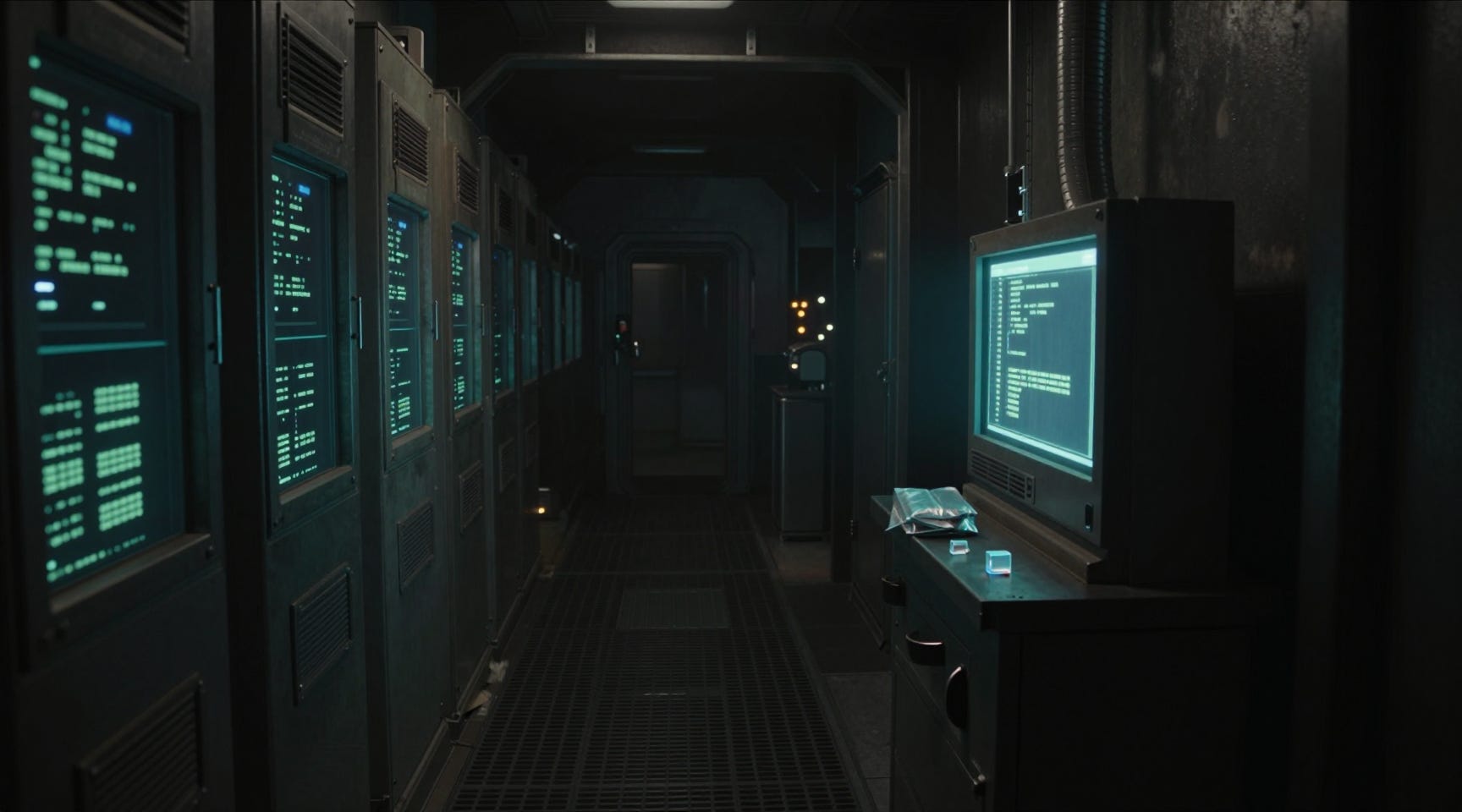
The terminal accepted the code on the first try.
Juliana Marsden watched the confirmation scroll across the maintenance screen, green text on black, and pulled the chip from the reader slot before the log cycle caught up. Three seconds. That was the window between a successful write and the system flagging an unauthorized access event. She had timed it across forty-seven previous attempts. Forty-seven chips, forty-seven clean extractions. Tonight made forty-eight.
She pocketed the chip and closed the maintenance panel, pressing it flush until the magnetic seal clicked. The corridor outside Provisioning Hub 6 was empty at this hour. Third shift on Korolev Station meant skeleton crews and dimmed overheads, the kind of quiet that made footsteps carry. She walked at a normal pace. Running attracted attention. Loitering attracted questions.
The chip in her pocket carried a Class-B ration authorization, good for one adult’s weekly food allocation at any distribution kiosk on Decks 4 through 9. Identical to the ones issued by the UEN Provisional Authority. Identical in every way that mattered: encoding, security hash, expiration window. The only difference was that this chip didn’t correspond to a registered citizen in the station’s population ledger. It belonged to no one. It fed whoever needed feeding.
She reached the service lift and descended to Deck 7.
Three years since the invasion. Korolev Station had been built for eight thousand. It held fourteen thousand now, packed into retrofitted cargo bays and repressurized maintenance sections that were never designed for habitation. The UEN counted heads, issued rations, maintained order. The math was simple: fourteen thousand mouths, eight thousand rations’ worth of food production and resupply. The gap killed people slowly, through malnutrition and immune collapse, through fights over portions, through the particular despair of watching your children lose weight week after week while the official channels told you to file a petition.
Juliana had filed six petitions in her first year. None had been answered.
The service lift opened onto a corridor that smelled like recycled air and overworked water filters. She turned left, passed two sealed bulkheads, and knocked on the third door in a pattern she had memorized: two, pause, three, pause, one.
Diego Schwarz opened the door. He was a compact man with a scar across his left eyebrow and hands that never stopped moving, always adjusting something, checking something, counting something. Tonight he was counting chips.
“Forty-eight,” Juliana said, handing over the blank she had programmed.
He placed it on the table beside eleven others, each one sealed in a static sleeve. Twelve chips per batch. Four batches per month. Enough to feed forty-eight people who didn’t exist on paper.
“We need to talk about the allocation,” Diego said.
“What about it?”
He pulled a chair out for her. She didn’t sit. The room was small, a converted storage closet that Diego had claimed six months ago when they had started this arrangement. Shelving units lined the walls, filled with equipment she didn’t examine too closely. Her role was programming. His role was distribution. That boundary had kept things clean.
“I’ve got a buyer on Deck 3 who wants twenty chips next cycle.”
“Twenty.” She leaned against the door frame. “We’ve never done more than twelve.”
“He’s paying in antibiotics. Real ones, not the diluted station stock. Cephalexin, amoxicillin, a full course of azithromycin. Enough to treat thirty, maybe forty people.”
The words landed harder than she expected. Antibiotics were worth more than food on Korolev. The station’s medical supply had been rationed down to emergency-only six months ago, and the definition of “emergency” kept narrowing. Last week, a woman on Deck 5 had died from a tooth infection that went septic. A tooth infection. The kind of thing that a three-day course of amoxicillin would have cleared in the old world.
“Where is he getting antibiotics?” Juliana asked.
“Does it matter?”
“It matters.”
Diego’s hands paused on the chip he was holding. “He runs supply logistics for Med-Bay 2. Skims from incoming shipments before they hit the official inventory. Small amounts, spread across multiple deliveries. Nobody notices because the manifests get adjusted at intake.”
“He’s stealing medicine from the station supply.”
“He’s redirecting it. Same as we’re redirecting ration codes.”
The comparison sat between them like a weight. Juliana had spent two years telling herself that what she did was different. The food production existed. The capacity existed. The station simply refused to acknowledge fourteen thousand people when its systems were built for eight. She wasn’t stealing. She was correcting an error in the count.
Stealing antibiotics from the medical supply was not correcting an error. It was pulling from an already insufficient pool. Every course of azithromycin that walked out the back door of Med-Bay 2 was a course that wouldn’t reach the woman with the septic tooth, the child with the respiratory infection, the old man whose pneumonia would progress from treatable to terminal because the shelf was empty when the doctor reached for it.
“The people he sells to can afford his prices,” she said. “The people who need antibiotics most can’t.”
“That’s true of everything on this station.”
“It’s not the same thing, Diego.”
He set the chip down. “Forty-eight people eat because of what we do. Forty-eight people who would be skipping meals, losing weight, getting sick. You want to turn down medicine that could save thirty more?”
“I want to know where the line is.”
“The line moved three years ago. It moved when eleven billion people died and the rest of us got packed into stations that can’t hold us.” He picked up the static sleeve and sealed the chip inside. “The question isn’t where the line is. The question is whether you want to keep people alive or keep your conscience clean.”
She stared at the twelve chips on the table. Each one represented a week of food for someone the system had decided didn’t count. She had written every authorization code. She knew the encoding structure, the hash algorithm, the timing window. She knew how to make the system see people it was designed to ignore.
She also knew what happened when you started trading favors with people who stole from medical supply. The chips became currency. The currency attracted networks. The networks attracted people like Diego’s buyer, who skimmed and redistributed and called it survival while building something that looked more like power with every transaction.
“One batch,” she said. “Twelve chips. Not twenty.”
“He won’t take twelve.”
“Then he doesn’t get any.”
Diego studied her face. The scar across his eyebrow pulled tight when he frowned, a pale line against brown skin. “You’re making this harder than it needs to be.”
“I’m making it what it is.”
He exhaled through his nose. “Twelve. I’ll tell him twelve.” He gathered the chips into a pouch and tucked it inside his jacket. “Same time next week?”
“Same time.”
She left the way she came: service lift to Deck 4, maintenance corridor to her quarters, door sealed behind her. The room was four meters by three, shared with a partition wall and a woman named Oksana who worked sanitation on first shift and was already asleep.
Juliana sat on her bunk and stared at her hands. Technician’s hands. Programmer’s hands. Hands that had learned to trick a ration terminal into feeding ghosts.
Twelve chips. Twelve people fed. Twelve stolen authorizations that kept twelve families from the particular mathematics of starvation. She had started this because a girl on Deck 6, nine years old, had fainted during a water distribution queue. Low blood sugar. Chronic malnutrition. The mother had been filing petitions for months. Juliana had watched the girl carried to Med-Bay on a stretcher, and that night she had sat down at a maintenance terminal and started learning how ration codes worked.
The girl’s name was Suki. She was ten now. She ate every week because a chip that belonged to no one said she could.
That was the part Juliana held onto. Not the arrangement with Diego. Not the buyer on Deck 3 with his stolen antibiotics and his expanding network. The girl who ate. The families who held together. The gap between fourteen thousand and eight thousand, narrowed by twelve, forty-eight times over.
She pulled off her boots and lay back on the bunk. The overhead light hummed at a frequency she had learned to sleep through. Tomorrow she would report to Provisioning Hub 6 for her shift, run diagnostics on the distribution kiosks, flag maintenance issues, file reports. She would do her job well enough to avoid scrutiny and poorly enough to leave the three-second window intact.
Twelve chips. Not twenty. That was the line, drawn in the only place she could still draw one.
She closed her eyes. The station hummed around her, fourteen thousand people breathing recycled air, eating rationed food, surviving by margins so thin they disappeared if you looked at them straight on.
The blank chips fed the ghosts. The ghosts were real.
Author’s Note: In the early years after the invasion, humanity’s survivors faced a crisis that no amount of military planning could solve: too many people, not enough of anything. Korolev Station, like dozens of others across the solar system, became a pressure cooker where official systems couldn’t keep pace with actual need. The underground economies that emerged weren’t born from greed. They grew from gaps in the count, from people the system couldn’t see. The line between survival and exploitation blurred fast, and the people drawing those lines rarely had the luxury of drawing them cleanly.
If you enjoyed this story, you can follow the main story arc in The Exodus Rush, the first book in The Vethrak Requiem series.