


Kira woke at 0400 because her body did not know how not to.
The ceiling was gray. Not the gray of Hope’s overhead panels, but flat drywall gray above a bunk that did not vibrate. No coolant circulation through the overhead conduits. No reactor hum at the base of her awareness, the deep subsonic note that had run beneath every moment of the last eleven weeks. No CLIO offering a status report in the calm voice that had become synonymous with safety.
The ship was docked. Reactor in standby. The bed beneath her was a standard Prometheus Station guest bunk, regulation mattress, regulation pillow, the kind assigned to officers who had quarters on their ships but needed a place to sleep while those ships sat cold in their construction frameworks.
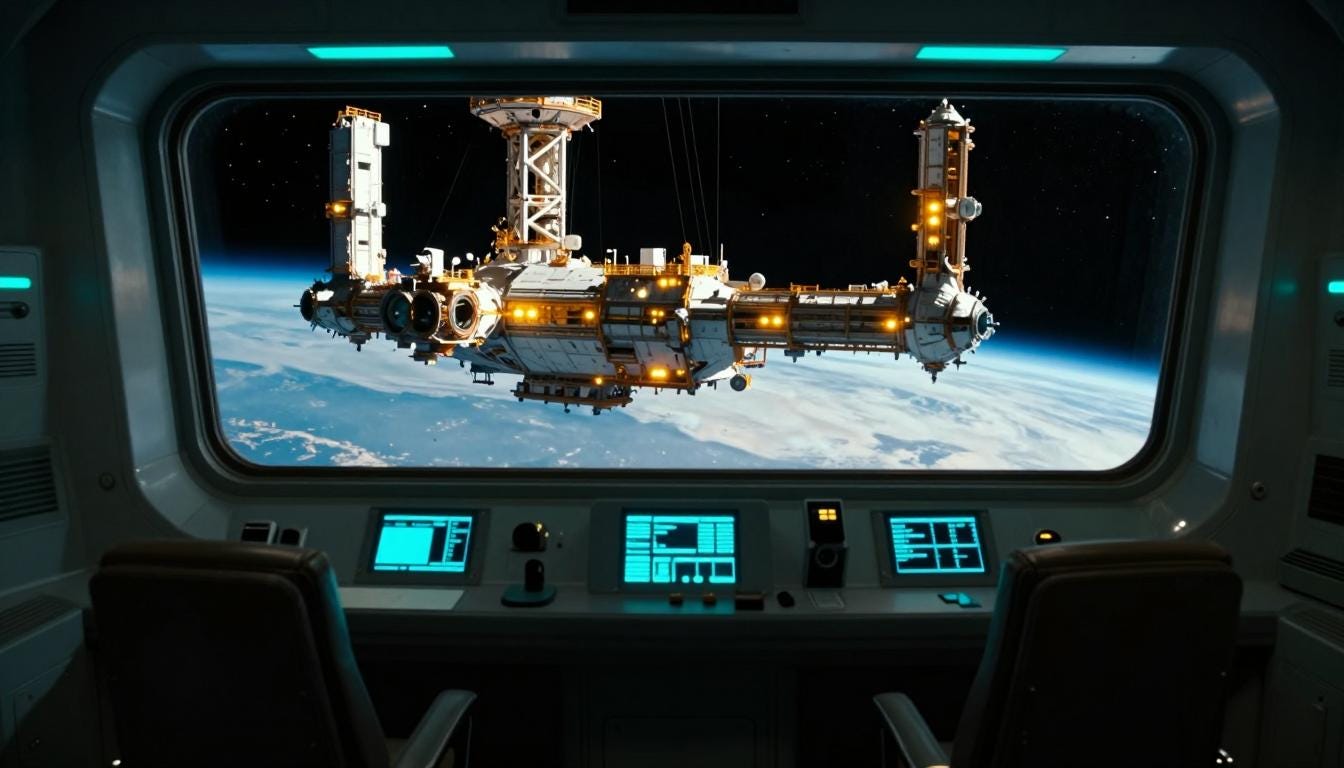
The viewport showed Earth, blue and white and turning, the terminator creeping toward dawn over the Atlantic. Twelve hours ago the same planet had been visible from Hope’s bridge, smaller behind armored glass, the cruiser settling into its docking cradle after eleven weeks of combat. The bridge viewport had been cold to the touch. This one was warm. Station environmental control at comfortable temperature instead of the five-degree offset Hope maintained to conserve reactor output.
Everything was wrong.
The command pin lay on the nightstand where she had placed it before sleeping, the silver wings catching the faint glow from the status display she had not turned off because turning it off was like closing her eyes. Tanaka’s mug sat on the shelf above the nightstand, the ceramic one with the hairline crack along the handle that Tanaka had filled with epoxy six years ago and used every watch since. Tanaka had handed it to Kira in the ready room before the depot raid. Her only words: “It’s yours now. Don’t break it.”
Kira had not broken it. She had placed it on the shelf in her quarters aboard Hope the day she moved into the captain’s cabin. Using Tanaka’s mug was like putting on someone else’s skin.
The deck was cold under her bare feet. Station decking, not Hope’s textured plating. She pulled on her uniform trousers, her jacket. The jacket was clean. Ten hours earlier a different jacket had been taken from her, the one with the scorch mark on the left sleeve from the conduit rupture during the extraction, the one that still smelled of ozone and reactor coolant. Someone had replaced it while she slept. She did not know who. She was grateful and unreasonably irritated about it in equal measure.
The station corridor was empty at 0430. Yellow work lights ran at half power. Prometheus Station at night was a different creature than the shipyard she knew, quieter, its industrial hum reduced to a whisper of ventilation and the distant clank of recyclers. The smell was different too. The air of a station that had been running for fourteen years on systems never designed to last more than five.
Her boots carried her toward the docking arm without conscious decision. The walk from guest quarters to Hope’s umbilical was eighteen minutes. She had timed it yesterday. Eighteen minutes of station corridor, ninety seconds of docking tube, and then the familiar pressure change as the ship’s atmosphere replaced the station’s.
The docking tube was guarded by a single marine. Young. Kira did not recognize him. He straightened at her approach, his hand coming up toward a salute, then stopping, uncertain whether a captain at 0430 wanted protocol or privacy.
“Captain.”
“Don’t.”
His hand dropped. She stepped past him into the tube.
Hope’s hatch was open. The pressure differential pushed a gentle current of ship’s air past her as she crossed the threshold. Cooler than the station. Five degrees cooler. The smell hit her first: coolant, electronics, the faint organic note of the hydroponics bay three decks down, the thousand small odors of a ship that had been lived in and fought in.
The corridor lights were at standby. The deck plating was cold under her boots, the thermal regulation cycling toward its morning adjustment. The ship breathed around her, ventilation fans carrying a rhythm slower than combat pace but still present.
She did not go to the bridge. She walked the corridors the way she had done a hundred times during the campaign, the muscle memory of inspection rounds that had never been about inspection. During the extraction runs she had walked these same passages at 0300 and 0400, touching bulkheads that were warm from reactor load, listening through her fingertips for the vibration that meant something was out of alignment. The ship talked through its surfaces. She had learned its language without knowing she was learning.
Tonight the bulkheads were cool. The reactor was in standby. The vibration was gone.
CLIO’s voice came from the nearest node, soft in the empty corridor. “Captain. The reactor is in standby. All systems are nominal. There is nothing to check.”
“I know.”
A pause. CLIO had been learning pauses, the timing of them, the weight. “Would you like a status report anyway?”
Kira’s hand rested on the bulkhead. The plating was cool and smooth and gave nothing back. “No, CLIO. Thank you.”
“Understood. I will be here if you require me.”
The node dimmed. Kira stood alone in the corridor and did not move for a long moment. The ship was silent around her, not dead, not damaged, just resting. The way she was supposed to be. The way she had earned.
The bridge viewport showed Prometheus Station through armored glass: the lights of construction frameworks half a kilometer distant, the amber glow of work pods moving between ships in the yard, the blue-white curve of Earth below. Kira did not sit in the captain’s chair. She stood at the viewport while the planet turned beneath her. The letter from Marcus sat unopened on her shelf, eleven weeks of combat sat behind her, and she could not remember the last time she had stood still without a tactical display demanding her attention.
At 0515 she walked to the mess. The coffee dispenser was operational. Some things never stopped. She poured a cup and sat at the table nearest the viewport, the one with the scar on the corner from the Kuiper Gap battle that nobody had ever explained and nobody had ever repaired. The coffee was hot and bitter and exactly the way the ship’s galley had always made it.
A junior tech came through the hatch. Paused at the sight of a captain in the mess at 0515. His hand twitched toward a salute.
“Don’t.”
He filled his own cup and sat at a table on the far side of the mess, giving her space the way you gave a senior officer space when you did not know whether they wanted company.
Kira drank her coffee. It cooled faster than it should have because the mess’s thermal control ran cool in docked mode. The ship hummed around her, softly, at standby, alive in a way the station was not.
She did not go back to the guest quarters. She stayed in the mess, alone at the table with the scar on the corner, drinking cold coffee, the first morning of the war that was not a battle. The ship around her waited. She waited with it.
If you enjoyed this story, you can follow the main story arc in The Exodus Rush, the first book in The Vethrak Requiem series.