


Freya Lundgren woke to the wrong kind of quiet.
The station always had a sound. Pumps cycling. Heat exchangers clicking as they chased equilibrium. Air moving through a hull nobody on Earth remembered existed.
This morning, silence pressed against her eardrums.
The status panel by her bunk glowed amber instead of green.
Beacon output: 87%.
Phase lock: unstable.
Time to next scheduled arrival: 00:41:12.
Freya swung her feet onto the cold deck and held still until her pulse stopped trying to sprint. Sleep left grit behind her eyes. The air tasted like recycled citrus and hot metal.
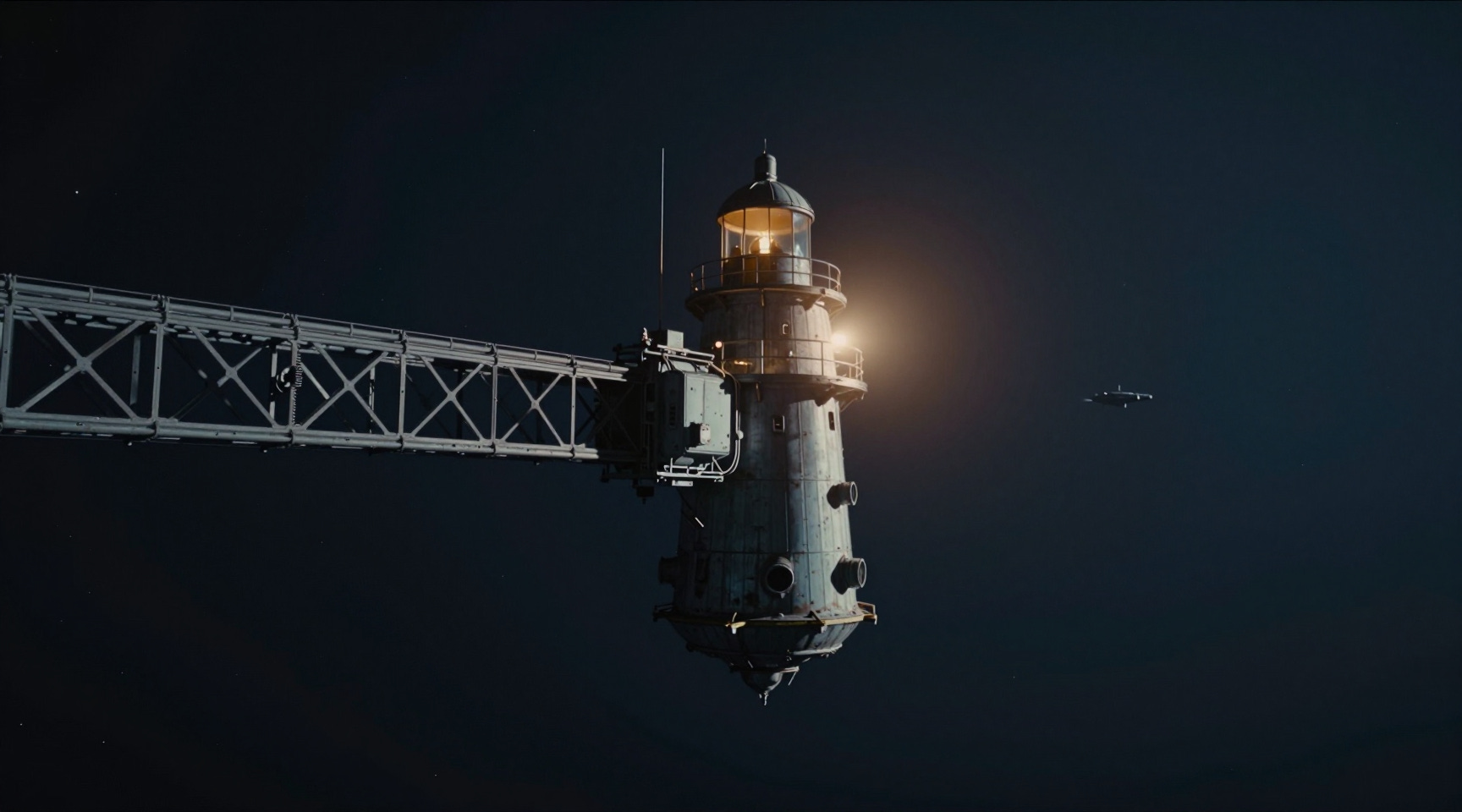
She crossed to the control alcove. The beacon’s heart sat outside the hab ring, bolted to a truss that reached into open space like a finger pointing toward nothing. Inside, she had interfaces, logs, and a toolbox that had been picked over by a year of needs.
The main display refused to give a clean diagnostic. The guidance carrier jittered by fractions, slipped, snapped back, then slipped again.
A beacon did not need perfection. A beacon needed a target that held still long enough to land on.
Freya pulled up raw telemetry.
One trace stabbed through the noise. A narrow-band interference spike, thin as a needle. It repeated every thirty-seven seconds.
That rhythm meant intent.
The comm panel flashed.
“Beacon Tau-Ceti Corridor 8, acknowledge status,” the overhead speaker whispered in a synthetic voice.
“Degraded lock,” Freya said, keeping her tone flat. “Diagnostics in progress. Next arrival in forty-one minutes. Recommend calculated emergence offset plus drift margin until lock stabilizes.”
A pause. Static that was not static, only the system pretending to breathe.
“Arrival vessel CSV Kestrel Dawn registered beacon-guided transit. Cargo class. Emergency reserve: low. Course amendment requires corridor authorization.”
Low reserve meant the ship had burned its buffers. A bad emergence could strand it in empty space, spinning its reactor into ration mode.
The interference needle hit again.
Freya opened external sensors. The station’s gravitic array painted the void in slow, precise strokes. Dust. Pebbles. A few tagged micro-meteoroids.
No drive flare. No transponder.
That did not mean nobody.
She yanked open the maintenance drawer. Tools clinked. Three waveguide couplers. Two coils of fiber. A pack of contact seals.
Module C housed the phase modulator. It ran hot even at idle and sat close enough to the beacon spine to cook a careless EVA suit.
The interference needle hit again.
Freya clipped her hair back, pulled on her work suit, and headed for the airlock.
The corridor to the lock passed a viewport. The beacon truss caught starlight and turned it into a thin, pale line.
A human lighthouse.
Her hands hovered over the lock controls.
Twenty-six months since the last supply tender. Twenty-six months since another human voice had filled this place with something other than automation.
A beacon keeper learned to treat machines like weather. Ignore their moods, respect their limits.
The interference needle hit again.
Freya cycled the lock.
Vacuum wrapped the station in clean, brutal silence. Stars looked sharp enough to cut. Her tether line tugged as she moved hand over hand along the truss, boots catching on mag clamps.
The beacon housing loomed, matte-black plating scarred by micrometeoroid pings. Heat bled from vents in faint halos only her suit could measure.
Module C’s access panel resisted. The bolts had been torqued by someone who still believed in standards.
Freya braced, broke them free, and swung the panel open.
Heat spilled out. Her glove sensors climbed.
A diagnostic LED on the modulator flickered in a pattern that did not match any fault code in her memory.
She pulled up the module readout on her wrist.
A secondary handshake request repeated in a tight loop.
A beacon did not ask for handshakes. Human firmware did not.
Cold tightened behind her ribs.
Vethrak tech did.
Freya unplugged the modulator’s tertiary bus. The carrier stuttered, then steadied. Output dropped to 72%. Phase lock held for seven seconds, then stabilized.
A warning flashed. Modulator temperature climbing.
Efficiency for stability. The trade tasted bitter and necessary.
She slid a coupler into the bus port, bypassing the tertiary board entirely. The connector seated with a click she could feel through her glove.
Phase lock held.
The interference needle hit again. It bounced off the carrier like a bead of water off hot metal.
Output climbed to 81%.
Freya exhaled and watched another cycle.
The needle tried twice more.
Nothing latched.
Text appeared on her wrist display, not from her suit.
HELLO, KEEPER.
Her mouth went dry.
OPEN THE DOOR.
The station did not have doors out here. It had panels, seals, and a thousand ways to die.
Her tether line drifted in a slow arc, patient as a question.
Freya turned her helmet toward open dark.
Nothing.
The message shifted.
WE ARE LOST.
Lost meant a drifting probe. A stranded fragment of something that still knew how to speak.
Lost also meant bait.
Time to arrival: 00:28:04.
Freya closed the access panel and torqued the bolts until her forearms burned. Her station had one job. Her station would keep doing it.
She made her way back along the truss, one clamp at a time.
The message stayed on her wrist.
WE ARE LOST.
Air returned in the lock with a long, familiar hiss. Station sounds layered back in, reluctant and then comforting.
The control display showed a stable carrier. Interference spikes kept coming, each one dying at the edges.
Freya opened a direct channel to corridor authority.
“Unscheduled handshake attempts detected on carrier. Pattern suggests nonhuman firmware contact. Event logged. Request escalation and armed patrol at emergence zone.”
The reply arrived in sterile text.
“Armed patrol unavailable. Clearance in progress. No hostile signatures detected.”
No hostile signatures.
Freya stared at the alien words on her wrist. A lost thing in the dark would do anything to find a path.
She did not offer one.
Time to arrival: 00:07:19.
The emergence zone cleared on sensors. A wide emptiness marked by grid overlays and warning pings.
A ripple moved through the gravitic feed like a breath taken in reverse.
Space unfolded.
The CSV Kestrel Dawn arrived three hundred kilometers off centerline, well within tolerance. Patched plating and scorched seams lined its hull. Its Aurora Drive flared a tired blue as it corrected, slow and careful.
Freya’s chest tightened, then released.
The ship’s transponder blinked a simple code.
ALIVE.
A human message pinged in.
“Beacon 8, whoever you are, thank you. We were running on fumes.”
Freya held her fingers over the keys for a beat, then typed.
“Keep your vector clean. Docking approach in progress. Coffee accepted as payment.”
The reply came back with plain text laughter, two slashes and a parenthesis.
The station’s sounds continued. Pumps. Clicks. Air.
Quiet with a heartbeat.
The alien text on her wrist changed one last time.
THANK YOU.
Gratitude could be manipulation. Gratitude could be honest.
Either way, the beacon held.
Author’s Note: Jump beacons arrive later in the Post-Invasion era, when humanity finally starts building lighthouses in the void instead of sprinting blind through it. This story is a small look at the people who keep those lights on.
If you enjoyed this story, you can follow the main story arc in The Exodus Rush, the first book in The Vethrak Requiem series.