


If you enjoyed this story, you can follow the main story arc in The Exodus Rush, the first book in The Vethrak Requiem series.
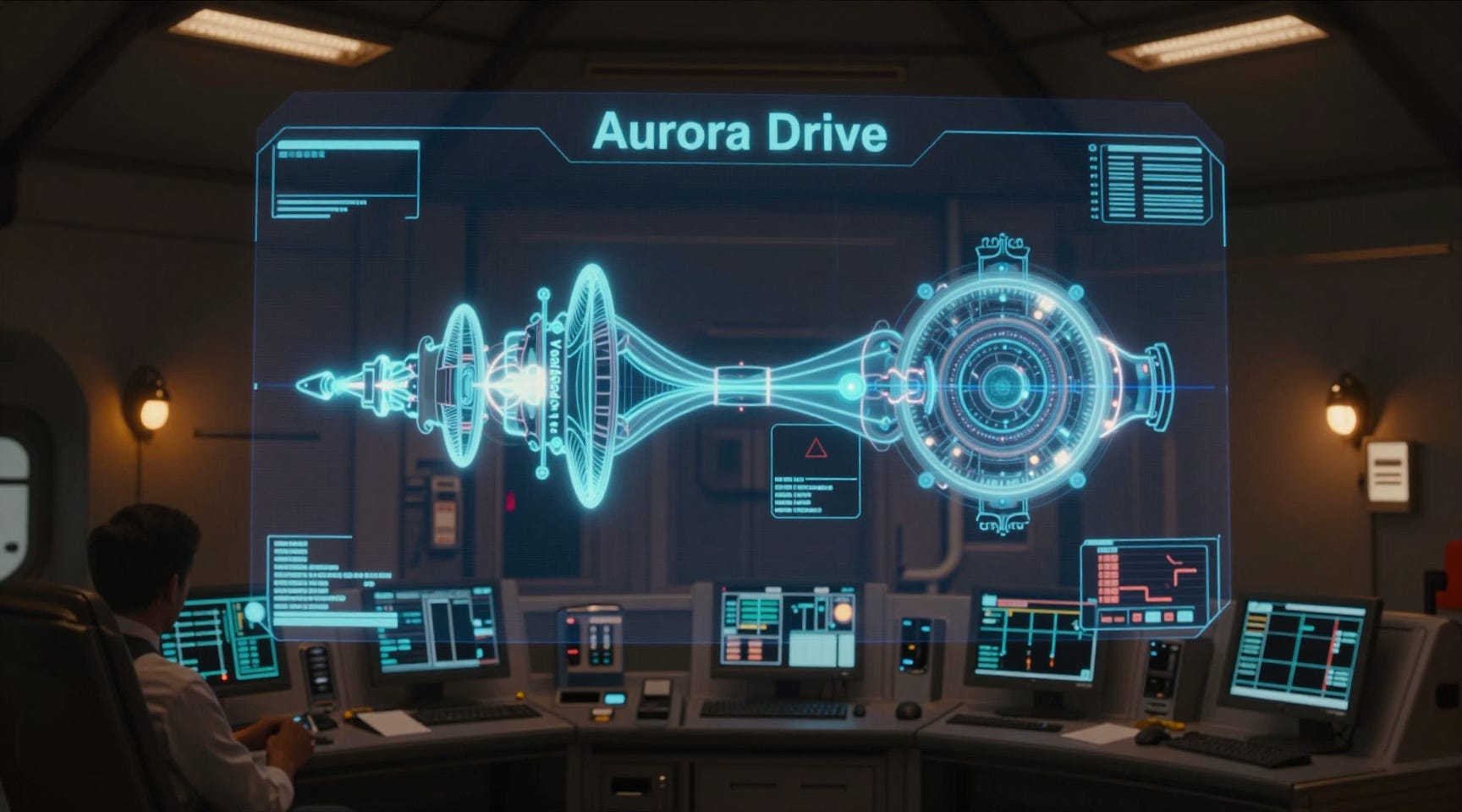
Themba Nwankwo studied the plasma flow readings. The Aurora Drive hummed through the deck plating, a constant vibration that most engineers learned to ignore. He never ignored it. The hum told stories if you knew how to listen.
CSV Perseverance. Civilian freighter. Four thousand metric tons of medical supplies bound for the outer settlements. Three-day transit at point-eight-c. Standard run.
Nothing about this burn was standard.
“Flow rate is dropping,” Wambui Dlamini said from the secondary console. “Point-two percent over the last hour.”
“I know.”
“Should I notify the captain?”
“Not yet.”
Themba pulled up the drive schematic. The Aurora Drive: humanity’s solution to sublight propulsion after the invasion. Salvaged Vethrak plasma accelerators married to human engineering. Elegant in theory. Temperamental in practice.
The drive worked by ionizing hydrogen fuel, accelerating the plasma through magnetic containment fields, and expelling it at relativistic velocities. Simple physics. Complex execution. The Vethrak had designed their accelerators for different fuel densities, different magnetic field geometries, different operating temperatures. Human engineers spent three years figuring out how to make it work with Earth-standard hydrogen and power systems that weren’t designed for the load.
The result: Aurora Drives that could push ships to eighty percent light speed. Reliable, efficient, powerful. When they worked correctly.
“Flow rate down another point-one percent,” Wambui said.
Themba watched the plasma temperature readings. Rising. Not much. Point-three degrees over baseline. Within tolerance. The magnetic containment was holding. Fuel pressure was stable. Accelerator coils showed green across the board.
Everything looked normal. Everything except the flow rate.
“Pull up the ionization chamber logs,” he said. “Last seventy-two hours.”
Wambui’s fingers danced across her console. Data streams filled the secondary display. Ionization efficiency. Chamber pressure. Electrode voltage. Magnetic field strength. Temperature curves. A thousand data points per second for three days.
Themba scrolled through the numbers. There. Fifty hours ago. Ionization efficiency dropped by point-zero-five percent. Recovered after thirty seconds. Forty hours ago. Same thing. Point-zero-eight percent. Recovered.
A pattern. Intermittent degradation. Short duration. Too brief to trigger alarms. Too consistent to be random.
“The number three electrode,” he said.
“Diagnostics show green.”
“Diagnostics measure current function. I’m looking at historical performance. The electrode is developing a fault. Microscopic erosion on the contact surface. Each time it arcs, efficiency drops. The plasma compensates by drawing more current through the other electrodes. Flow rate decreases to maintain thermal equilibrium.”
Wambui pulled up the electrode monitoring system. Real-time voltage readings. All six electrodes showed identical output. No variance. No indication of trouble.
“I don’t see it,” she said.
“You won’t. Not until it fails completely. The erosion is too small to measure directly. We’re seeing the secondary effects. The drive is compensating for something that diagnostics can’t detect.”
“How do you know?”
Themba pointed to a curve on the screen. “This is the ionization efficiency over time. See the dips? They’re getting longer. Point-zero-five percent for thirty seconds becomes point-zero-eight percent for forty-five seconds. The pattern is degradation. The electrode is dying slowly.”
“When will it fail?”
“Sixty hours. Give or take twelve.”
Wambui calculated transit time. “We’re thirty-eight hours from our destination.”
“I know.”
“So we’re fine. The electrode will hold until we complete the burn.”
“Unless the erosion accelerates. If the contact surface fails catastrophically, we lose one-sixth of our ionization capacity. The other five electrodes take the load. They’re not designed for twenty percent overcurrent. We’ll burn through them in hours. No ionization, no plasma. No plasma, no thrust. We drift. Three days from the nearest settlement. Four thousand tons of medical supplies that never arrive.”
Wambui stared at the data. “You’re recommending we abort the burn? Return to port for maintenance?”
“I’m recommending we understand what we’re risking.”
“The settlements need those supplies. People will die without them.”
“People will also die if we lose the drive halfway through the transit and can’t get help in time.”
Silence. The Aurora Drive hummed. Point-eight-c through deep space. Forty billion kilometers from anywhere.
“Show me the failure progression,” Wambui said.
Themba overlaid the historical data with a predictive model. The dips in ionization efficiency, plotted against time, formed a curve. Exponential degradation. The electrode wasn’t failing linearly. It was accelerating toward critical failure.
“If the pattern holds,” he said, “we have forty-two hours before catastrophic failure. We’re thirty-eight hours from destination. Four-hour margin.”
“That’s enough.”
“Only if nothing else goes wrong. If we encounter unexpected debris and need to maneuver. If we have to reduce burn rate for any reason. If the pattern accelerates faster than predicted. Four hours becomes three, then two, then zero. We lose the margin. We lose the drive. We drift.”
“Or we complete the burn and save lives.”
Themba closed his eyes. Engineering was mathematics. Clear problems. Clear solutions. Lives complicated the mathematics. Four thousand tons of antibiotics, surgical supplies, blood plasma, vaccines. How many lives did that represent? Five hundred? A thousand?
He pulled up another display. Drive maintenance logs. The number three electrode had been installed eleven months ago. Standard lifespan: eighteen months. It was failing early. Manufacturing defect. Substandard materials. The reality of post-invasion supply chains. Sometimes you got good components. Sometimes you got components that looked good until they failed.
“We can adjust the burn profile,” he said. “Reduce thrust by fifteen percent. Lower the ionization current. That takes thermal stress off all the electrodes. The number three electrode lasts longer. Failure point extends past our transit time.”
“How much longer does the transit take?”
“Nineteen hours.”
“So instead of thirty-eight hours, we’re looking at fifty-seven hours. People die waiting for supplies that arrive a day late.”
“People also survive because the supplies arrive at all.”
Wambui met his eyes. “You’re the chief engineer. Your call.”
Themba studied the numbers. Ionization efficiency. Electrode erosion. Plasma flow dynamics. Magnetic containment stability. Every system interconnected. Every variable affecting every other variable. The Aurora Drive was elegant engineering. It was also fragile. One component failure cascading through the entire propulsion system.
Year Nine. Eleven years past the end of the world. Humanity rebuilding with salvaged technology, inadequate resources, and components that failed early because manufacturing standards didn’t exist anymore. Engineers made decisions like this every day. Risk the ship to save lives. Risk lives to save the ship.
“We hold the burn,” he said. “Point-eight-c. Standard transit profile. Thirty-eight hours.”
“And if the electrode fails?”
“We have procedures. Emergency shutdown. Switch to backup ionization using the secondary plasma injectors. Reduced efficiency. Longer transit. We complete the run.”
“How much longer?”
“Forty hours instead of thirty-eight. We gain two hours on the transit, lose two hours if we have to use the backup system. Net zero.”
“Why not just use the reduced burn profile? Guarantee we don’t have problems?”
“Because nineteen hours might matter. People might die in those nineteen hours who would have lived if we’d pushed harder. I’m betting the electrode holds. If I’m wrong, we have backups. If the backups fail, we call for help and someone tows us in. The supplies arrive late. People die. My fault.”
Wambui looked at the data. Looked at Themba. Nodded.
“I’ll monitor the ionization chamber. Any change in the pattern, I notify you immediately.”
“I’ll be watching the magnetic containment. If we start seeing field instabilities, we reduce burn rate regardless of transit time.”
“Agreed.”
Themba returned his attention to the drive telemetry. The Aurora Drive hummed. Point-eight-c. Deep space. Four thousand tons of medical supplies. Forty-two hours until predicted electrode failure. Thirty-eight hours until destination.
Four-hour margin. Everything could go wrong in four hours.
He pulled up the backup procedures. Emergency shutdown protocols. Secondary ionization systems. Towing vessel contact lists. He reviewed every contingency. Every fallback. Every option if the mathematics failed and the electrode died early.
The Aurora Drive hummed. Themba listened. The vibration told stories if you knew how to hear them.
Right now, it was telling him a story about risk, trust, and the four-hour margin between success and failure.
Author’s Note: CSV Perseverance, Year 9. The Aurora Drive represents humanity’s mastery of salvaged Vethrak technology. Reliable sublight propulsion that can push ships to eighty percent of light speed. Chief Engineer Themba Nwankwo understands the elegant physics and the fragile reality: post-invasion manufacturing means components fail early, and every transit is a calculated risk.
This technical deep dive explores how Aurora Drives work, ionizing hydrogen, accelerating plasma through magnetic fields, expelling it at relativistic velocities, while showing the human decisions required when theory meets reality and lives hang in the balance.
