


Francesca Sullivan pressed the spectrometer probe against the salvaged circuit board and waited for the reading.
Three seconds. Five. The display populated: titanium alloy substrate, Grade 7 mil-spec. Copper trace routing, ninety-four percent purity. Silicon wafer intact, functional. She logged the results on her tablet, marked the board as B-Plus salvage, and placed it on the graded pile.
Twenty-six more components in the tray.
Ceres Station’s Salvage Assessment Lab occupied a converted storage bay on Deck Nine, wedged between the water recycling plant and an atmospheric scrubber that rattled through its intake cycle every forty seconds. The noise had bothered her during the first week. Now she timed her work to its rhythm, lifting each component from the tray as the scrubber exhaled, testing it during the quiet intake, logging the result as it exhaled again.
The UEN paid her twelve hundred calories per day for this work. Enough to function. Not enough to ignore the tremor in her left hand, the one that started six months ago when the anti-radiation dosage from medical stores stopped matching her prescription.
She needed forty milligrams daily. The UEN allocated thirty.
The difference came from Ignacio.
He arrived at 2200, after the official shift change emptied the corridor outside the lab. The door’s biometric lock recognized his palm print because Francesca had added it three months ago, the night he delivered her first supplemental dose of potassium iodide in a med-pack stamped with no origin code.
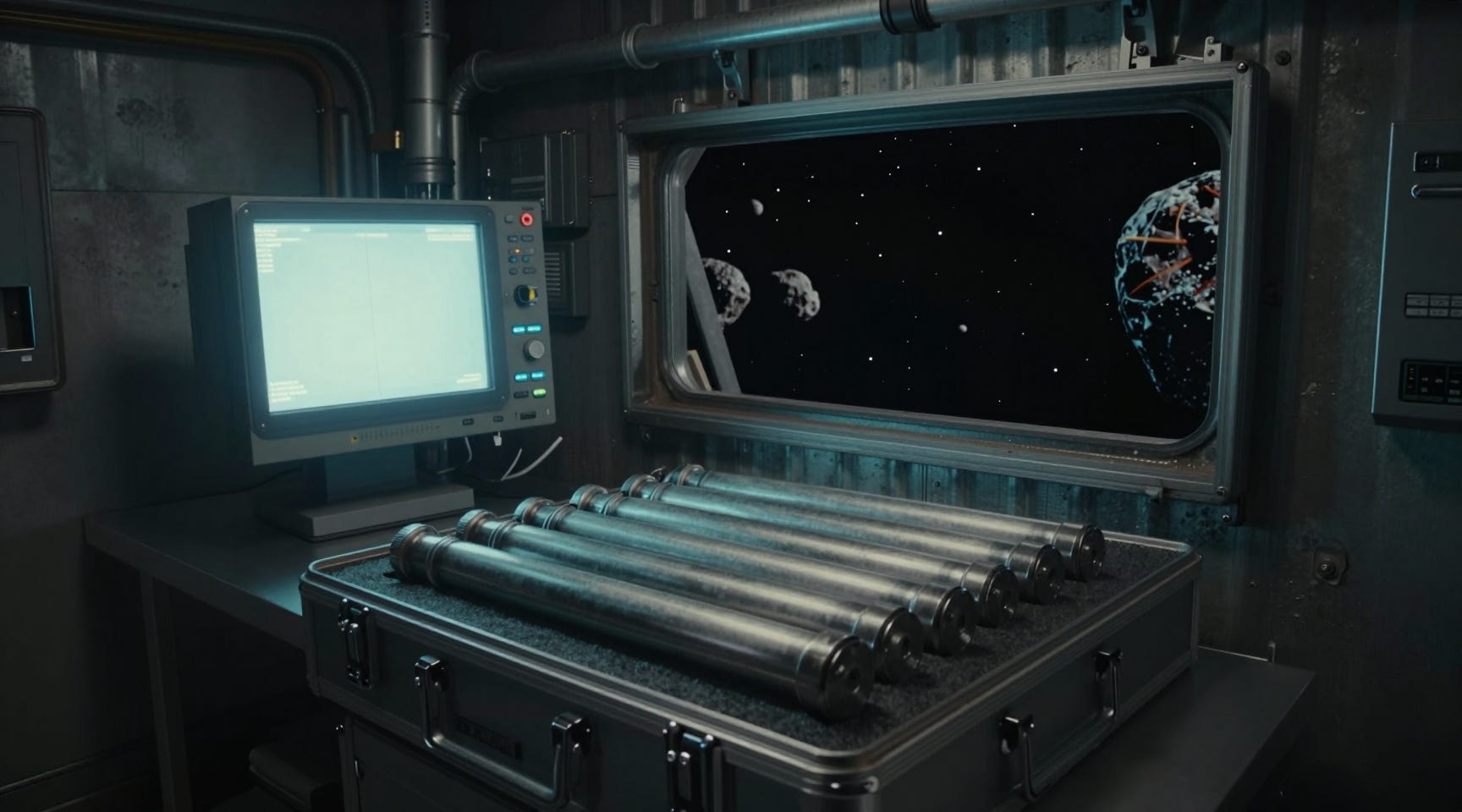
He carried a cargo case. Standard size, unremarkable, the kind of container that moved through Ceres by the thousands every day. He set it on her bench without ceremony.
“Six items,” he said. “Standard assessment.”
She opened the case.
Six cylindrical objects, each the length of her forearm, nested in shock-absorbing foam. Brushed steel casings with serial numbers laser-etched along the flange. Magnetic coupling rings at both ends, polished to mirror finish. She recognized them before the spectrometer confirmed it.
Cascade reactor fuel rods. Class Three, mil-spec. The kind that powered capital ships and orbital stations. The kind the UEN tracked by individual serial number.
“Where did these come from?”
Ignacio leaned against the doorframe. His expression didn’t change. “Salvage.”
“These aren’t salvage. Salvage doesn’t come with intact serial numbers.”
“Everything is salvage after the world ends. Some of it takes longer to find.”
The spectrometer hummed against the first rod’s casing. Readings scrolled across the display. Fuel grade: ninety-seven percent enrichment. Casing integrity: no fractures, no radiation leakage, no thermal scarring. These rods had never been installed. They were new, pulled from a supply chain before they reached their destination.
“A convoy was hit three weeks ago between Mars and the Belt.” She kept her voice level. “Thirty-two fuel rods reported missing. UEN is investigating.”
“The UEN investigates everything. They resolve nothing.” Ignacio crossed his arms. “Enceladus Settlement has four hundred people and a reactor running at thirty-one percent. Their allocation request has been pending for nine weeks. These six rods bring them to sixty percent. The difference between a settlement and a freezer.”
Francesca set the spectrometer down. The tremor in her left hand was worse tonight. A side effect of the deficit: ten milligrams per day, compounding over months into nerve damage that no future dosage increase would fully reverse.
Ignacio supplied her medication. Ignacio supplied Enceladus. The supply lines were the same, funded by the same network, routed through the same unmarked containers. The fuel rods on her bench and the pills in her pocket came from the same ecosystem of theft and redistribution that the UEN called criminal and the stations called survival.
“If I grade these, your people sell them.”
“At cost. Enceladus can’t afford a markup.”
“Generous.”
“Practical. Dead settlements don’t buy anything.”
She picked up the first rod and placed it in the spectrometer’s cradle. The machine hummed its forty-second cycle, measuring density, composition, radioactive signature. She could grade them accurately, reporting their true value. She could downgrade them, shaving the assessment to reduce the syndicate’s leverage. She could refuse entirely and return the case, knowing the rods would find a different assessor, one with fewer scruples and less precise instruments.
None of the options were clean.
The spectrometer completed its cycle. Ninety-seven percent enrichment. Zero defects. Military-grade, worth more than anything else that had crossed her bench this year.
She entered the grade on her tablet. Accurate. No adjustment, no inflation, no games. If Ignacio’s crew sold these to Enceladus at cost, the settlement survived the winter. If they marked them up, four hundred people paid whatever price the network demanded, because the alternative was dark and cold.
She graded all six rods in twelve minutes. Placed each one back in the foam, closed the case, handed Ignacio her tablet for his signature on the unofficial ledger that existed on no UEN server.
He signed. Picked up the case. Paused at the door.
“Your next supply is Tuesday,” he said.
“I know.”
“The dosage is increasing. Forty-five milligrams.”
Her hand stopped trembling. Not from the medication. His network tracked her medical needs more precisely than the UEN’s system did.
“Thank you,” she said. The words tasted foreign.
He left. The door sealed behind him, and the atmospheric scrubber rattled through its cycle, filling the lab with recycled air that tasted of ozone and old metal.
Francesca cleaned the spectrometer, powered down the display, and secured the lab for the night. The official tray still held twenty-six components. She would grade them in the morning, using the same tools, the same methods, the same precision she had applied to six stolen fuel rods.
The work was identical. The line between the two jobs had been imaginary for months.
She locked the door and walked to her quarters, her left hand steady in her pocket, waiting for Tuesday.
Authors note: Three years after the invasion, Ceres Station served as a hub for both UEN salvage operations and the black-market networks that filled gaps in official supply chains. The line between legitimate recovery and criminal enterprise blurred daily as stations across the system struggled to maintain basic infrastructure with dwindling resources. This story is part of The Vethrak Requiem universe, set during the desperate early years of reconstruction.
If you enjoyed this story, you can follow the main story arc in The Exodus Rush, the first book in The Vethrak Requiem series.