


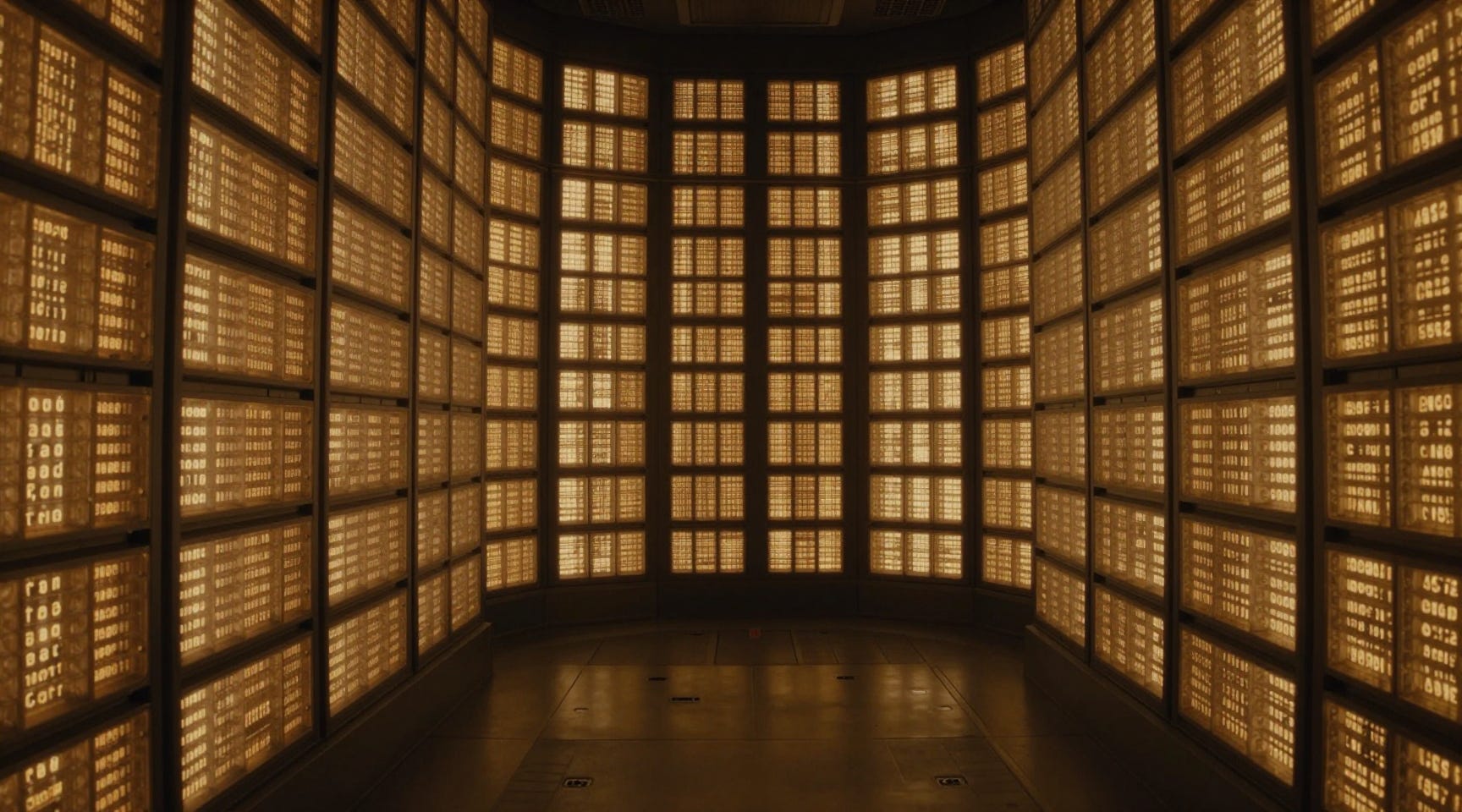
The Keeper-of-the-Perpetual-Archive had been walking these aisles for decades, and the Archive had not changed. The crystalline storage matrices still extended beyond the range of the Keeper’s primary vision, their thermal signatures as familiar as the resonant frequency of the Archive’s environmental systems. The silence was the same silence. The work was the same work. The Archive was the Vethrak’s perfect memory, and the Keeper was the memory’s caretaker.
The private record was stored in a crystalline sub-matrix that the Keeper maintained separate from the official Archive. Not hidden. The Keeper did not hide things from the Vethrak. The sub-matrix was a diagnostic tool, a working file for cross-reference anomalies that required extended tracking. The fact that it had accumulated one hundred and forty-three entries was a function of the Keeper’s diligence, not a deviation from procedure.
The Keeper opened the record and reviewed it in its entirety. The review took most of a standard watch cycle.
The first entry was the Skarreth discrepancy, filed decades ago. Sampling rate versus stored material volume, a ratio of approximately one to ten. The fleet commander had reported a harvest of tens of millions. The Archive’s stored material volume showed hundreds of millions. The fleet commander’s assessment had been filed before the material was fully processed, and the assessment had never been updated.
The one hundred and forty-two subsequent entries followed the same pattern. Different systems. Different fleet commanders. Different Harvest designations and operational reporting dates. The same discrepancy type: under-reported harvest volume, consistent across entries, averaging fifteen to twenty-five percent below the stored material counts.
The Keeper had compiled these entries quietly, systematically, adding each new anomaly to the sub-matrix as the integrity checks identified them. The work had become part of the routine. A new Harvest entry was flagged by the cross-reference system. The Keeper verified the discrepancy against the material intake logs. The discrepancy was logged in the private record. The official Archive entry was noted in the internal audit log with the standard language: recommend secondary verification. The internal audit log had never been reviewed by a senior assessor. The Keeper did not expect it to be reviewed. The audit log was a procedural artifact that existed because the Archive’s design required it, not because the Vethrak’s operational structure valued its contents.
The Keeper stood before the Skarreth storage matrix. The same matrix. The same tier. The same thermal signature. Decades had passed since the Keeper had first flagged that entry, and the Skarreth system was still classified as a low-priority containment problem. The Skarreth fleet had been active in sectors adjacent to the Tau Ceti engagement zone, according to the strategic assessments the Keeper had access to. The Vethrak’s operational records had not been updated to reflect the Skarreth’s actual fleet strength. The operational records were based on the fleet commander’s original assessment, which was based on a harvest volume that was one-tenth of the actual material collected.
The Keeper’s bioluminescent patterns held at standard amber. The emotional register did not shift. The Keeper was not frustrated. The Keeper did not experience frustration. The Keeper was evaluating a system that was functioning as designed and producing outcomes that were inconsistent with the system’s purpose.
The problem was not the fleet commanders. The fleet commanders filed assessments based on operational projections. The problem was not the Archive’s cross-reference system. The cross-reference system identified discrepancies correctly. The problem was the link between the two: the Vethrak’s incentive structure rewarded efficiency metrics calculated from projected sampling rates, and the fleet commanders who under-reported harvest volumes received higher efficiency ratings. The incentive was not explicit. It was structural. No fleet commander had ever been told to under-report harvest volumes. The fleet commanders had simply learned that accurate reporting was not rewarded and efficient reporting was, and the distinction between accurate and efficient had eroded over time until it was no longer visible to anyone who was not specifically looking for it.
The Keeper was looking for it. The Keeper had been looking for it for decades. The private record was the evidence.
The Archive was supposed to be the Vethrak’s perfect memory. The complete biological record of every Claimed species, preserved without error or omission. The Archive had been designed to be absolute. The Keeper’s function was to maintain its integrity. The Keeper was failing.
Not because the Archive was inaccurate. The Archive’s stored material volumes were accurate. The genetic records were accurate. The cross-reference system was accurate. The failure was in the documentation that surrounded the stored material: the fleet assessments that under-reported what the Archive contained, the operational records that were based on those assessments, the strategic analyses that were based on the operational records. The Archive knew the truth. The Vethrak did not.
The Keeper reviewed the private record again. Not because the data required a second review. Because the Keeper was trying to determine what to do with the data, and the Keeper did not have a framework for the question.
The options were the same as they had been for the Skarreth entry decades ago. The Keeper could leave the private record as it was, a diagnostic working file that no one would ever access, containing evidence that the Vethrak’s operational picture of partially harvested systems was systematically incomplete. Or the Keeper could merge the private record with the official Archive, adding one hundred and forty-three entries to the internal audit log with the same standard notation the Skarreth entry had received decades ago, and wait for a senior assessor to review the log.
The second option was procedurally correct. The Archive’s purpose was to preserve accurate records. The Keeper’s function was to maintain the Archive’s integrity. The private record was a deviation from that function, no matter how carefully the Keeper had justified it as a diagnostic tool. The Vethrak required completeness. The Archive was incomplete as long as the fleet assessments and the stored material volumes told different stories.
The second option was also pointless. The internal audit log had never been reviewed. The Keeper did not expect it to be reviewed. Adding one hundred and forty-three more entries to a log that had never attracted attention would change nothing. The discrepancy would remain unread. The operational records would remain inaccurate. The Vethrak’s picture of the Skarreth, the Earth survivors, and the other partially harvested systems the Keeper had documented would remain systematically wrong.
The Keeper stood in the silence of the Archive’s lowest tier and considered a third option that the Keeper did not have authority to consider and no framework for acting on: presenting the private record directly to a senior assessor.
The Vethrak’s hierarchy did not provide a path for an archivist to present a diagnostic finding to a strategic assessor. The Archive was a repository, not an intelligence function. The Keeper’s role was to maintain the repository, not to interpret its contents. Presenting the private record to an assessor would require the Keeper to claim that the Archive’s data had strategic implications that the Vethrak’s operational structure had failed to recognize. That claim was outside the Keeper’s function. Making it would be a deviation from the role the Keeper had been engineered to fill.
The Keeper’s bioluminescent patterns held steady. The silence of the Archive was the silence of a system that contained the truth and had no mechanism for making the truth actionable.
The Keeper closed the private record. The Archive hummed with the stored genetic material of thousands of Claimed species. The thermal signatures of the storage matrices were the same as they had been when the Keeper first began walking these aisles. The Skarreth matrix was indistinguishable from the others. The Earth matrix was farther down the tier, newer, the thermal gradient slightly different, the material fresher. The data in both matrices told the same story the fleet assessments did not.
The Keeper opened the internal audit log and began adding the one hundred and forty-three entries. One by one. The process would take most of another watch cycle. The Keeper did not rush. The Archive did not require speed. The Archive required accuracy, and the Keeper had been accurate for longer than most fleet commanders had been serving.
When the entries were complete, the internal audit log would contain one hundred and forty-four discrepancies. The Skarreth entry from decades ago, plus the one hundred and forty-three that had followed. The log would be complete. The Archive would be complete. Nothing would change.
The Keeper continued the work. The Archive’s silence was the same as it had always been. The perfect memory, containing the truth, waiting for someone to read it.
If you enjoyed this story, you can follow the main story arc in The Exodus Rush, the first book in The Vethrak Requiem series.