


Seventeen pieces of salvage, and sixteen of them were noise.
Zanele Tremblay cataloged them by eye before she touched anything: connector blocks, insulation shells, a sensor housing still scorched from orbital entry. Standard debris-field material, the kind that moved through Korolev-7 every week, pulled from the scatter zones between Mars and the Jovian corridor. Iron Wake paid her to sort signal from noise. Noise was mostly what she found.
The seventeenth piece sat at the bottom of the transport case, wrapped in static-damping cloth.
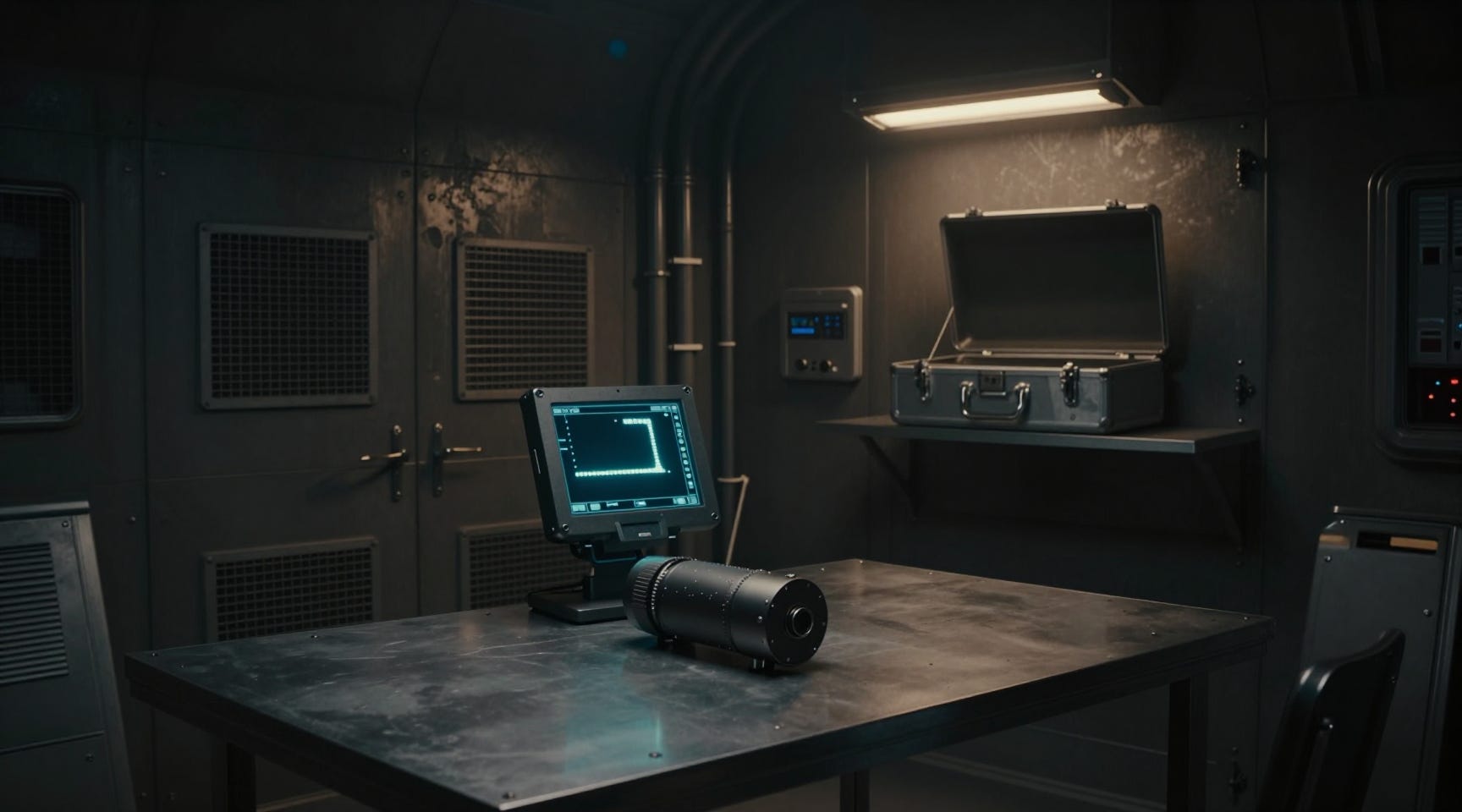
She unwrapped it carefully. Cylindrical, roughly twelve centimeters, with a surface texture that absorbed the bay’s overhead lighting rather than reflecting it. No visible seams. No manufacturer markings. The material wasn’t metal and wasn’t polymer, it fell between those categories in ways she couldn’t name on first handling, occupying some property her hands registered without her instruments agreeing on. She had tested three pieces of Vethrak hardware in six years working for Iron Wake. None of them had felt like this.
She set it on the calibration plate and ran the standard scan.
The scanner stalled.
Not errored. Not returned a null reading. It stalled, processing cycle spinning without output, the way it behaved when the input didn’t map to anything in its reference library. After forty seconds it produced a single line of text: FIELD ACTIVE. CATEGORY UNKNOWN.
Zanele sat back in her chair.
The workspace was a converted utility bay on Deck 11: small, private, ventilated by filtered air that tasted faintly of recycled oxygen. She had set it up three years ago when Iron Wake’s transit coordinator on Korolev-7 had offered her the arrangement. Test the hardware. Assign a value. Pass the value up the chain. Neither of them asked questions about the other side of the business.
FIELD ACTIVE.
She put on her grounding gloves and picked up the cylinder again. Nothing changed in her hands. No heat, no vibration, no sensation she could describe. The calibration plate, however, was reading something she had never seen before: a low-amplitude waveform cycling at irregular intervals, emanating from the object whether she was touching it or not.
She set it back on the mat and removed her gloves.
The waveform held. The cylinder was producing its field passively, independent of contact or proximity. She could shut down every instrument in the bay and it would still be there, cycling through whatever it was cycling through, twelve centimeters of alien hardware sitting on her work table in the middle of a station carrying twelve thousand people.
Her comm chimed. Saeed Lindström’s identifier.
“Still running tests,” she said.
“The buyers have a window.” His voice was careful, the way it got when commission was close. “Three hours. They fold out of Korolev at 0300, no extension. If we have a value before then, everything clears tonight.”
The commission was significant. She had been running the numbers since Saeed had shown her the manifest two days ago. Enough to cover transit to Ceres. Enough left over that she would not have to keep running numbers for a while.
“I can’t give you a value on this piece.”
Silence on the line.
“Zanele.”
“It’s active. Not residual active. Active right now, on its own, without input.” She looked at the waveform still cycling on her screen. “My scanner can’t categorize the field. That means either the scanner is broken, which it isn’t, or this object is producing something outside every known parameter set I have.”
“The buyers will have their own—”
“The buyers’ people will see exactly what I’m seeing and either not understand it or decide to ignore it. Those are both worse outcomes.” She paused. Through the bulkhead, the water reclamation unit cycled through its hourly flush. Normal station sounds. Twelve thousand people trusting the walls around them to stay inert. “I don’t know what this field does at higher ambient temperatures. I don’t know what it does in proximity to certain materials, or under pressure differentials, or whether it has a threshold. I don’t know what happens when it reaches that threshold.”
“The protocol is guidance,” Saeed said.
“The protocol exists because the last time someone fenced a functional piece without flagging it, seventeen people on a transit hub died and three years later no one fully understands why.” She kept her voice even. “I’m not flagging this for the protocol. I’m flagging it because in six years of reading Vethrak hardware I have never had my scanner stall.”
His breath came through the line before his answer. “The commission.”
“I know.”
“You’re not going to Ceres this cycle.”
“I know that too.”
A longer silence. Then: “I’ll take it up the chain. Containment protocol. They’ll send someone.”
“Tell them to bring a sealed transport unit. Not standard cargo grade.”
He ended the call.
Zanele looked at the cylinder on the mat. It sat the way all Vethrak hardware sat: still and indifferent, producing its quiet waveform in the recycled air of Deck 11 as though it had always been here and always would be. The scanner still showed FIELD ACTIVE. The calibration plate still showed the cycling intervals, irregular and patient.
She packed her instruments in order, working through the sequence she had built over six years: calibration plate last, scanner case sealed, work mat rolled and clipped. She left the cylinder on the bare table surface, visible, the way the protocol required. She composed the containment notice and sent it through the Iron Wake escalation channel with the scan data attached.
Her transit account still showed what it had shown that morning. Not enough for Ceres. Not close.
She sat down to wait for the courier, and she did not think about the commission much at all.
Author’s Note: This story is set in Year 13, roughly one year after the events of The Exodus Rush*. The Iron Wake salvage network expanded rapidly in the post-invasion years, moving hardware from the outer-ring debris fields to inner-system buyers who wanted it badly enough not to ask too many questions. Most of what their appraisers handled was inert. Most of it.*
If you enjoyed this story, you can follow the main story arc in The Exodus Rush, the first book in The Vethrak Requiem series.