


The third geophone came back with the same pulse.
Ji-woo Han locked her boots to the deck strip in the survey alcove off Tunnel 3-Bravo and waited for the dust to drop. It did not drop. On Ceres the fines hung in the air like a stain that had forgotten gravity, a gray film that moved only when a body or a vent pushed it. Her tether ran from the hip ring to the alcove rail. The rock around her carried a low, regular thrum from the main haulage line two compartments over. The pulse in the traces was not that.
She reran calibration.
The unit took forty-one seconds. The checksum matched the last certified load. Tool vibration lived in a different band. She had logged that band yesterday, when a loader had brushed the alcove frame on the way past. This signal sat lower. Cleaner. Three sensors, three distances from the aging brace line, the same frequency arriving a few milliseconds apart, amplitude climbing from the first survey of the shift to this one.
The readings did not name an hour. Helios did not ask safety engineering for hours. Helios asked for thresholds.
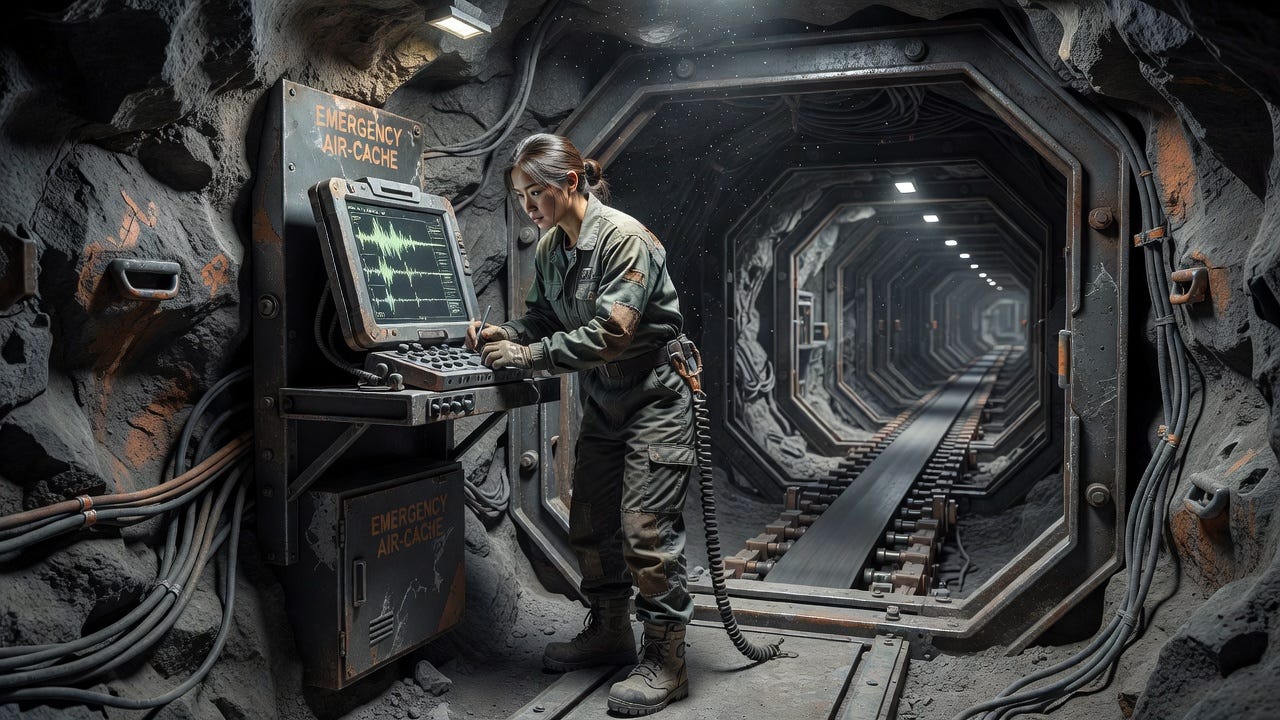
The amber threshold sat on the screen in a number she had memorized in her first month on Ceres: repeated microseismic events clustered on a load-bearing frame, plus an overdue inspection, plus rising amplitude. Tunnel 3-Bravo had all three. The brace inspection was two shifts late. The last logged visual had been a walk-past from a crew already behind on ore, a note that said no obvious deformation and nothing else.
Ji-woo saved the raw traces to the local cache. Standard practice. Version history. Instrument checksum. The central system would take a summary. The cache kept the rest.
She keyed the hold.
AMBER. Pause extraction before further loading. Brace inspection required before additional cycle loading. Signed: Han, J. Safety Engineering, Helios Ceres Operations.
The alcove comm chimed. Production control. Shift turnover.
“Survey, Control. We have an emergency train already late on 3-Bravo. Can you narrow that?”
A man’s voice, not unkind. Tired in the way the whole station was tired this year. Belt output climbing. Reserve projects eating iron nobody was allowed to name. April still sitting in the mess-hall talk like a bruise people had stopped touching.
“The traces cross the hold threshold,” Ji-woo said. “Inspection is two shifts overdue. I am signing amber.”
A pause. Mag boots found a rail on his end, the small click of a body in the spin section, where cups stayed on tables and people could stand without thinking about their feet.
“Monitor while operating,” he said. “We can put a watcher on the face. The train is already in the slot. Emergency reserve is waiting on this load.”
Emergency reserve. The phrase that meant classified yards and a two-hundred-percent climb that did not live in any public schedule. Everyone on Ceres knew the ore had to move. Everyone also knew what a brace line did when it failed in a tunnel that still had people in it. Rock kept its mass in any gravity. Momentum did not negotiate.
“A watcher does not replace the inspection,” she said. “Amber is the procedure. I am not removing it.”
“You understand what a missed train does to the yards.”
“I understand what a missed brace does to the tunnel.”
Silence stretched. Then: “Copy. Routing your recommendation. Control out.”
She signed again, the second signature the system wanted when a hold would delay a tagged emergency load. The local cache took the signed file, the traces, the checksum. She left the survey unit docked in the instrument rack and tagged the cage for retrieval at end of shift. Older units lived in that cage, tagged, sometimes forgotten, not always networked. This one still talked to the system. She wanted a copy in a place the network was not the only home it had.
Her hands shook once on the tether release. She locked the tremor down and pushed off the rail, a controlled drift along the handholds toward the main tunnel, boots finding the next strip, then the next.
3-Bravo was a carved industrial throat. Brace frames every twelve meters. Cable runs clipped to the wall. Dust-control skirts that never quite caught the fines. Emergency air caches painted the same faded orange as every refuge door on the station. Miners moved in anchored steps, tools clipped so they would not float into a face. The haulage belt ran at a crawl that still looked fast in the weak gravity, ore chunks hanging a moment too long at each transfer before the next dog caught them.
Lena Vasquez stood at an old drill three frames in from the survey junction. The machine was older than half the crew, the housing scarred where heat had lifted paint. Lena’s glove rested on the casing, not the controls, the way a person put a hand on a thing that had a habit. The pitch of the bit changed under her palm. She eased the feed a fraction. The pitch came back.
Ji-woo’s boots found the strip and held.
A veteran would know if the rock had been talking. Lena had been running drills longer than Ji-woo had been certified. The traces were numbers. Lena’s glove was the other instrument, the one the forms did not have a field for.
The question sat in Ji-woo’s mouth and stayed there.
The hold was signed. Control had routed it. Safety engineering did not poll miners in the tunnel for a recommendation already in the system. That was the rule, and the rule was what kept a junior engineer from becoming a rumor on the next shift board.
She passed without speaking. Lena did not look up. The drill held its note. Dust hung in the light from the face lamps, almost motionless, a gray weather that did not fall.
Helios Ceres Operations control sat in the spin section, a ring of consoles under lighting that made the coffee stay in the cups. Shift turnover crowded the rails. Status boards ran production, seismic, life support, haulage. 3-Bravo’s tile sat mid-board, a green extraction bar with a countdown underneath: next ore train, eighteen minutes.
Ji-woo logged the survey at the safety station. The amber icon came up beside the tunnel tag, a small hex the scheduling overlay did not like. The countdown did not pause. Eighteen minutes became seventeen. The train stayed in the slot.
A controller two stations over, the same tired voice from the alcove comm, spoke to the board rather than to her.
“Hold is up. We keep the train until the superintendent reviews. Safety can talk at the top of the hour.”
On her screen the word was still AMBER. HOLD. Pause extraction before further loading. The file had left her station. The routing had begun. The culture of the board was already treating the hex as a color that could wait eighteen minutes.
She did not argue from the rail. The file was in the cache. The traces were in the cache. The checksum would match at the top of the hour, when she would stand at the superintendent’s table with the same numbers and the same overdue inspection and the same signed sentence.
Seventeen minutes. Sixteen.
The amber icon glowed beside 3-Bravo’s schedule. Underneath it, the ore train kept counting down.
If you enjoyed this story, you can follow the main story arc in The Exodus Rush, the first book in The Vethrak Requiem series.