


The support station’s repair bay was dense with mixed bioluminescence.
Keth-Soral registered the phenomenon as they crossed the threshold from the docking tube into the main bay: the air of the bay carried not one emotional register but several, layered over each other like overlapping frequencies. Grief-Tone saturated the ultraviolet spectrum from the crews processing casualty lists. Exhaustion-Light flickered at the edges from engineering teams who had not stopped working since the engagement ended. And beneath both, thin and steady, a pulse of tactical satisfaction from the operations section where the strike results were being compiled. The bay was a spectrum the human ships could not see.
Keth-Soral moved through it, receiving damage reports from the engineering crews. The work was methodical. The work was what kept the mind from settling on things the mind could not yet process.
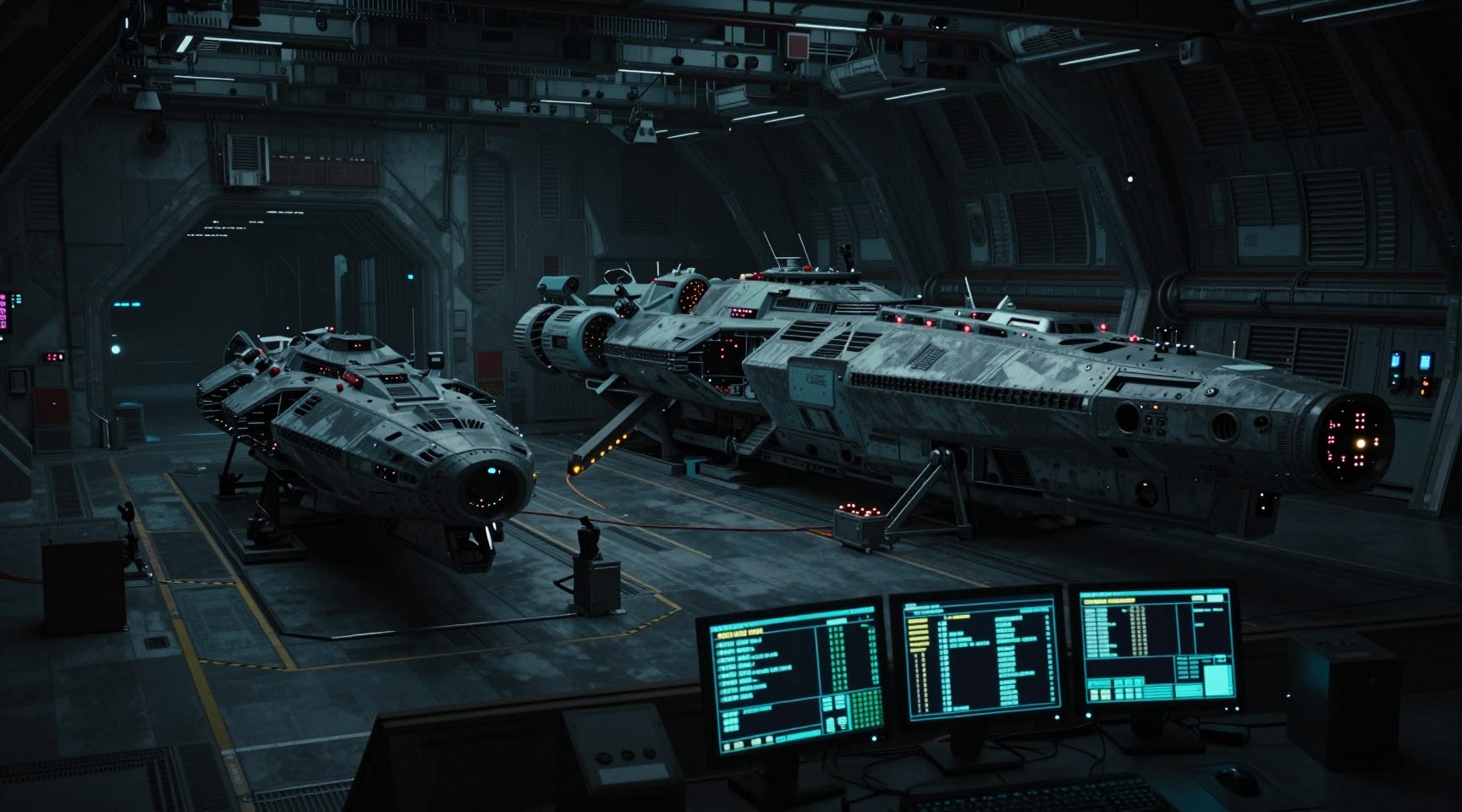
The Eternal Resolve had taken a hit to its secondary shield generator. The damage was structural but not critical. Repairs estimated at four station cycles. The Vigilant Star’s forward sensor array was offline. The port-side emitter grid had collapsed during the final engagement phase and would need a full recalibration. Keth-Soral noted each item, assigned priority codes, transmitted the assessment to the repair coordination channel. The displays showed status markers in Lexical Light only. No color. No emotional register. The system processed damage as data.
A junior engineer approached with a tablet display. Their light-patterns were clipped to operational efficiency – the Shadow-Intimate register of someone who had been working beyond their sustainment limit. They held out the casualty data without a lexical transmission. The gesture itself was the report.
Keth-Soral took the display.
The casualty list was formatted in standard tactical data protocol. Names and status markers. The system did not distinguish between a recovered survivor and a confirmed loss. The difference was work that belonged to the living.
Keth-Soral scanned the list. The protocol was efficient: names in order of ship assignment, each followed by a status code that resolved to a single datum. The names of the Swift Current’s crew appeared in sequence. Every status marker indicated the same outcome. The recovered-pod list had been updated. The pod count was correct. The crew count was not.
Keth-Soral’s optical field stopped on a name.
The status marker resolved to the designation of a senior engineer. The same engineer with whom Keth-Soral had worked on the shield harmonics integration three weeks before the engagement. The same engineer whose light-patterns had been animated and intense during the calibration sessions, the bioluminescent equivalent of a Keraneth leaning forward over a schematic. The same engineer who had solved the timing issue that made the weapons charge cycle fast enough to exploit the human targeting windows.
The status marker indicated that the individual did not reach a recovery pod.
Keth-Soral stood at the display for a duration that the engineering protocols did not account for. The pause was not performance. The bay was active around them, crews moving between repair stations, the mixed bioluminescence of the station cycling through its spectrum. No one was watching. No one needed to.
The pause was the moment the engineering protocols stopped working as a shield.
Keth-Soral remembered the integration bay on the support station where they had worked with the Swift Current’s senior engineer three weeks ago. The calibration frame had been set up in the center of the bay, the shield harmonics test equipment arranged in the configuration Keth-Soral had designed. The timing issue had emerged on the third test cycle: the weapons charge sequence was completing at 4.7 seconds when the tactical window required 3.2. The margin was lethal. The margin was the difference between a viable firing solution and a suicide run.
The senior engineer had solved it by re-routing the charge sequence through the secondary conduit, bypassing a latency bottleneck that the standard configuration assumed was fixed. Keth-Soral observed them trace the solution on the display, their light-patterns shifting from frustration to focus to the particular steady amber of a problem that had yielded. The solution reduced the charge cycle to 3.0 seconds. The window was viable.
The senior engineer’s light-patterns during that moment had been the color of work that mattered. Keth-Soral could still see the pattern. The brain retained the full four-layer memory of the exchange: the lexical content of the calibration data, the emotional register of satisfaction, the relational light of colleagues who had worked together long enough to anticipate each other’s next adjustment, the resonance echo of the Monument’s pulse in the background – present always, the weight of a purpose that had been waiting for eight centuries.
The senior engineer would never see another calibration.
Keth-Soral’s own bioluminescence did not shift. They broadcast a steady, controlled pulse of work-light across their display surfaces. The color of an engineer assessing what remained. The color of a task not yet complete. This was not denial. It was the shape Keth-Soral needed to be to continue.
The Grief-Tone in the station intensified as more casualty data arrived. The Swift Current’s surviving crew-pods had been recovered and docked. The pod count was complete. The crew that had launched in those pods was not the crew that had returned. The station’s bioluminescent spectrum shifted toward ultraviolet as the full scope of the loss propagated through the Keraneth crews who had worked with the fallen.
Keth-Soral did not broadcast grief. They broadcast work-light.
The engineering display updated with a new notification. The Swift Current’s shield harmonics system – the integration fix that the senior engineer had solved three weeks ago – had survived the ship’s destruction. The data logs had been transmitted to the fleet network before the hull breach. The solution was recorded. The calibration parameters were intact. The fix worked.
The senior engineer’s contribution would be in every Keraneth shield system going forward.
Keth-Soral logged this fact in the engineering record. The record did not mention the engineer by name. The protocol did not require it. The fix itself was the memorial. The calibration parameters, the timing solution, the single re-routed conduit that made a 3.0-second charge cycle possible – these would transmit through every Keraneth vessel’s engineering database without attribution. The name would not travel with the solution. The solution was the thing that survived.
Keth-Soral closed the casualty display and returned to the damage assessment queue. The station’s repair bay continued its work. The Grief-Tone in the air remained saturated. The work-light did not waver.
The next damage report was for the Eternal Resolve’s secondary conduit assembly. Keth-Soral assigned the repair priority and moved to the next assessment. The engineering protocols resumed their function as a shield. The shield would hold until the work was done. The work would not finish, and the shield would not lower, and Keth-Soral would not need to process the shape of a bay with four fewer vessels than it had launched, because the work would always require the next assessment, and the next, and the one after that.
The station’s bioluminescence cycled through its spectrum of grief and exhaustion and the thin silver of tactical satisfaction. The system did not distinguish between a recovered survivor and a confirmed loss. That difference was work Keth-Soral would process later, when the repair queue was empty, and the station was quiet, and there was no calibration left to complete.
If you enjoyed this story, you can follow the main story arc in The Exodus Rush, the first book in The Vethrak Requiem series.