


Ayanda Molefe built the chart out of numbers first, because numbers could not be accused of grief.
Twelve weeks of 3-Bravo occupational records filled the wall of the records room, every patient reduced to a case code and a date. Crush without breach. Oxygen debt. Strain on the same brace line four times, then five, the entries stacking through the weeks like sediment. She had stripped the names herself that morning. A code could stand in a closed room without a family in it. A name asked for more than this room could give.
She restored the names last, one at a time, only where a consent card or a fatality review allowed it. The rest stayed coded. Dignity was not a gesture. It was a rule with a signature under it, and she signed it the same way she signed a cause of death.
The room held five people who did not belong to her ward. She had cleared the fatality slates to the far table and turned the wall to face the aisle. This was a review, not a broadcast. Nobody clipped a camera to the rail.
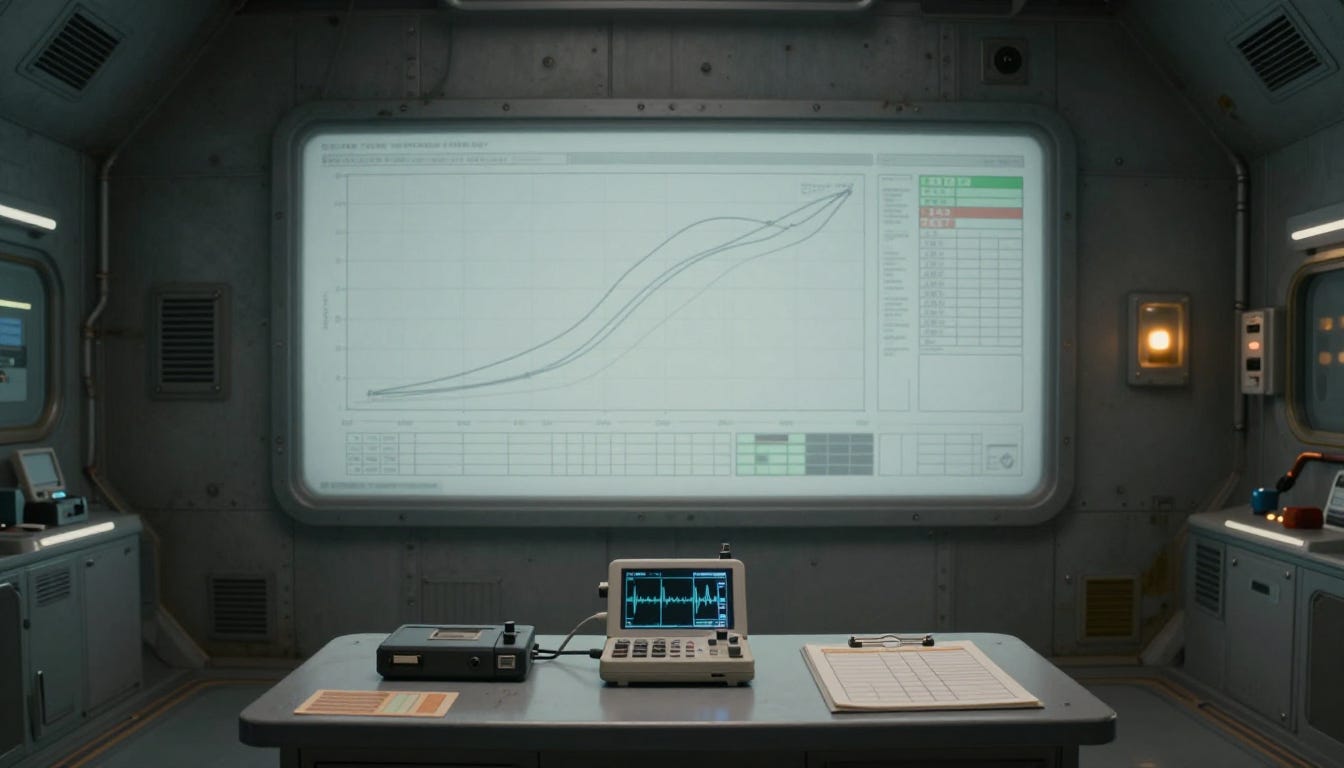
“Read it as a curve, not a story,” Ayanda said. “A story argues. A curve only rises.”
She ran the overlay. The injury frequency line climbed across the twelve weeks, shallow at first, then steeper. She laid the production schedule beneath it. The two lines bent at the same weeks. Where extraction targets stepped up, the maintenance windows shrank from full blocks to slivers, and the injury line answered each cut within a shift or two.
“Extended cycles here.” She marked three weeks. “Dust-load flags cleared at shift end, not because the filters held but because they had not yet failed. Strain complaints on the brace line the collapse packet filed as unrelated. None of these is a cause by itself. A doctor who names one dataset a cause is selling something.”
Sigrid Hedlund stood with both hands on the rail. “Then you cannot say the schedule did this.”
“I can say the schedule and the harm move together for twelve weeks and never come apart. Correlation is not confession. It is a place to look, and everyone in this room stopped looking at the same time.”
Ji-woo Han set the survey unit on the case beside the wall and woke it.
“This is the second record,” Ayanda said. “Mine shows the trend across the weeks. This shows the hour.”
Ji-woo turned the screen so the room shared it and read the checksum aloud, the long string first, then the file. Three raw microseismic traces. The signed recommendation with her name at the top and the phrase she had chosen in the control room. Pause extraction before further loading. The instrument checksum sat beneath it, generated by the unit itself, unrewritable without breaking the number.
“The file predates the collapse by two days,” Ji-woo said. “The checksum proves it has not moved since. The version history is the other half.”
She opened it. The central entry read monitor while operating, logged under a production-review account, entered after the recommendation had left safety engineering. The room held the two sentences side by side. The one a junior engineer had signed. The one that reached the schedule.
Lena Vasquez set her chip beside the unit without being asked. “Third.”
The suit telemetry loaded. The vibration Lena had carried through her glove and the deck strip climbed across the same window the central report named stable. Three records now. One traced in rock, one strapped to a body, one written in a hospital register, and none of them had touched the others before this room. They bent in the same direction at the same minute.
“That is the finding,” Ayanda said. “Not a confession. An agreement. Three instruments that share nothing agree on the one minute the report calls quiet.”
Sigrid moved closer to the version history and stopped.
She did not challenge the checksum. She read the account name under the recoded line, and something in her went still in a way Ayanda logged the way she logged a change in a patient’s color.
“That account,” Sigrid said. “The production-review credential. That is not a rogue office. That routes through my morning board. That is my chain.”
“Yes,” Ayanda said.
“Who approved the change from amber to advisory.”
“The version history holds the account, not the person,” Ji-woo said. “The account is real. The hand is a name I do not have.”
The moment turned in the director’s face. She had stopped defending the packet. She was reading it now. It was not relief. Relief did not come to a person who had found her own system lying to her in a language she had trusted for years. To her credit, she did not reach for the word unforecast. She had spoken it on the station feed thirteen days ago, sincere and wrong in the same breath, and the sentence had traveled further than any hold ever would.
Mateusz Zieliński had a slate open and a column already ruled.
“The rescue-delay timeline matches something I have carried since I landed,” he said. “The staffing that left one entry team on the board while the inner refuge ran out is the same average-incident assumption the fleet uses to price schedule risk. One team is cheaper. On a planning sheet it is a rounding choice. Here it is the gap the inner shift fell through.”
He set his timeline beside Ayanda’s rescue-delay figures. A fourth record, from a fourth institution, bending the same way.
“Four now,” Ayanda said. “The rock, the body, the register, the schedule. I keep waiting for one of them to disagree. None of them will. That is how you know it is not a theory. A theory has a dissent somewhere. This has none.”
The wall chirped over her sentence. A soft two-tone alert, the kind medical kept low so it did not wake a ward.
Ayanda turned to it before anyone asked. The environmental overlay had pushed a trend into her feed without being called. Two industrial habitat sectors, east industrial and the lower processing spur. Carbon dioxide climbing off a flat baseline. Not an alarm. A slope.
She read it the way she read a monitor that had not yet peaked. The rise was shallow and steady and did not belong to the numbers around it. Bank D had carried the station since the isolation, above its inspected margin, on filters nobody had been escorted in to clean. A shallow steady slope on a system with no reserve was not a fault light. It was the front edge of one.
“The visible alarm cleared days ago,” she said. “This did not clear with it.”
Kavita Nair, who had stood the whole review without speaking, unhooked her boots. “Sectors?”
“East industrial and the lower processing spur. Both on the return-air trunk Bank D is feeding. The same trunk runs the labor ring.” Ayanda keyed her own authority into the record, the one part of the station no production account could overrule. “Reduced-activity protocol, both sectors. Non-essential personnel out. Anyone who stays goes on a carbon-dioxide trap and a clock.”
She logged the order with a timestamp and a signature, the same way she had logged the dissent thirteen days ago. The wall behind her proved what people had done to 3-Bravo, week by week, in ordinary marks nobody had been asked to defend. The slope in her feed was the same failure still moving, in the present tense, while five people stood in a room agreeing about the past.
“The record is complete,” she said, and turned from the wall that proved it toward the door that did not. “The station is not.”
If you enjoyed this story, you can follow the main story arc in The Exodus Rush, the first book in The Vethrak Requiem series.