


Hannes Pellegrini had never stolen anything in his life. He repeated this as he slid the panel back into place, the magnetic seal clicking home with a sound like a knuckle cracking. Three blister packs of amoxicillin sat behind that panel, wedged against a conduit junction that no one visited except Hannes, because no one else on Themis Station could fit through the access hatch at Frame 77.
Not stolen. Found. The distinction mattered, even if no one was keeping score.
His cache occupied a section of dead space behind the water recycling manifold: four purification tablets in a sealed pouch, two backup oxygen scrubber cartridges, a cracked emergency lantern, six nutrition bars past their printed expiration, and now the antibiotics. Each item had arrived through its own logic. Damaged supply pack. Surplus from a maintenance cycle. Disposal bin. Written-off cargo. Found. Recovered. Salvaged.
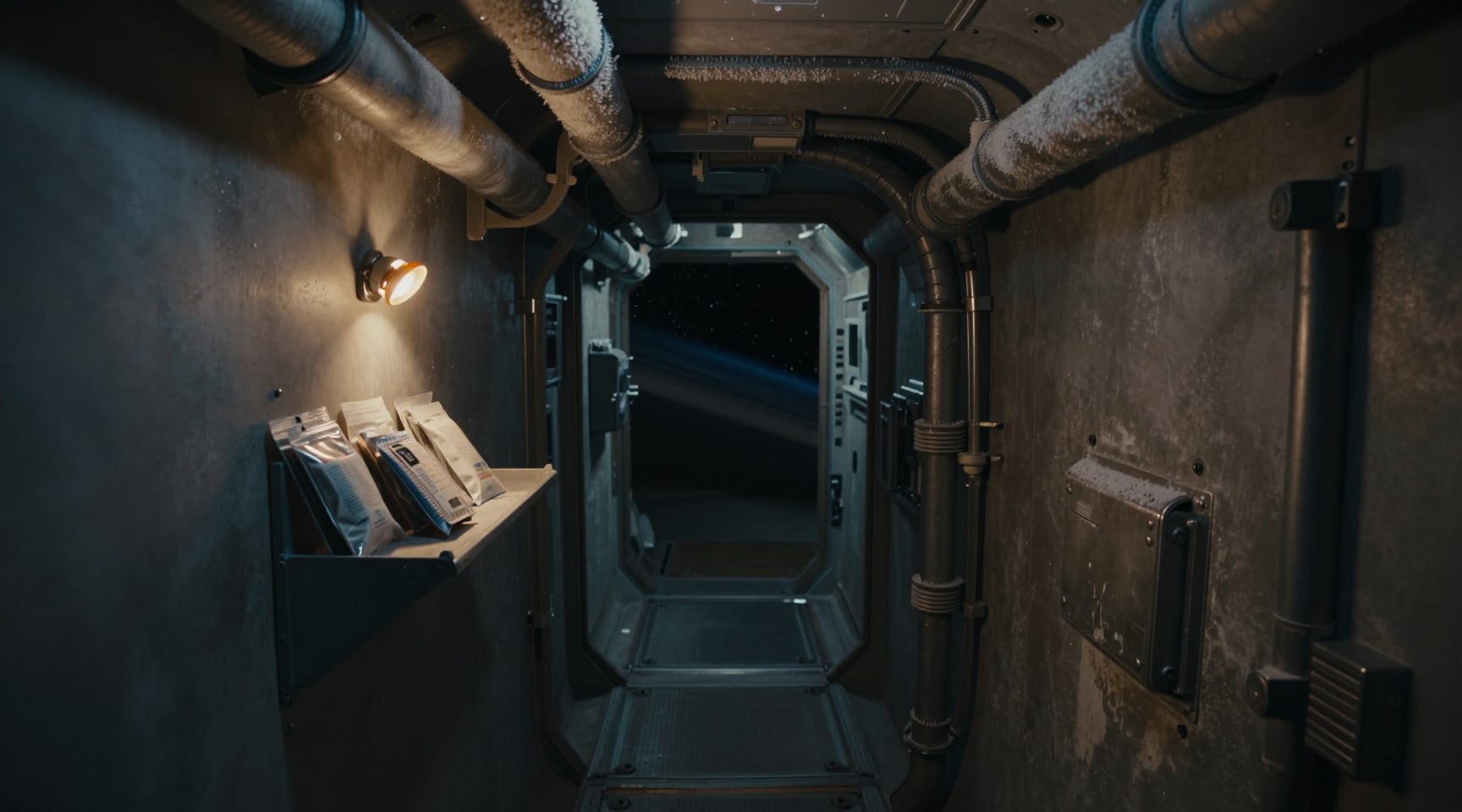
The crawlspace was narrow, cold enough to frost the conduit joints where insulation had worn through. His breath came out in slow clouds that hung in the still air. He kept his headlamp angled low, though there was no one to see the light. Habit. Eleven months of quiet work in spaces where no one looked had made caution reflexive.
Hannes crawled backward through the hatch and stood in the corridor. Deck 14 was silent at this hour. The overhead lights ran at forty percent to conserve power, casting everything in yellowish gloom that made the corridor feel like the inside of an old photograph. Three hundred meters forward, the corridor joined the main transit spine where the station’s population moved between habitation blocks and the processing center. Eighteen hundred people on a station designed for twelve hundred, every deck converted, every common space repurposed, every spare meter of volume pressed into service.
The station hummed around him as he walked. He knew every system by sound: the loose mounting bolt at junction 14-C, the hairline crack in the atmospheric duct near the head that he’d reported twice and patched once with sealant tape, the deeper throb of the cascade reactor turning hydrogen into heat and electricity. Twenty-two years of maintenance work had given him spatial understanding that went beyond schematics. Pressure differentials registered through the soles of his boots. A failing pump motor shifted pitch three days before diagnostics flagged it.
That knowledge had kept him alive during the invasion. When the Vethrak struck and the outer ring decompressed, Hannes had sealed his section, rerouted emergency atmosphere, and guided eleven people through maintenance passages to the intact inner decks while the main corridors were still venting. Seven of those eleven were alive today.
The same knowledge now made him valuable to Kaja Ugwu.
She was waiting at the junction where Deck 14 met the transit spine, leaning against the bulkhead with her arms crossed. Twenty-six, maybe twenty-seven. She’d arrived on Themis four months ago on a refugee transport from the Mars orbital corridor, carrying nothing but a duffel and a datapad she kept closer than most people kept their air supply. In those months she’d built something she called the Threadline: a network threaded through the maintenance infrastructure of three stations along the Mars-Saturn transit corridor.
“Pellegrini.” She pushed off the bulkhead. “Frame 77 again?”
“Routine maintenance.”
“The recycling manifold on Frame 77 hasn’t needed manual inspection since the refit eight years ago. Automated diagnostics handle it.”
He stopped. The nearest surveillance node was twelve meters behind them, its lens fogged by humidity for three days. No repair ticket filed. Perhaps no one had noticed. Perhaps someone had made sure of that.
“Whatever you have behind that manifold, keep it,” Kaja said. “Consider it your retirement fund. I need something else. Something that costs you nothing.”
“I’m a maintenance technician.”
“You’re the maintenance technician. The one who knows every access point, every dead sensor zone, every section where the environmental monitoring doesn’t reach because the wiring was never extended after the emergency refit.” She paused. “You know where cargo can sit without being inventoried. You know which hatches open from both sides and which ones don’t.”
They walked toward Habitation Block C. Around them, the station’s night population moved in the dim light: a woman carrying a sleeping child, two men in UEN coveralls heading toward engineering, a teenager reading against the wall with a cracked datapad.
“Two hours a week,” Kaja said. “You tell me which maintenance corridors are clear, which sensor nodes are offline, which cargo sections are unmonitored. Nothing moves through your hands. You don’t touch anything, carry anything, deliver anything. Information only.”
“What are you moving?”
“Medical supplies. Water filters. Protein supplements.” She let the last word settle. “The things the UEN distributes on a priority schedule that puts Themis Station at tier three. Sixty percent of calculated need. Three hundred people on this station are running a deficit every single day.”
He knew the numbers. Everyone knew the numbers. Tier three meant the station received enough to prevent starvation and system failure. Enough for survival. Not enough for health. Not enough for children to grow properly, or for the woman on Deck 7 whose chronic kidney condition required medication the UEN had classified as non-critical.
“Where do the supplies come from?”
“Sources I’m building. Surplus from settlements that over-ordered. Salvage from disabled transports. Sometimes a margin skimmed from shipments where the accounting tolerates loss. The supplies exist. The official distribution system can’t move them where they need to go. The Threadline fills the gap.”
“Skimming from military shipments is a capital charge.”
“Skimming from military shipments is Tuesday.” She said it flat, without bravado. A fact from a world where the old rules had stopped matching the new reality. “The UEN keeps this station operational. Operational means the reactor runs, the air circulates, and nobody freezes. It doesn’t mean the children eat enough. It doesn’t mean the sick get treated. The gap between operational and alive is where we work.”
They reached the entrance to Block C. Behind those bulkheads, fifteen hundred people slept in quarters designed for eight hundred. Families in converted storage rooms. Singles in rack beds stacked three high.
“The access fee,” he said. “What do I get?”
“One priority medical request per month, filled from our supply chain. Whatever you need, for whoever you need it for. No questions.”
The woman on Deck 7. The child on Deck 11 whose cough had deepened over three weeks. His own knees, aching from two decades of crawling through hatches, examined once by the station’s medical officer and placed on a waiting list for anti-inflammatories that never arrived.
“Information only,” he said. “I tell you which corridors are clear. That’s all.”
“That’s all.”
The station hummed. Eighteen hundred people breathing, eating, sleeping, waiting. The machinery sustaining them was held together by technicians who understood that the gap between what the systems were designed to do and what they actually did was where survival lived.
The gap was where Kaja lived too.
“Deck 14, Frame 60 through 85,” he said. “The environmental sensors in that section were damaged in the pressure event and reconnected to the wrong monitoring loop. They report to a diagnostic channel nobody reads. Cargo transit through that section doesn’t register on any active feed.”
Kaja nodded. No notes. No datapad.
“Weekly updates,” she said. “Maintenance schedules shift. Sensors go up and down.”
“I know when they shift. I’m the one changing them.”
She extended her hand. A handshake. A contract. A threshold he could not uncross.
Hannes Pellegrini had never stolen anything in his life. He was about to help other people do it, and the price was a piece of knowledge he’d carried the way other men carried their names: quietly, completely, without understanding its value until someone offered to buy it.
He shook her hand.
Behind the panel on Frame 77, three blister packs of amoxicillin waited in the dark for someone who needed them more than the system that had lost them.
Author’s Note: In the first year after the invasion, the line between survival and crime barely existed. Orbital stations like Themis received enough from the UEN to keep the air flowing and the reactors running, not enough to keep everyone healthy. The informal networks that filled those gaps, small crews like the Threadline threading supply lines through maintenance corridors and dead sensor zones, would eventually grow into the syndicate structures that shaped the post-invasion economy for decades. Every network started with someone who knew the station better than anyone else, and someone smart enough to ask.
If you enjoyed this story, you can follow the main story arc in The Exodus Rush, the first book in The Vethrak Requiem series.