


Dr. Anya Volkov stared at the data stream for the third time that hour.
The numbers refused to make sense. Seventeen distinct gravitational anomalies, each one massive enough to register on sensors at three light-years distance. They had appeared in the span of six weeks, clustering in a region of space that previous surveys had marked as empty void.
“Coffee delivery.” Lieutenant Marcus Chen set a steaming cup beside her workstation. “You’ve been at this for fourteen hours.”
“Look at this.” Anya gestured to the holographic display. Clusters of red markers floated in three-dimensional space, each one tagged with mass estimates and velocity vectors. “These readings don’t match any known stellar phenomena.”
Marcus leaned in, squinting at the data. “Could be sensor drift. We’re at the edge of our range.”
“I calibrated the array twice. The readings are consistent.” She pulled up a comparative analysis, overlaying historical survey data. “Six weeks ago, this sector was empty. Now we’re detecting mass signatures equivalent to large asteroids or small moons. Moving in formation.”
“Formation?” Marcus straightened. “Natural objects don’t move in formation.”
“Exactly.” Anya pulled up the velocity vectors, highlighting the parallel trajectories. “They’re maintaining relative positions. Consistent speed, consistent heading. All of them pointed toward the inner systems.”
Marcus was quiet for a long moment. “You’re saying this is artificial.”
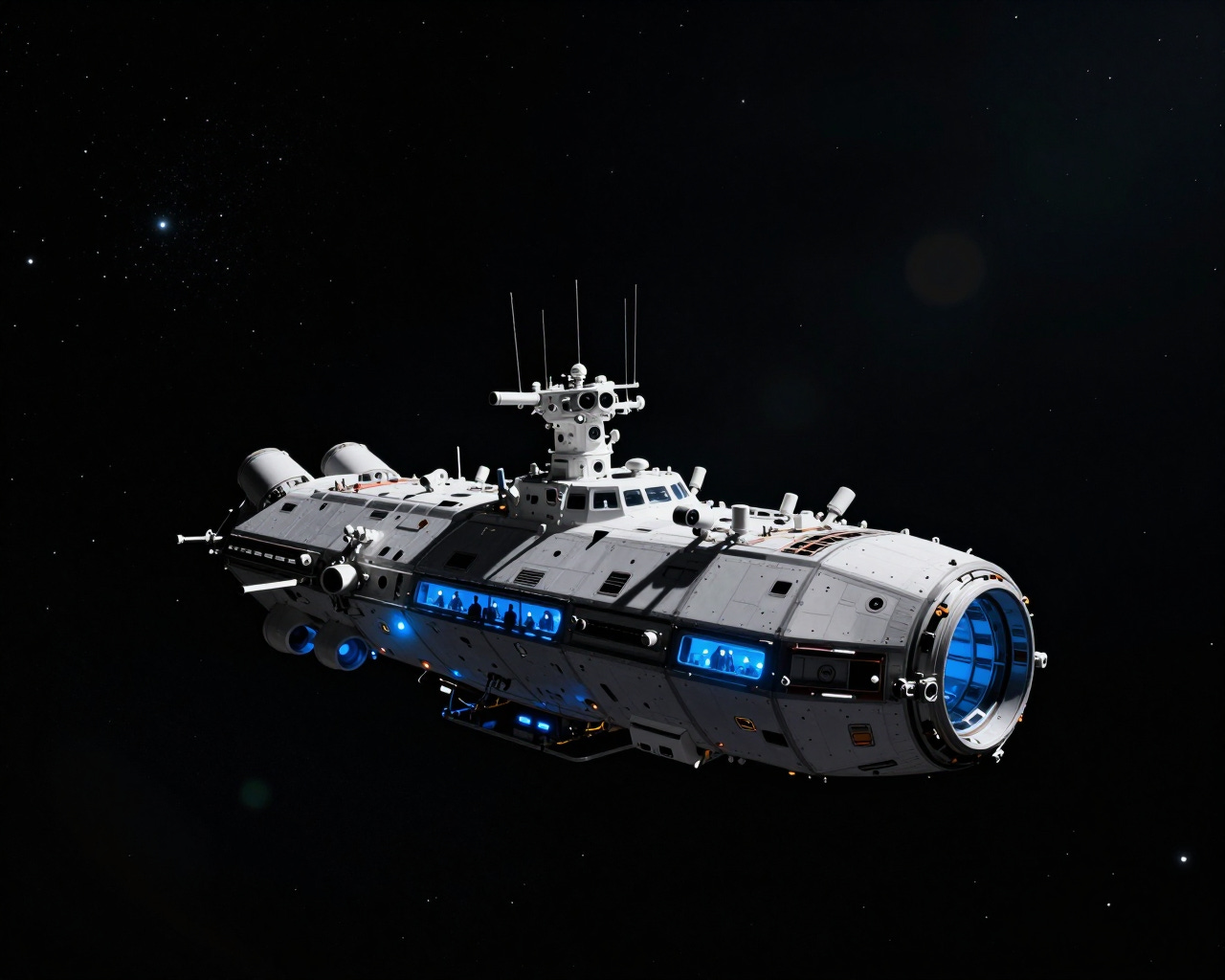
“I’m saying it’s not natural.” Anya saved the data to the ship’s archive, flagging it for priority review. “Could be a convoy of generation ships. Could be an automated mining operation. Could be something we’ve never seen before.”
“Could be nothing.” Marcus picked up his coffee, took a long drink. “Remember the Kepler Anomaly? Six months of analysis, turned out to be a calibration error in the sensor suite.”
Anya remembered. The whole astrophysics community had spent half a year chasing ghosts because one technician had installed a component backwards. She had been part of that embarrassment.
“Maybe.” She pulled up the raw sensor logs, checked the timestamps. “I’ll run another calibration sweep. Full diagnostic on the primary array.”
“Good plan.” Marcus headed for the door, paused at the threshold. “Get some sleep, Anya. The data will still be here in the morning.”
She nodded, knowing she wouldn’t sleep. Not yet.
The diagnostic took three hours. Every component checked out. Every sensor reported nominal function. The gravitational anomalies remained exactly where they had been, still moving, still holding formation.
Anya filed her report at 0600 hours. Subject: Unusual Gravitational Signatures in Sector 447-Delta. Priority: Medium. Recommendation: Further observation and analysis.
Fleet Command acknowledged receipt four days later. Their response was brief: “Continue monitoring. Report significant changes. No action required at this time.”
She continued monitoring. The anomalies kept moving, slow and steady, headed toward the core systems. Toward Earth.
Three months later, they crossed into the outer system. Three months after that, they arrived.
By then, everyone knew what they were.
Author’s Note: This story takes place in Year -1, approximately eleven months before the Vethrak invasion begins. Dr. Volkov’s survey ship, the CSV Kepler Dawn, was conducting routine deep-space mapping operations when it detected the approaching Vethrak fleet. At the time, humanity had no context for interpreting the readings. The gravitational signatures were dismissed as sensor anomalies or, at best, an unknown natural phenomenon. By the time the truth became clear, it was far too late to prepare. This is the story of humanity’s first detection of the Vethrak threat, recorded by someone who didn’t realize she was looking at the end of the world.
If you enjoyed this story, you can follow the main story arc in The Exodus Rush, the first book in The Vethrak Requiem series.