


The conference deck sat on Mimas Station’s second commercial ring, in a leased office that had been a bulk freight insurance suite before the invasion. The corporate signage was still visible under fresh tape on the back wall: a logo from a company that had stopped answering messages from any account it had ever held.
Anya cycled the door twenty minutes before second-shift cap. Davit was already inside. Two captains were already inside.
The two captains were not speaking to each other.
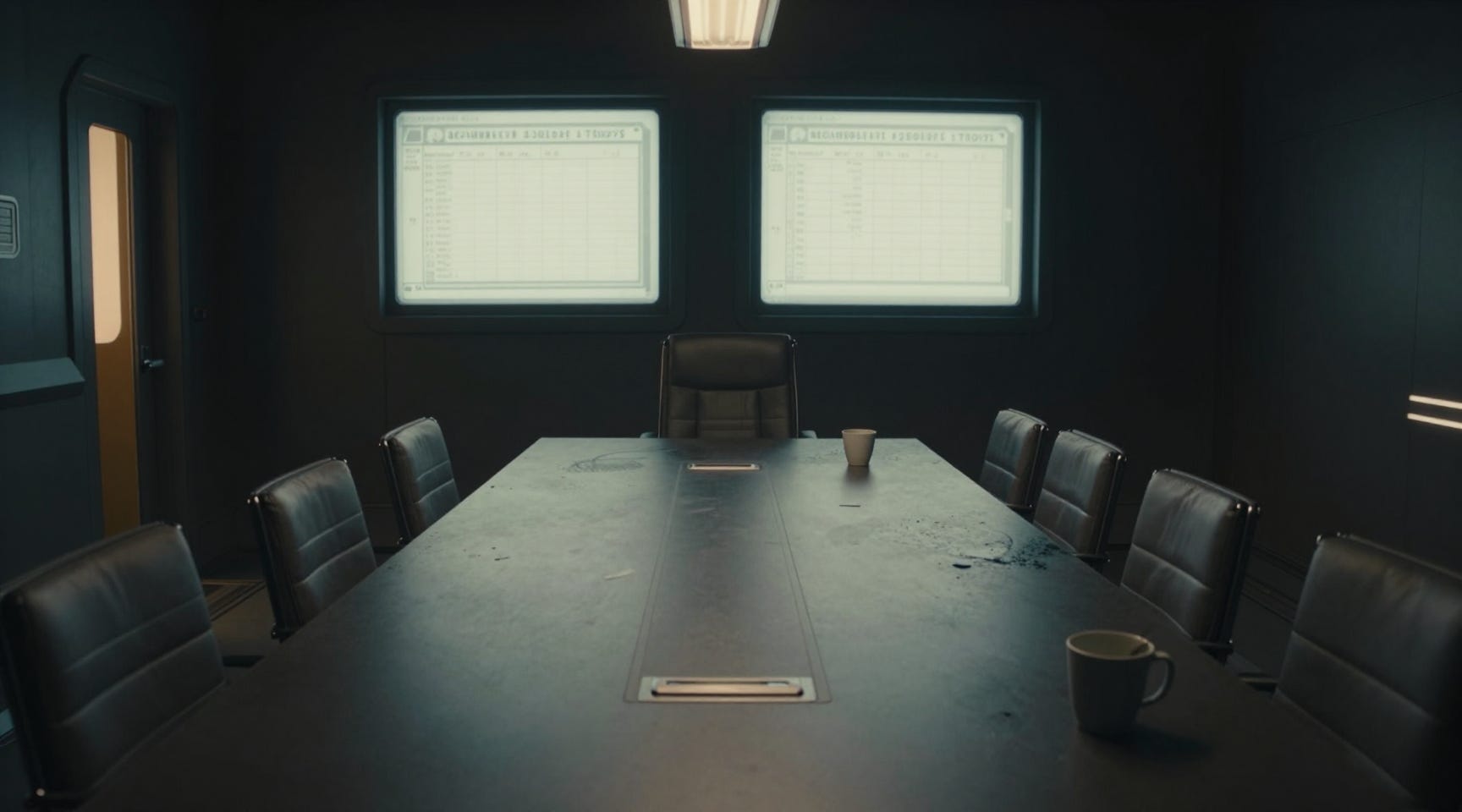
The room held a long conference table, eight chairs, and a single slate at the head of the table. The overhead light was flat and cold. Davit had laid out water cups in front of every chair, and at least two of the cups had been refilled, because the table bore condensation rings in places where someone had set them down hard.
Anya took the chair Davit gestured her toward. It was at the far end of the table, opposite the slate. The witness chair, she understood, even though no one had named it that yet.
Davit sat at the slate. He did not stand. He did not call the meeting to order.
“Klaudia. Otieno,” he said. “The logs first. Then we talk.”
Captain Klaudia Walczak ran a three-skiff crew out of the Pallas approach corridor. Her suit liner was clean. Her hands were not. She slid a slate across the table and let Davit pull it the rest of the way without comment.
Captain Otieno Macharia ran a heavier crew, four skiffs, ring-belt born like Anya. He pushed his slate after Klaudia’s with a force that traveled through the table.
Davit took both. He pulled the slate displays into parallel windows on the wall slate at the head of the room. The two field-registration logs sat side by side, pale on dark.
The contested field was a Vethrak debris cluster in the Cassini drift, designation 4-Theta-9. The numbers were unromantic. The contested object inside the field was a mid-rated cascade core fragment, partially intact, the kind of recovery that paid out four months of crew expenses on a single sale.
Klaudia’s registration was timestamped seventeen hours before Otieno’s.
Otieno’s registration was filed under a different cooperative protocol, an older one Anya had used herself before Davit’s room had existed. It was technically valid. It was filed second.
The silence in the room had texture. It was the silence of two captains who already knew what the slate said and were waiting for someone to translate it into a verdict.
Davit did not look at either of them. He looked at the slate.
“Klaudia’s registration is first by seventeen hours,” he said. “Both registrations are valid under their respective cooperative protocols. There is no field overlap question. The dispute is which timestamp wins.”
Otieno opened his mouth.
Davit raised one finger.
Otieno closed his mouth.
“I understand,” Davit said, “that Captain Macharia’s registration was filed in good faith under a recognized protocol. The argument that the older protocol carries historical precedence is real. The argument has been made elsewhere. This room is not elsewhere.”
He paused exactly long enough for the sentence to land.
“This room rules on a precedent set earlier this year. Two crews in the outer ring, no arbitration available to them. One crew held earlier registration logs. The other crew accepted them and stood down. Both crews walked out alive and uncompromised. The precedent was practical. The precedent worked. This room recognizes it as the precedent we operate under going forward.”
Anya’s throat tightened. She held her face still. Davit was speaking about her standoff with the rival crew in the outer ring months earlier, the one she had walked away from before the cooperative had existed, and he was not naming her, and the not-naming was the courtesy.
“The earlier registration prevails,” Davit said. “Captain Walczak’s claim on field 4-Theta-9 stands. Captain Macharia’s crew steps off the field by next shift change.”
Otieno’s hand on the table flexed once and went flat.
Klaudia did not smile. She nodded once.
Otieno spoke. His voice was even. “What about the registration system going forward.”
“Going forward,” Davit said, “this room recognizes one registration timestamp per field. First filing wins. Disputes are arbitrated here, in this format, with the winning party’s logs as the binding record. The losing party retains salvage rights on adjacent fields up to the cluster boundary, not inside the contested zone. We are calling this the ring-two protocol because we are sitting on ring two and someone has to call it something.”
He had named it without noting that he had named it. Anya filed the moment.
Otieno looked at Klaudia. Klaudia looked back. Neither of them looked at Davit.
“Accepted,” Otieno said.
“Accepted,” Klaudia said.
The verbs were the smallest possible sound. The verbs were also the entire institution.
The captains left first. Klaudia took her slate back without comment. Otieno took his back with the same force he had pushed it forward. Davit shook neither of their hands. The door cycled twice and closed.
Anya stayed in the witness chair. Davit stayed at the slate.
He did not move for a long moment. He drank water from his cup. He studied the wall slate where the two registration logs were still displayed in parallel.
Then he killed the display and looked at her.
“We just made a rule,” he said. The smile was small, almost private. “We should write it down.”
She did not answer right away.
He gathered the cups onto a tray, wiped the condensation rings with the corner of his sleeve, squared the chairs around the table. Months earlier he had been a broker who paid in thermal credits and inspected samples in a back office and asked no questions. Tonight he had named a protocol after a corridor on a station, on the strength of a precedent he had borrowed from her field standoff, in a room he had booked, with witnesses he had selected, ruling on disputes he had quietly invited the cooperative to bring to him.
She had been treating Davit Kade as the man who moved the material. The material moved because someone was building the rails it moved on. The rails had not built themselves. The man building them was patient and did not need credit, and was therefore going to build everything.
“Okay,” she said. Her voice was dry. “Write it down.”
Davit’s smile did not change. He picked up the tray.
The conference deck’s overhead light hummed in the way overhead lights on leased space always hummed. Outside the door, in the corridor, Mimas Station went about the second-shift business of pretending nothing in particular had happened on the second ring tonight.
Anya stayed in the witness chair a moment longer.
Then she stood up and went home to write down what she had seen.
Author’s note: Day Nine of the Iron Wake Origins arc. Anya Rask sits as a witness while Davit Kade adjudicates the cooperative’s first arbitration, a contested Vethrak salvage field in the Cassini drift with two captains, two registration logs, and seventeen hours separating the timestamps. Davit’s ruling is narrow. The earlier registration prevails. The precedent he leans on, without naming, is Anya’s own outer-ring standoff months earlier. Walking out, Davit names the rule after the corridor they are sitting on. He calls it ring-two protocol. He tells Anya they should write it down. The cooperative now has its first written rule of engagement, and Anya sees Davit Kade for the first time as something other than a fixer. Year 1, Month 12.
If you enjoyed this story, you can follow the main story arc in The Exodus Rush, the first book in The Vethrak Requiem series.