


Mateusz Zieliński split the red schedule into three categories nobody had asked him to create.
The Fleet Construction logistics room on Ceres lacked a spin floor. His work slate stayed clipped to the wall rail, his case floated against a short restraint, and two boot loops kept him from pushing backward whenever he touched the display. Twelve project windows crowded the main screen. Every one showed red.
Red had brought him to Ceres. Red had put sabotage in his first report. Red had followed him into yesterday’s arbitration room, where the compensation survived and the safety offer failed.
He closed the summary layer.
The schedule underneath contained three different clocks.
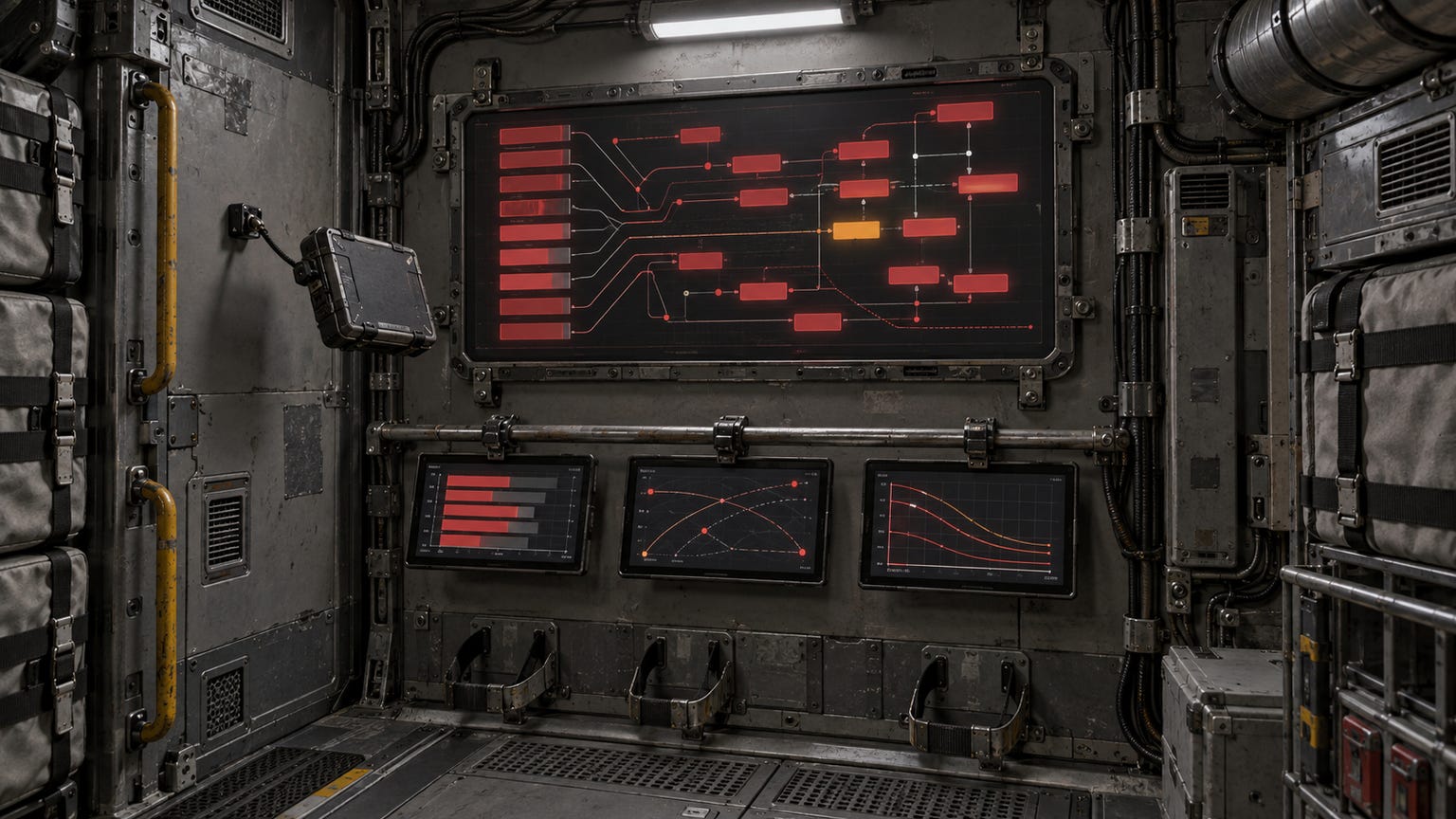
The first measured fabrication: stock on hand, forming time, inspection, pressure test. The second measured transport: cargo release, transfer window, route, receiving capacity. The third measured promises. Public completion dates. Executive reviews. A camera visit attached to the first visible section of a new hull.
The dashboard treated all three as loss of construction capacity.
Mateusz loaded the Ceres inventory beside the fabrication records and entered the transit times by route. The two nickel pallets remained held in the cargo hub. Existing metal sat at four other sites, already assigned and not yet cut. He shifted each quantity against actual consumption instead of delivery dates.
Three red blocks changed.
Two stayed red for reasons the summary did not reveal. A sensor-housing order had six days of raw stock but no certified transport. A coded reserve demand carried no fabrication date at all, only a priority inherited from its classification. Neither could be solved by the nickel at Ceres. He marked the first as a route risk and the second as unverified demand, then attached the source gaps to both. The display asked whether he wanted to preserve their executive severity. He selected no. A schedule could contain secrets without pretending every secret expired at midnight.
One public hull milestone had missed an executive reporting date. Its first exterior section would not be ready for the scheduled broadcast, but structural testing did not begin for nineteen days. Twelve days of usable float sat between the ceremony and the work that depended on it.
A pressure-shell line carried a different margin.
Three days, eighteen hours.
The line had already stopped once after losing its receiving slot. Its forming stock could support one shortened run. After that, crews would stand down, calibration would expire, and the next available batch would arrive too late to prevent a seven-day break in pressure-section output.
Mateusz opened the source field. The line served two public habitat contracts and one coded reserve order. The destinations remained sealed. The material class did not.
People would live behind those walls.
He moved twenty-eight tonnes of uncut alloy from the ceremonial milestone to the pressure-shell queue. The public project slipped behind its camera date and stayed eleven days ahead of structural testing. The pressure line gained five days.
A confirmation box filled the center of the display.
Resequencing conflicts with executive reporting commitment. Escalation required.
He selected execute and escalate.
The remote conference opened thirty seconds later.
Five project sites appeared as initials around the screen, each connection carrying a delayed queue instead of a live room. The lead scheduler’s channel bore Fleet Construction authorization. Two fabrication managers joined from locations hidden behind contract codes. Helios dispatch occupied a voice-only channel. Mateusz transmitted the revised dependency table before anyone could return the discussion to the summary dashboard.
“Reverse the transfer,” the lead scheduler said.
“The public milestone has twelve days of float. The pressure-shell line has less than four.”
“The milestone was committed to the Council communications office.”
“The test sequence was committed to Fleet Construction. It remains protected.”
A fabrication manager opened the pressure-line record. “This buys five days if the reassigned stock passes intake without another inspection hold.”
“It carries a current certificate,” Mateusz said. “Your receiving team confirmed acceptance six minutes ago.”
The lead scheduler enlarged the coded reserve column. “You were sent to recover Ceres supply, not expose reserve allocation against public delivery messaging.”
“I am separating deadlines by consequence.”
“Those categories were combined for a reason.”
“They were combined for reporting. Negotiation requires an auditable need.”
Silence crossed five sites at five different delays.
Helios dispatch entered first. “The union rejected release yesterday.”
“The union rejected an unverifiable destination and unilateral custody. The cargo remains available under a conditional transit offer.”
“Fleet Construction cannot disclose the receiving site.”
“It does not need to.”
Mateusz opened the verification service used for restricted transfers. It could confirm a contract class, acceptance window, approved mass, and life-safety designation without returning a location. He generated a single-use code tied to the two pallets. The result named no yard and exposed no reserve project. It confirmed pressure-habitat fabrication, required delivery inside seventy-two hours, and rejected diversion to any other order.
The lead scheduler’s channel sharpened. “Do not send that outside the allocation chain.”
“The union asked for a cleared reviewer. This is the review.”
“Your mandate is cargo priority.”
“This is cargo priority.”
Mateusz released the code to Kavita Nair and requested a joint channel.
Kavita joined from the cargo hub with the nickel manifest already open.
“The code identifies a contract class,” she said. “Not the receiver.”
“The location stays restricted. The verification service will answer four questions for both custodians: material, mass, acceptance window, and approved use. It will invalidate the release if the receiving order changes.”
“Who controls the seal record?”
“One Helios custodian and one union custodian. Both signatures attach to the original pallet seals. Fleet Construction receives the matched receipt. Neither side can alter the other’s copy.”
“Extraction remains closed.”
“This release covers stored stock only.”
“No production crew moves with it.”
“Cargo handling and pressure-safe transit only.”
Kavita left the channel open while she checked the code against the offer she had filed four days earlier. Cargo noise crossed the connection: a carrier motor, a ratchet taking tension, one clipped exchange too distant for words.
The lead scheduler sent Mateusz a private order to suspend external transmission. He attached the executed resequencing record and returned the order with a request for the authority under which an already-issued verification could be withdrawn. No answer arrived.
Kavita came back on the joint channel.
“The chapter approves these two pallets under the emergency carve-out. Each load separately. Joint custody, sealed receipt, no diversion, no precedent for extraction or later cargo.”
Helios dispatch answered at once. “We’ll stage the carrier.”
“Record the exception correctly,” Kavita said. “The line has not reopened.”
Mateusz changed the cause field before dispatch could populate it.
“Humanitarian exception,” he said. “Verified pressure-habitat fabrication. Union conditional release accepted.”
“That wording will be read as a concession to the strike,” the lead scheduler said.
“It is a description of the transaction.”
Kavita’s approval appeared beside the first pallet. The second remained pending its separate seal check. Nothing in the record converted the release into resumed extraction. Nothing called the held cargo sabotage. The conditions occupied more space than the urgency label had.
Mateusz returned to the full schedule.
The public milestone shifted twelve days to the right. Its executive marker stayed red. The structural test beneath it remained on time. The pressure-shell line now carried enough stock to run through the verified nickel window, if both seals matched and the transfer left Ceres on schedule.
He saved the three categories as the default view for his next negotiation packet: hard stop, recoverable delay, reporting milestone.
One block turned amber. The others remained honestly red.
If you enjoyed this story, you can follow the main story arc in The Exodus Rush, the first book in The Vethrak Requiem series.