


Wanjiku Bett brought the cracks back onto the release board. The proposed transfer copy had reduced them to a single open work item.
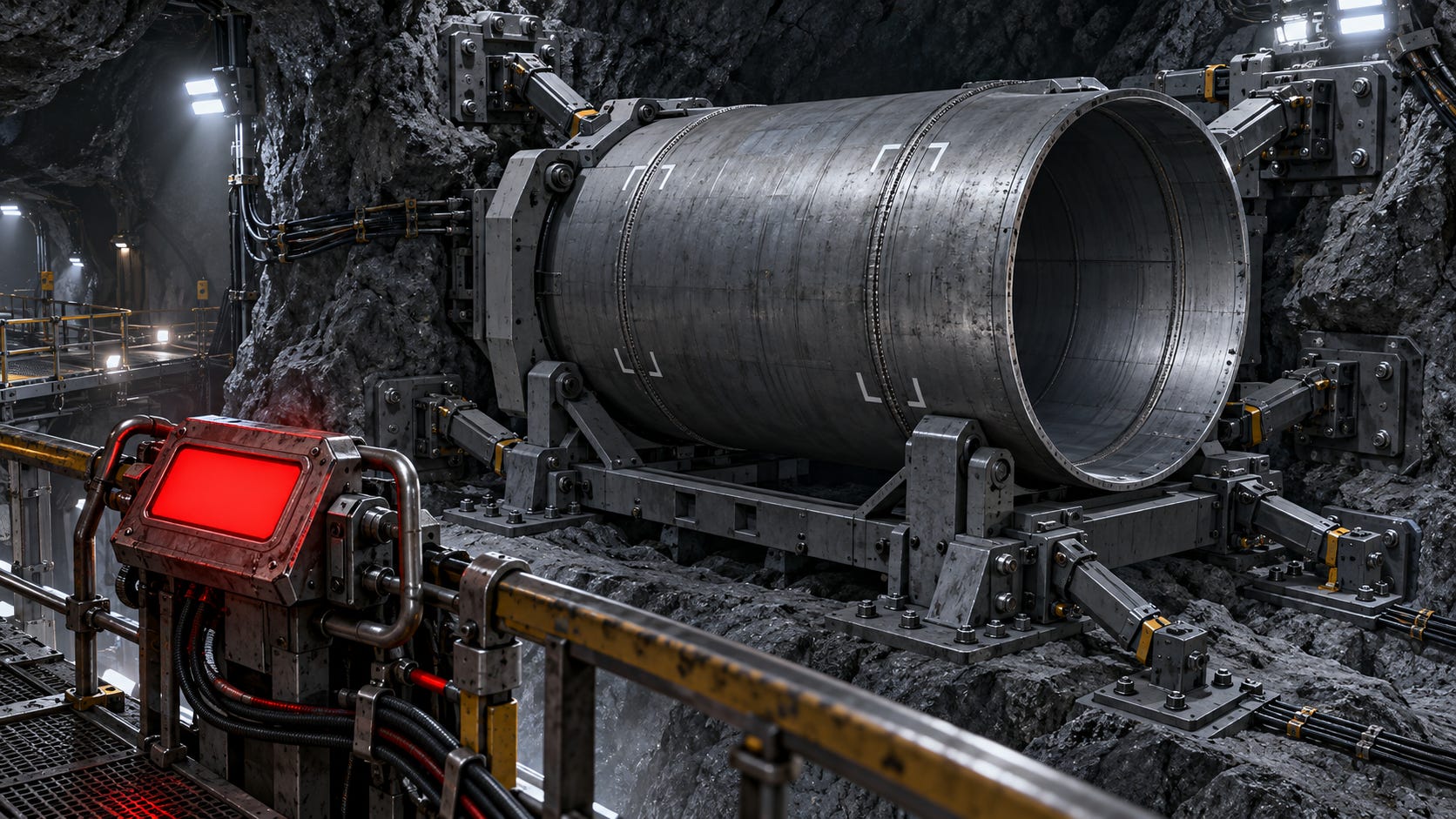
Three narrow brackets returned to the outline of Article Four. Beyond the inspection boundary, the steel barrel remained captured in Slip Two’s proof cradle, its actuators isolated, its outer surface unbroken to the eye.
She secured her boots beneath the terminal and opened the full examination beside the proposal. Shallow microcracking in the heat-affected plate at three mixed transitions. Corresponding locations clean in the retained pre-proof scans, within their resolution. Repeat acoustic events during unloading. No completed proof at the planned maximum.
The remote schedule packet offered conditional transfer of the unaffected work packages. Transition seams would remain subject to localized rework. Removing the barrel from the cradle would return the fixture to the yard and preserve the outbound allocation.
Her signature field waited below a list of completed tasks.
Wanjiku scrolled past it.
Samrawit Assefa clipped into the adjoining station with the material overlay. Two certificate hashes met at every marked transition. Same-hash examined joints remained clean within recorded coverage. Tuva Hawthorne’s witnessed same-row control had passed its loading sequence and the examination afterward.
Wanjiku opened the control’s geometry limit next to its result. A representative segment. Useful evidence, incapable of carrying the barrel’s release by itself.
“Any process answers?” she asked.
“None.”
Samrawit brought up the five requested categories: forming method, principal working direction, stress-relief cycle, final heat treatment, revision chain. The fields remained unanswered beneath both hashes.
Onur’s signed denial and separate design request stayed attached. No unrestricted opening, no authorized narrow return path before the scheduled closure. No repair procedure concealed in either decision.
Wanjiku checked the attachments against the release session’s record. Nothing missing from the evidence. Too much missing from the metal’s history.
Foreman Cho arrived along the corridor rail. He caught the station handhold and read the proposal over her shoulder before fastening his slate into a bracket.
“They haven’t asked you to clear the seams,” he said.
“They’ve asked me to clear the structure around them.”
“With the seams carried forward.”
Wanjiku expanded the assembly drawing. The proposal colored the completed packages green and left three short bands amber. Most of Article Four looked ready.
She turned off the work-package colors.
The barrel’s primary load paths appeared over the same steel. At one end, the interface would receive force from the structure it joined. That force crossed plate, frame and transition before reaching the other end. The proof cradle’s rock anchors and actuators let them impose those loads here, without a ship around it.
Her finger followed the axial path through the first marked band.
“Acceleration doesn’t stop at this work-order boundary.”
She traced the bending path next, where an interface would pull one side of the shell while the other carried compression. Another bracket interrupted the line.
Cho moved closer to his slate.
“The clean plate still passed inspection.”
“Its inspection stays valid. This proposal gives that result a different job.”
She brought up the pressure-load case. Article Four was open at both ends in the fixture. In the completed hull, pressure would try to expand the shell and separate the closures beyond it. The barrel and its connections would have to carry their part of those forces across the same transitions.
“The steel can’t send the load around an open item,” she said. “We haven’t established what these joints can carry after repair. We haven’t established the repair.”
Samrawit touched the control result.
“This tells us the recorded procedure can pass with one pairing. It doesn’t qualify a change to the mixed joints.”
Cho studied the uncolored drawing. His thumb rested against the edge of the transfer proposal.
“Could it leave the fixture under a handling restriction?”
A narrower question. Wanjiku opened the proposed destination step. Outbound preparation, with structural completion accepted except for the listed rework. The schedule offered no separate engineered holding arrangement or assessed handling disposition.
“That would need its own supported plan,” she said. “This isn’t one. It’s acceptance with an attachment.”
She opened the receiving checks beneath the green packages. Their dates, signatures and coverage remained intact. Refusal would not erase that work. She kept each result attached to the location it described, then linked the unresolved transitions across them. The drawing grew less convenient to summarize. A reviewer would have to follow the connected structure instead of counting closed boxes.
She retained the proposal rather than dismissing it from the screen. Someone beyond the yard had tried to recover a scarce fixture and a transport slot. Her answer needed to address that attempt, not merely record that she disliked it.
Wanjiku unclipped her boots and pulled herself along the boundary rail. Her slate traveled on its short tether until she secured it in the inspection bracket.
Cho followed. Samrawit stayed at the board, keeping the session open.
Across the marked limit, the cradle’s reaction members ran back into asteroid rock. The crane slings remained restrained clear of the fixture. Nothing had taken Article Four’s support away. Nothing had put another proof load through its damaged transitions.
Wanjiku matched each chalk bracket to the map. Three small interruptions in a broad gray curve. From here the clean expanse dominated, as it had on the transfer copy.
A rigger at the corridor junction held a captive rigging tablet against his forearm.
“Do we keep the preparation crew assigned?” he asked Cho.
Cho looked at Wanjiku.
She could sign another temporary hold. Leave the milestone pending, let the preparation crew wait, give the next shift a board that still suggested an answer might arrive before closure. Nobody would have to admit the slot was gone until the slot had passed.
“No outbound preparation,” she said. “I’m recording refusal.”
The rigger checked the instruction on Cho’s slate before withdrawing along the rail.
Cho remained beside her.
“We lose the slot,” he said. “There isn’t a replacement window in the packet.”
“Record that with the refusal.”
“The largest proof fixture stays occupied through dark state. Other work waits for it.”
She kept her hand around the rail. A release condition could be technically sound and still cost people shifts they could not recover. Cho would have to fit those displaced tasks around reduced power and protected environmental loads. Her signature would not make him more room.
“Yes,” she said.
He opened the fixture allocation and retained Article Four against it. No appeal pane appeared beside her inspection record.
Wanjiku took one last look along the intact shell, then returned to the board.
She entered the decision beneath the full defect map.
“Release refused pending root-cause evidence, approved repair procedure, and repeated full-load proof.”
She read the sentence aloud. Samrawit checked the conditions against the unresolved materials disposition.
“The evidence has to support the procedure,” the engineer said.
“It will. A clean result alone won’t close the other conditions.”
Wanjiku linked each condition to its own unresolved requirement. No promise of a test during the closure. No permission to load the known-damaged barrel again. The repeated full-load proof would follow an approved repair, with the necessary examinations retained in its plan.
Tuva’s execution signature stayed where it belonged. Her completed work did not become a failed release decision, nor did it authorize one. Wanjiku attached her own name to the structural refusal and signed.
The board held the entry while the record saved.
Cho brought up the outbound transfer code. He locked it against the signed refusal, read back the inhibited state, and removed Article Four from preparation. He recorded the lost slot and continued fixture occupancy without replacing either with a hoped-for date.
“The crew can be reassigned,” he said.
Wanjiku checked that his transfer restriction linked to all three conditions. The old proposal remained in the session history, with her load-path drawing and answer beside it.
The release board turned red.
Beyond it, Article Four remained whole in the cradle. Its separate work packages could close around completed tasks. The structure could not move.
Author’s note: This story continues the Site Anvil arc in late Year 3, on the final day before the scheduled dark-state window. Article Four’s inspection decision carries consequences for the rest of the yard.
New to The Vethrak Requiem? Start with The Exodus Rush, Book 1, where humanity fights for survival after an alien invasion using technology it barely understands. These short stories explore the wider universe; the novel begins the main story.