


The hearing room had been a concert hall, once. The seats were still upholstered in the carmine the planners had chosen for a building that was supposed to outlast them, and on the back wall the gilded relief of a phoenix from the old Republic still spread its wings over a chamber that had been carved up by partitions and re-pointed with cabling and rewired for a function nobody had imagined when the building was poured. The plaque by the door called it Hearing Room 3. The Pacific reconstruction senators called it the Ash Room. Helena Chen had testified in it eleven times.
She testified now.
The lights were three meters above her and tuned warmer than they needed to be, a courtesy from the production unit that did not change the fact of the cameras. There were four cameras she could see and two she could not. She had counted them on the way in, the way she counted exits in any room. The cameras were not the point. The senators were not the point. The point was the four million people on the orbital ring and the three billion on the surface who would, between dinner and bed, hear thirty seconds of this hearing on a feed, and decide, in the thirty seconds it took them to set the dish down, whether the United Earth Navy was an institution they still wanted to pay for.
She had no notes.
She had not used notes in two years. The hearings had taught her that notes were a tell. A notes-using witness was a witness who could be cornered into the page. A witness without notes could be cornered only into the country.
She answered the line items. The figures for slip refits at Prometheus. The figures for the Cascade Reactor maintenance program. The figures for the crew-pipeline costs nobody on the appropriations side had wanted to fund and which had, in the end, been the cheapest line on the page. The senators from the Atlantic and the Indian Ocean rims asked the questions she had prepared for them, in the order she had prepared for, and she answered without raising her voice.
Then the senator from Manila spoke.
Senator Villanueva had been on the subcommittee since the Year 9 reorganization. She wore a charcoal jacket and the pin of the Pacific reconstruction coalition over her left breast, a small gold seam meant to represent a coastline rebuilt. She did not raise her hand to the chair. She did not need to. She had the chair’s eye before she opened her mouth.
“Admiral.”
“Senator.”
“We have not seen a Vethrak signature in eleven years.” Villanueva’s voice was even. There was no theater in it. “We have not seen a contact. We have not seen a probe. We have not seen a fragment, a ping, an anomaly, a sensor return that any independent panel has found credible. Are we building warships against a ghost?”
The hearing room was quiet in a way the hearing room had never been quiet in any of the eleven prior sessions.
The honest answer was a paragraph. Helena Chen had written the paragraph in her head, in seventeen versions, over the eleven years she had been writing it. The paragraph said: We do not know whether they are coming. We have arguments. We have models. We have the silence itself, which is the strongest argument we have, because the species that took us did not lose interest in livestock that ran from them. The silence is not the absence of the predator. The silence is the predator working. The paragraph was true. The paragraph was not television.
She gave the answer she was allowed to give.
“Senator. The cost of being wrong about a ghost is the cost of three warships. The cost of being wrong about a fleet is the cost of every city the Pacific has rebuilt since Year One.” She let the sentence sit. “We have built three ships. We are asking for permission to build the next ten.”
It was correct. It was insufficient. The room knew it, in the half-second of unease that ran along the back rows before the chair gaveled the line of questioning closed, and the cameras knew it, in the tiny lateral pan one of them did toward Villanueva’s face. Villanueva did not smile. Villanueva did not press. Villanueva let the gavel close the question and made a small mark in her tablet that Helena Chen, even from twelve meters away, recognized as the gesture of a person who was going to come back to this.
The walk to her office was four hundred meters of polished basalt corridor and one elevator.
The aide who fell in beside her had been on her staff for three weeks. He was twenty-six. He had a hand pad and a habit of saying things meant to be encouraging that landed three feet short of where he had aimed them.
“You did well, Admiral.”
“Thank you.”
“The polling will hold.”
“Thank you.”
He read her quiet the way an aide three weeks in read his admiral’s quiet, which was as silence requesting silence, and he made the correct decision not to fill it. He held the elevator. He pressed the floor. He stood at parade rest in the corner. The doors closed and the car began its descent, and Helena Chen looked at her own reflection in the dark polished steel of the elevator wall. The woman in the reflection was not an admiral. The woman in the reflection had given a correct answer and not the right one.
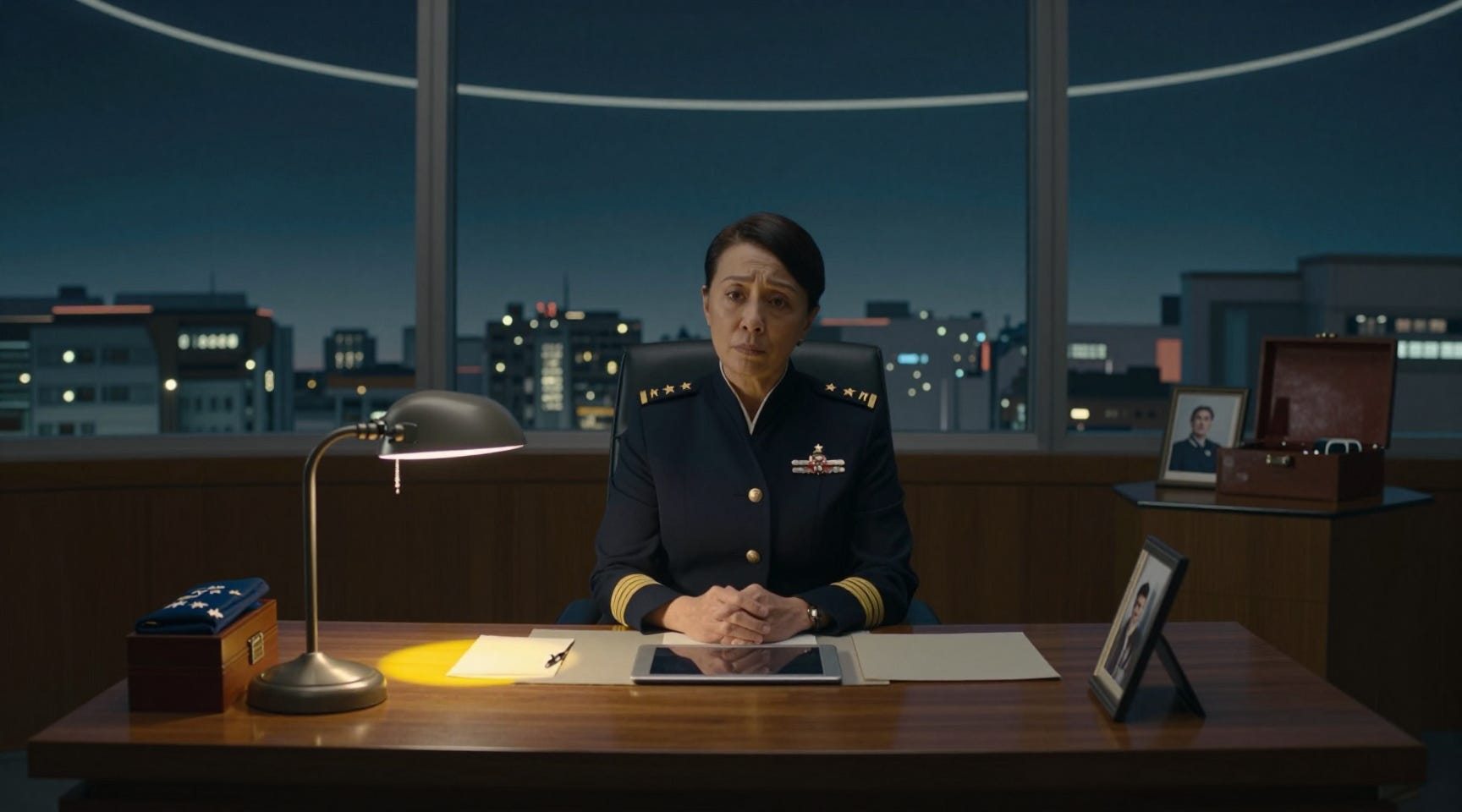
The office was on the twenty-second floor and faced north over the reconstruction grid. She closed the door. She did not turn on the overhead. The desk lamp threw its small yellow circle over the blotter, and she sat down inside the circle, and she opened the blank document she had been opening, in one form or another, for two years.
She wrote one line.
Because we cannot afford to be wrong about a silence.
She read it. She read it twice. She read it the way she had read every version of it she had written in two years, looking for the place where the sentence stopped being a draft and became a paragraph. The sentence did not become a paragraph. The sentence sat on the page the way it had sat on the page every time, complete in itself, refusing to become the thing it needed to be in order to be said aloud.
She deleted it.
She tried again. The species that took us has not finished. She read it. She deleted it.
If we are wrong, we have spent three ships. If they are wrong, we have spent a planet. She read it. She read it a third time. It was good. It was the closest she had come. She deleted it because she could hear, in her own ear, the senator from Manila saying back to her, Admiral, you have built me a sentence. I asked you for evidence.
She closed the document without saving.
She went home.
The elevator down was empty.
She looked at her reflection in the polished doors the way she had on the way up, and she let herself, for the length of the descent, think about her grandchildren. The girl was nine and the boy was six and they lived in a rebuilt district of Cebu in a house her son had bought with the back pay she had refused to spend. The girl had asked her, at the last visit, what an admiral did. Helena had told her: I help build the ships that watch the sky. The girl had thought about it. The girl had asked: What are they watching for?
Helena had given the girl the answer she was allowed to give.
The elevator slowed. The doors did not open yet.
In the dark polished steel the woman in the reflection was a woman who had spent eleven years building a fleet against a thing she could not prove, for a planet that had begun to forget, and who would, in the morning, return to the hearing room and do it again.
The doors opened.
She stepped out into the lobby and the city beyond it, the one she had helped rebuild, and she went home to write the next year’s budget.
If you enjoyed this story, you can follow the main story arc in The Exodus Rush, the first book in The Vethrak Requiem series.