


Ji-woo touched Dr. Molefe’s raised finger, then her own nose, five times without missing.
Molefe changed hands. Ji-woo followed the movement across her field of view and repeated the sequence. Her arm carried a fine tremor from the shoulder down, but her fingertip landed where it should.
“Ninety-eight percent,” Molefe said, reading the pulse oximeter. “That tells me you are carrying oxygen. It does not tell me the carbon dioxide left you unharmed.”
She checked the capnography trace from Ji-woo’s nasal sampler, then opened the blood-gas result taken after the rescue. The carbon-dioxide value had fallen since transfer. It had not returned to Ji-woo’s baseline. Molefe asked her to state her name, location, and the last task she had performed before the door closed.
“Temporary sensor brace. Structural mount inspection. No adjustment to the loaded support.”
“Headache?”
“Four.”
“It was six twenty minutes ago.”
“Still four.”
Molefe pressed two fingers against Ji-woo’s wrist while the monitor counted a rhythm of its own. “Ten minutes at the table. Seated and clipped. If the headache rises, your hands stop answering together, or you lose the order of an event, you return to the cot.”
“The order is the point.”
“The order will survive eleven minutes. You may not.”
Ji-woo unclipped from the cot rail. Molefe kept one hand on her transfer tether until Ji-woo secured it to the evidence-table ring.
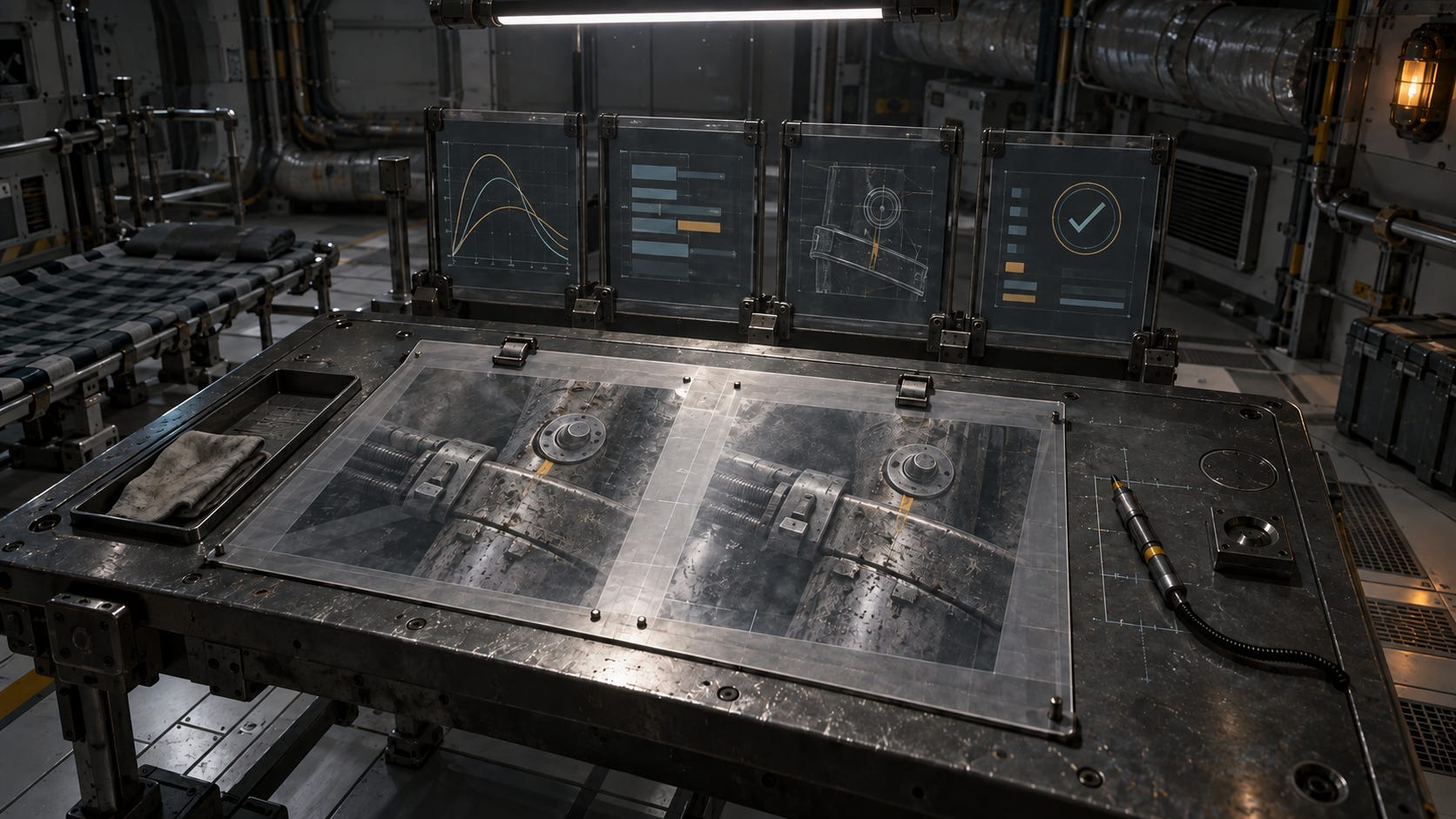
The temporary infirmary occupied a sealed work bay beside the damaged branch. Nothing rested loose. Slates sat in rail clamps. The evidence table had been bolted through its legs and fitted with two body straps for anyone working without locked boots. Ji-woo fastened one across her hips.
Kavita Nair had arranged the records in four vertical panes. The recovered inspection image occupied the first. The current photograph occupied the second. Pressure history and command receipts filled the others.
Ji-woo took the grease pencil.
The recovered image showed the brace before the fresh buckle. Dust lay in a gray fan around the upper washer, except for a clean crescent where the washer had once covered the frame. She laid a transparent copy over the current photograph and aligned three fixed points: the lower bolt, the cable bracket, and a scored edge on the duct flange.
The brace did not align.
She marked the earlier washer position on the overlay, then drew a second line at its present edge. Five millimeters separated them. The lower flange had shifted less, which meant the brace had rotated before its final displacement.
“Pre-strike?” Kavita asked.
Ji-woo checked the timestamp against the local reader’s acquisition clock and the maintenance clock correction. Both sat inside the image record.
“Before Strike Day One. Before the structural alarm. The drift existed when this image was taken.”
She opened the brace work order. Replacement had been scheduled, postponed, and returned to the queue without a completed inspection attached. The image should have traveled with that order. It had remained in the local cache instead.
Ji-woo circled the clean crescent.
“This proves movement. It does not prove dust caused the movement.”
A strike representative leaned against the far rail. “The shutdown loaded the frame.”
“The strain kept rising after fan vibration fell. The brace and the air failure are separate tracks.”
She brought the pressure history forward.
Bank C’s isolation at 0413 earlier in the strike appeared as one narrow interruption. One bank offline. Bank D carrying station flow. Eleven minutes before restoration. No command signature RC-7316.
The Strike Day Fourteen shutdown sat farther right at 1816. Two trains on Bank D’s labor-ring branch had accepted a remote isolation under RC-7316. That command staged the interruption. It did not create the filter loading already present.
Ji-woo overlaid the differential-pressure record. The maintenance summary listed one hundred twenty pascals. The local instrument had recorded three hundred sixty before the command reached the trains. Missed cleaning and deferred replacement had packed the filters with dust while the posted contingency continued to assume clean media and rated bypass flow.
“The shutdown model allowed four hours,” management counsel said through the table speaker.
“The clean-filter model allowed four hours.” Ji-woo traced the actual curve. “At three times the recorded resistance, the remaining bank had no clean reserve to absorb the transfer. Access restrictions delayed the crew carrying replacement media. Reduced reserve had already been accepted. Once the branch stopped, every workaround loaded capacity the system no longer had.”
She marked the point where the pressure curve bent away from the contingency.
“This is runaway capacity loss. Compounding loss, not an explosion. Dust made a controllable shutdown uncontrollable.”
The structural trace remained beside it. Its increments continued after the fans stopped.
“Brace drift narrowed the return path and threatened the duct. Dust consumed air capacity. They met in the same emergency. One is not evidence for the other.”
Kavita moved four records into a row.
Procurement had deferred the filters. Maintenance scheduling had postponed the brace replacement. Operations had accepted reduced reserve. Security had restricted the logs after the earlier credential incident. Each record carried a valid signature at a different level. No page contained the whole risk.
The fifth record came from the recessed reader.
Its access history showed a hold applied by an operations-security review function under delegated authority. The same session excluded the inspection image from the routine maintenance packet. The credential identified a duty function and authorization scope. It did not identify the person using it.
The strike representative pointed to RC-7316. “Same office had command access.”
“Access is not use,” Ji-woo said. “This proves who could apply the hold and who removed the image from the packet at the function level. It does not prove which person sent the command.”
“Someone did.”
“Yes.”
“Then name the office.”
Kavita kept her hand off the pane. “The office is in the record. The person is not.”
Management counsel opened a proposed summary beneath the evidence. A staged environmental interruption exceeded modeled duration due to degraded maintenance conditions. Individual responsibility remains under review.
Ji-woo read it twice. Every word could survive a hearing. The sequence could not.
The strike representative offered another sentence. Operations security concealed structural evidence while disabling life support.
That version joined two acts the records had not joined.
Ji-woo pushed both summaries to the edge of the display.
“Keep the image with its timestamp. Keep the pressure history with the local readings. Keep both shutdown receipts so nobody turns them into one event. Keep RC-7316 as a command signature, not a person’s name. Keep the hold, the packet exclusion, and every approval in the order they occurred.”
Counsel’s voice tightened. “A release packet needs a readable account.”
“Then let the account point to the records. Do not replace them.”
Molefe tapped the table clock. Ten minutes.
Ji-woo capped the grease pencil. Her hand missed the clip on the first attempt. She stopped, placed it carefully, and transferred her tether back to Molefe.
Kavita locked the five panes into one evidence group. Raw image. Timestamps. Commands. Pressure history. Approvals. No culprit field appeared beside them.
The release field remained unsigned beneath Sigrid Hedlund’s authority. Counsel’s legal and regulatory warnings filled the pane beside it.
No single signature carried the whole failure. Together, ordinary signatures had spent the station’s margin, and none of them would leave the table alone.
If you enjoyed this story, you can follow the main story arc in The Exodus Rush, the first book in The Vethrak Requiem series.