


The diagnostic board showed green across every system on Vanguard, and Thomas ran the reactor calibration a second time anyway.
The first pass had finished in four minutes. Four minutes was correct for a cold reactor on station feed with no load variance. He knew the number was right before the board confirmed it, and he keyed the sequence again, because four minutes was too fast to trust after eleven weeks of readings that mattered.
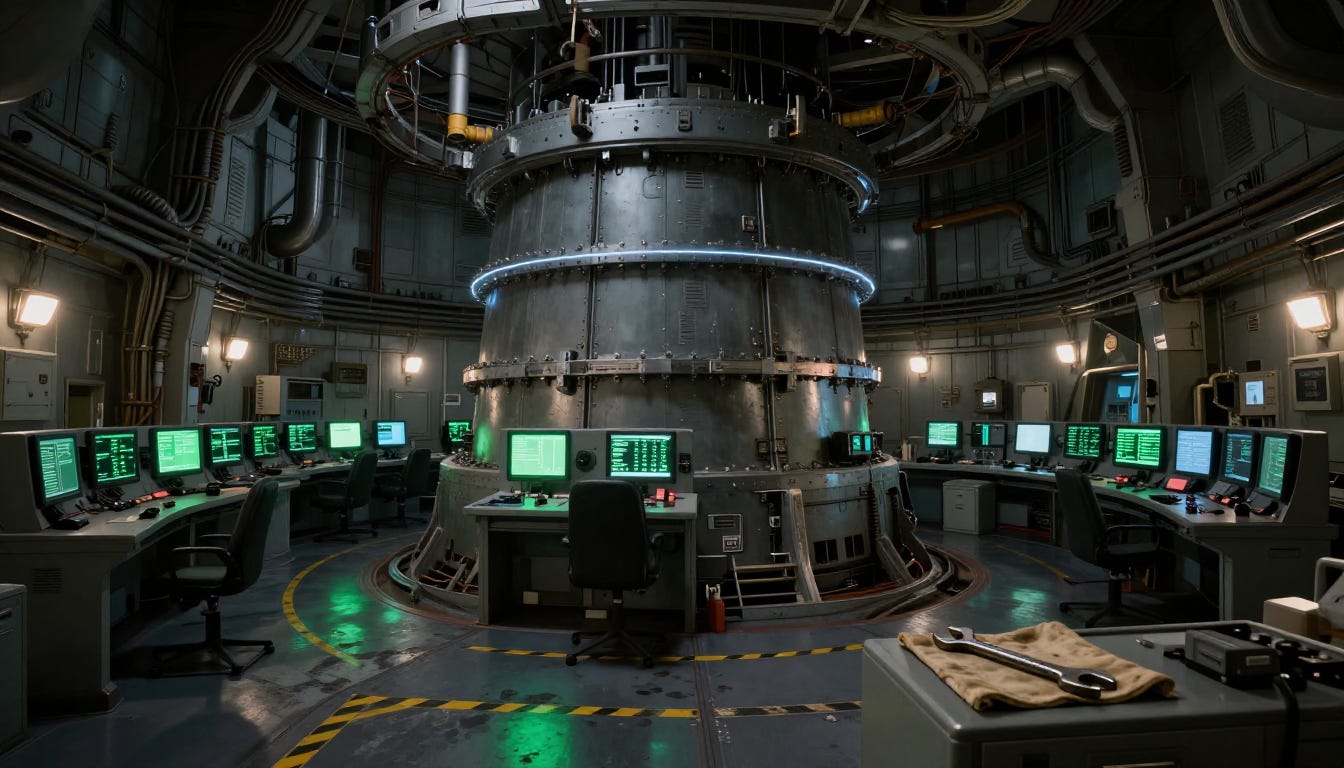
Around him the engineering bay held the deep quiet of a docked ship. The Cascade Reactor sat in standby behind its triple containment rings, the Cherenkov glow dimmed to a faint blue thread along the housing seams. Coolant ran on trickle circulation, a sound closer to breathing than machinery. The work lights burned at half power over stations nobody stood at. Two days ago the strike force had come home with a captured depot behind it and every hull intact. The bay had not been this quiet since before the force mustered.
“Second calibration pass complete,” TYCHE said from the console node beside him. “Results match the first pass to within zero point zero zero two percent. The probability that a third pass produces new information is below one percent.”
“Noted.”
A pause, precisely measured. “Would you like me to run one anyway?”
“No.” Thomas keyed the fold drive cooldown assessment instead. The drive had come out of the extraction runs with accumulated stress on the field coils, and the cooldown curve was the one place left on the ship where a number might still surprise him.
The curve came up clean. Decay within projection. Coil temperatures converging on the drydock handoff values ahead of schedule. He read it twice, hunting the anomaly, and there was no anomaly, and he sat back in the chair in front of a wall of green light telling him that nothing on this ship needed him.
The wrench lay on the console beside the input panel, wrapped in its square of oilcloth gone soft from decades of hands. He unwrapped it without deciding to, the way he did most things involving the wrench. The steel was old and clean, carrying the particular smoothness that tools take on when they outlive their owners. He picked it up. Turned it once, the way his father had taught him to test a bolt’s give before asking anything of it. Put it down.
The weight was familiar in a way the quiet was not.
Park had stood at this console. Months ago, a different lifetime of the war ago, when Vanguard sat between refits and the bay was almost this quiet, Park had pulled a stool to the reactor monitoring station, made Thomas sit on it, and told him to watch numbers that were not doing anything.
“Diagnostics tell you what the machine is doing,” Park had said, coffee in one hand, the other tracing the load-balance display without touching it. “They do not tell you how the machine is holding up under it. Watch the variance bands. See the flutter on the third coolant loop? That is not a fault. That is a personality. The machine tells you when it is unhappy. You have to learn to listen.”
Thomas had learned. He had gotten better at it than anyone had a right to expect from an engineer his age, through the extraction runs, through the nights when the fold coils ran hot enough to frighten the projections, through everything that came after the war took Park and left the bay full of systems that still spoke in the vocabulary Park had taught him.
He was still holding his coffee ration untouched. The truth arrived the way anomalies did, out of a clean board, without warning. He had spent months listening to machines because machines were easier to listen to than people. A reactor told you it was unhappy in variance bands and thermal flutter, and you adjusted a flow rate, and it stopped being unhappy. People told you in hesitations and half-finished sentences and letters they did not send. Park had told him, in a hundred small ways, that the mentoring mattered more to him than the machines did, and Thomas had answered by getting better at the machines. Kira had come back from the depot with something new and unspent behind her eyes, and Thomas had asked her about Hope’s power curves. He had not asked himself anything at all in longer than he could account for.
The hatch cycled at the far end of the bay. Shift change. A junior engineer came through with a pad under one arm, crossed to the duty station, and stopped at a respectful distance from the man sitting alone in front of a green board an hour before he needed to be.
“Sir. Anything you need before I take the watch?”
“No,” Thomas said. “Everything’s working.”
Her hand paused above the console, half a second, no more. He knew that pause. It was the pause of someone who had run on crisis long enough that a clean board sounded like a trap, someone waiting for the rest of the sentence, the fault behind the good news. He had been making that pause himself all morning, in his own way, with a calibration sequence run twice.
“That was the good news,” he said. “Your section’s numbers are clean. The power trunking work your team did before the muster held through every extraction run without a single fault. Good work.”
The pause let go of her. She stood a little differently, the way people did when the work was seen. “Thank you, sir.”
“The third coolant loop has a flutter in the variance band,” Thomas said. “It is not a fault. It is a personality. Watch it long enough and you will know this reactor better than the diagnostics do.”
She looked at the board with new attention, and Thomas recognized the expression from the inside: an engineer being handed a way of listening, years before she would understand what it was worth.
He rewrapped the wrench in its oilcloth, folded the corners the way his father had folded them, and set it in the top tray of his toolkit. The kit closed with a click that sounded loud in the standby quiet. He stood, and his back informed him precisely how long he had been sitting, and he took his cold coffee and walked toward the hatch.
The board behind him burned green from end to end. Nothing on the ship needed fixing. Somewhere between the console and the hatch he decided that learning what to do about the rest of it, the people, the letters, the questions he had not asked himself, was going to be a slower calibration.
He would run it as many times as it took.
If you enjoyed this story, you can follow the main story arc in The Exodus Rush, the first book in The Vethrak Requiem series.