


Park’s cabin aboard the Vanguard was three meters by four meters by two point five. It was larger than the ensign berths below, a perquisite of seniority, and smaller than it had looked in the deck plans he had read a year ago during construction. The desk folded down from the wall. The bunk was recessed into the opposite bulkhead. The shelf above the desk held three things: a tablet, a framed photograph of his father in his lieutenant’s uniform, and nothing else.
He sat at the desk. The chair did not adjust. It was bolted to the deck because everything on a warship was bolted to the deck.
He opened the document. The file was named weekly_letter. It was the same file he had been opening for twelve years. He had written the first letter at fourteen, a few months after the invasion, sitting at his mother’s kitchen table with the apartment in Seoul still smelling of the smoke that had drifted across the city from the fires in Incheon. He had not sent that one either.
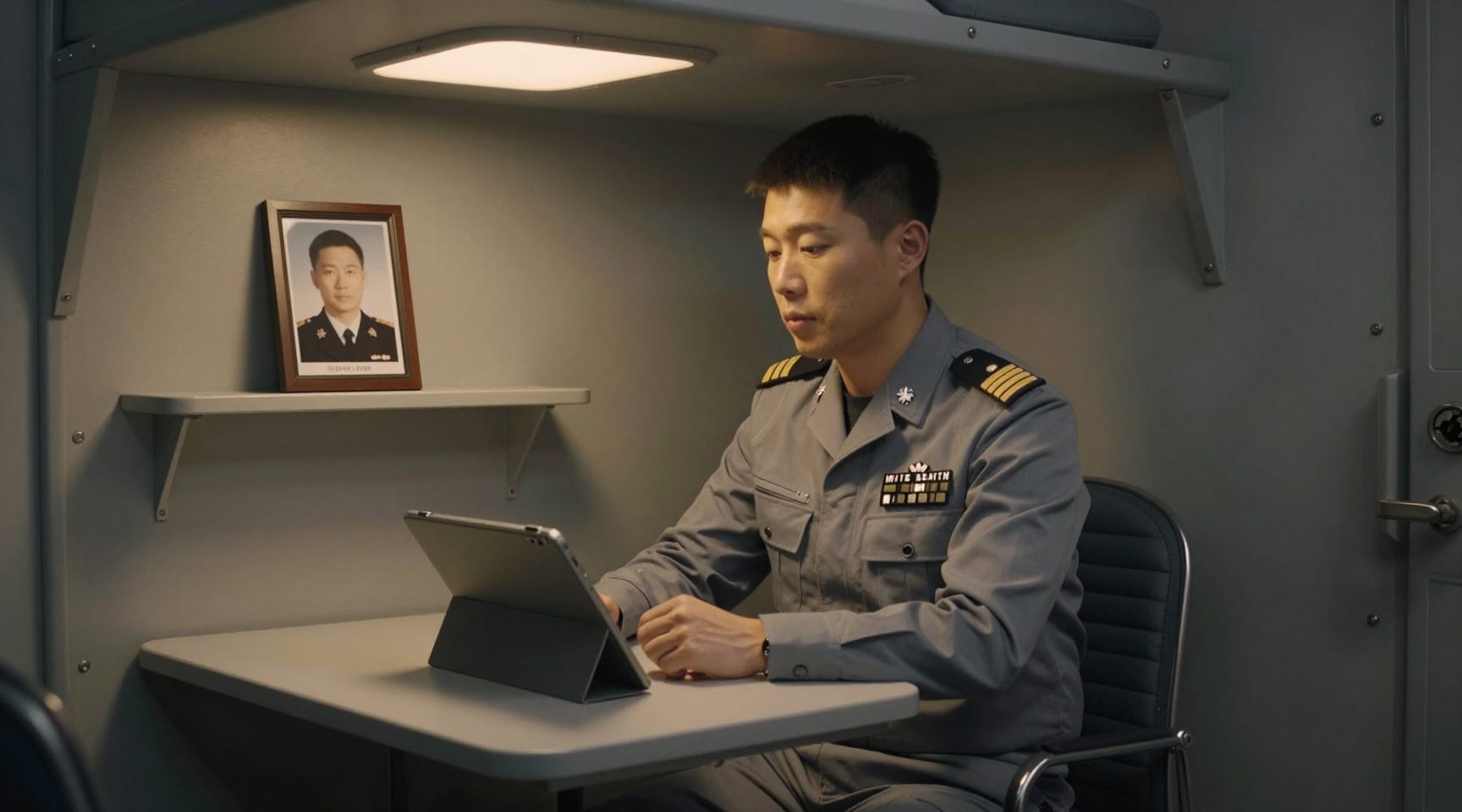
The cursor blinked on the empty page.
Mother,
He stopped. He always stopped at the greeting. Twelve years of weekly letters, and the salutation still took him the longest to write.
The ship is good. The reactor runs cleaner than I expected for a first-generation build. Lieutenant Commander Park, no relation, has asked me to write the cascade tuning protocol for the engineering manual. It is not the kind of work I thought I would be doing on a warship, but it is the kind of work that needs to be done. That is most of what I do now. Needs. Need has become the shape of my career.
He wrote the next paragraph without pausing.
I have an ensign. He has inherited his father’s wrench. He carries it wrapped in cloth in his pocket. He thinks I have not seen him reach for it. He has reached for it four times in the last week, each time in a moment of uncertainty, and each time his hand has settled after he touched it. I have not told him I noticed. He needs to discover what that means alone.
He read the paragraph back. He had not meant to write about Thomas. He had meant to write about the ship, about the patrol, about the ordinary things a son reports to his mother so she does not worry. The words about Thomas had written their own sentence.
His father was an engineer too.
He stopped. The cursor blinked.
He knew what came next. He had been writing variations of it for twelve years. The sentence that followed his father was an engineer too was always the same sentence, and he always deleted it before he finished the letter, and he always started a new letter the following week with the same intention to write something else and the same failure to accomplish it.
His father was an engineer too. He died during the invasion. That is why the ensign carries the wrench. That is why I recognize the shape of a hand reaching for something that is no longer there.
He did not delete it this time.
He looked at the photograph on the shelf. His father in his lieutenant’s uniform, the UEN dress grays that had been standard before the invasion, the old cut with the brass buttons and the stand collar. The photograph had been taken on the day of his father’s final deployment. Park remembered the morning. His father had pinned the collar tabs on in front of the hallway mirror, the same mirror Park had used every morning of his childhood. Fourteen years old, watching his father finish dressing, and Park had said something about the brass being crooked. His father had straightened it. He had said thank you. That was the last conversation.
The cursor kept blinking.
I think about him every day. I think about the morning he left. The brass was not crooked. I said it was because I did not know what else to say. I do not think about that in a way that hurts anymore. It is more like a part of the background, the hum of the ship that you stop hearing until it changes pitch. I have been waiting for the pitch to change for twelve years. It has not. I do not think it will.
He read the paragraph. He considered deleting it. His hand hovered over the trackpad.
He did not delete it.
I will write again next week.
He closed the document. He did not read it over. He saved it to the folder that already contained six hundred twenty-four others and closed the terminal.
The cabin was quiet. The ship hummed around him, the low bass frequency of the Cascade Reactor running at standby, the whisper of the circulation fans, the tiny clicks and flexes of a vessel settling into its first weeks of life. He sat for a moment with the desk folded down and the photograph looking at him from above it.
He had never sent a single letter. He had never read one back. Each letter was written and saved and left alone, a record of a conversation he was holding in a room with no one in it. He did not think of them as unsent. He thought of them as unfinished. There was a difference. He was not sure what it was, but the difference was there, and it mattered enough to keep him writing.
He pushed back from the desk. The cabin was three meters by four meters. The bunk was a meter wide. The ship was four hundred eighty-five meters long and carried four hundred fifty people. He was one of them. He had written six hundred twenty-five letters to his mother and sent none of them.
He lay down. The lights dimmed. The ship hummed.
Someday I will send one of these. Probably the last one.