


UNITED EARTH COUNCIL
SALVAGE PROTOCOL DIVISION
LUNA STATION ALPHA - RESEARCH ANNEX
CLASSIFICATION: Restricted
INCIDENT DATE: 14 March 2128
REPORT DATE: 16 March 2128
REPORTING OFFICER: Dr. Anaya Okonkwo, Lead Materials Scientist
SUBJECT: Catastrophic Failure During Alloy Analysis, Lab 7
SUMMARY:
At 0847 hours on 14 March, Research Team Epsilon experienced a catastrophic containment failure while conducting spectral analysis on Vethrak hull fragment V-447. The incident resulted in one fatality, two serious injuries, and the complete loss of Lab 7’s primary analysis equipment.
This report documents the sequence of events, immediate response, and recommended protocol revisions.
BACKGROUND:
Hull fragment V-447 was recovered from the Gobi Impact Site on 2 February 2128. Initial assessment classified the fragment as inert debris suitable for destructive analysis. The fragment measured 1.2 meters by 0.8 meters and weighed 47 kilograms, consistent with outer hull plating from a Vethrak cruiser-class vessel.
Research Team Epsilon, led by Dr. Marcus Chen, was tasked with determining the alloy composition and molecular bonding structure. The team had successfully analyzed eleven similar fragments without incident over the preceding six weeks.
SEQUENCE OF EVENTS:
0830: Team Epsilon arrived at Lab 7 and began standard preparation procedures. Present were Dr. Marcus Chen (team lead), Dr. Yuki Tanaka (spectral analysis), and Technician First Class Ramon Vega (equipment operation).
0842: Fragment V-447 was secured in the analysis chamber. Dr. Tanaka initiated the spectral scanning sequence.
0845: Anomalous readings detected. The fragment’s surface temperature increased by 12 degrees Celsius with no external heat application. Dr. Chen noted this in the session log and authorized continued scanning.
0846: Temperature increase accelerated. Fragment surface began emitting low-frequency vibrations. Dr. Chen ordered the scanning sequence suspended.
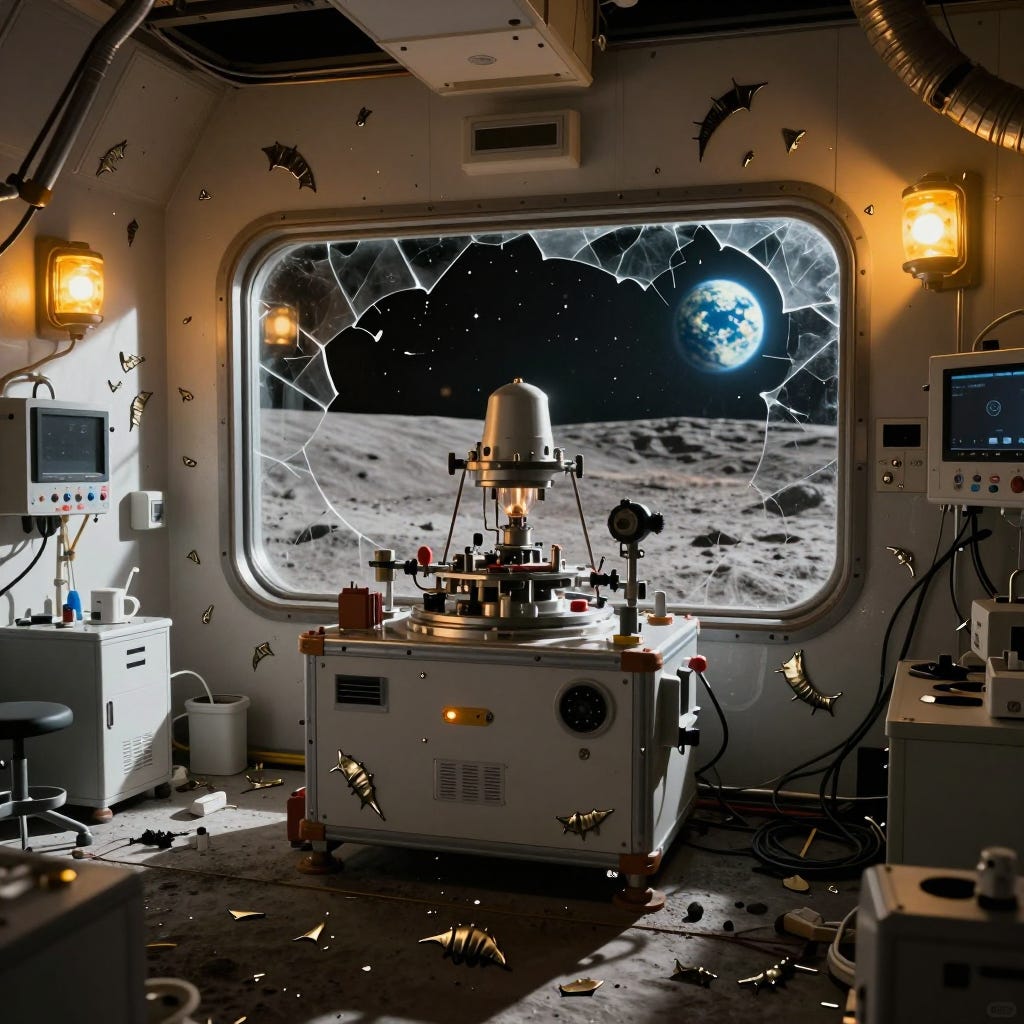
0847: Before shutdown could complete, the fragment underwent rapid structural transformation. The outer layer separated into approximately 200 individual scales, each measuring 4-6 centimeters. These scales accelerated outward at velocities estimated between 80-120 meters per second.
Technician Vega was struck by multiple scales and killed instantly. Dr. Tanaka suffered lacerations to the face and upper body. Dr. Chen was thrown against the chamber observation window by the concussive force, sustaining a fractured clavicle and severe bruising.
0848: Emergency containment protocols activated automatically. Lab 7 sealed. Medical response teams dispatched.
0856: Dr. Tanaka and Dr. Chen extracted and transported to Medical Bay 3.
0912: Technician Vega pronounced dead at scene.
ANALYSIS:
Post-incident examination of Lab 7 revealed that fragment V-447 was not inert hull plating as initially classified. Recovered scales show internal circuitry consistent with active defense systems observed on intact Vethrak vessels.
The fragment appears to have been a dormant reactive armor plate. The spectral scanning frequency, combined with the chamber’s electromagnetic containment field, triggered a defensive response pattern.
We did not recognize what we were holding because we had never seen it in isolation before. On an intact Vethrak hull, these plates lie flat, interlocked, indistinguishable from standard armor. Only when threatened do they respond.
The fragment waited. It waited through recovery, through transport, through six weeks of storage. It waited until we gave it a reason to activate.
IMMEDIATE ACTIONS TAKEN:
All salvage analysis operations suspended pending review
Remaining hull fragments quarantined in reinforced storage
New scanning protocols drafted requiring graduated frequency testing
Incident notification sent to all Salvage Protocol research facilities
CASUALTIES:
Technician First Class Ramon Vega
Age 34
Survived by spouse Elena Vega and daughter Maria (age 7)
Service record: 4 years Luna Station Alpha, previously 8 years Earth-based aerospace manufacturing
Cause of death: Multiple penetrating trauma
Ramon volunteered for Salvage Protocol duty the week it was announced. He said someone had to figure out how their machines worked. He said his daughter deserved to grow up in a world that could protect itself.
He was right. He was also the fourteenth researcher to die this year learning lessons the Vethrak never intended to teach us.
RECOMMENDATIONS:
Reclassify all Vethrak hull materials as potentially active regardless of initial assessment
Implement minimum 30-meter remote operation distance for first-contact analysis
Require graduated electromagnetic exposure testing before any intensive scanning
Develop new fragment classification system distinguishing passive structural materials from reactive defense components
Increase protective shielding in all analysis chambers to withstand fragmentation events
PERSONAL ADDENDUM:
I have written fourteen of these reports since joining the Salvage Protocol. Fourteen times I have documented how we reached into the unknown and had our hands bitten off.
We cannot stop. Every fragment we study, every system we decode, every principle we extract brings us closer to understanding. Understanding brings capability. Capability brings survival.
Ramon knew this. He accepted the risk because the alternative, remaining ignorant while the Vethrak prepare their return, is no alternative at all.
I have approved the revised safety protocols. I have signed the condolence letter to his family. Tomorrow I will return to Lab 9 and continue our work.
We learn, or we die. There is no third option.
REPORT SUBMITTED:
Dr. Anaya Okonkwo
Lead Materials Scientist
Salvage Protocol Division
Luna Station Alpha
DISTRIBUTION:
Director Chen, Salvage Protocol Central Command
Dr. Vasquez, Research Safety Division
Commander Torres, Luna Station Alpha
[REDACTED], United Earth Council Security Committee
Author’s Note: This story takes place in Year 3 of the Post-Invasion calendar, during the early days of the Salvage Protocol. Humanity’s desperate effort to reverse-engineer Vethrak technology came at a steep cost. For every breakthrough, there were setbacks. For every discovery, there were casualties. The fourteen researchers who died that year were among the first in a long line of scientists, engineers, and technicians who gave their lives so humanity could learn to fight back.
If you enjoyed this story, you can follow the main story arc in The Exodus Rush, the first book in The Vethrak Requiem series.