


Samrawit Assefa left the source-identity panel closed. The plate in front of her required a forming history, a thermal history, and a match to the procedure already qualified. Its route into Site Anvil would tell her none of those things more reliably. She checked the engineering record again, then touched the local identifier on the restrained replacement section with her gloved finger. The tag and the record agreed. This piece had been worked and accelerated-cooled. The section waiting in the adjacent sling was normalized. Both belonged in Article Four. They no longer belonged under one set of instructions.
Beyond her console, Slip Two’s lamps picked out the gaps Tuva had cut through the flawed transitions. Captured sample containers lined a rack beside Samrawit’s knee restraint. Each held a removed section with its location and orientation preserved. She had inspected the exposed boundaries against Wanjiku’s scans before the repair team arrived. The gaps were inconvenient and exact. Nothing in the new record asked anyone to remember which bright edge had once been trusted on the strength of an incomplete receiving summary.
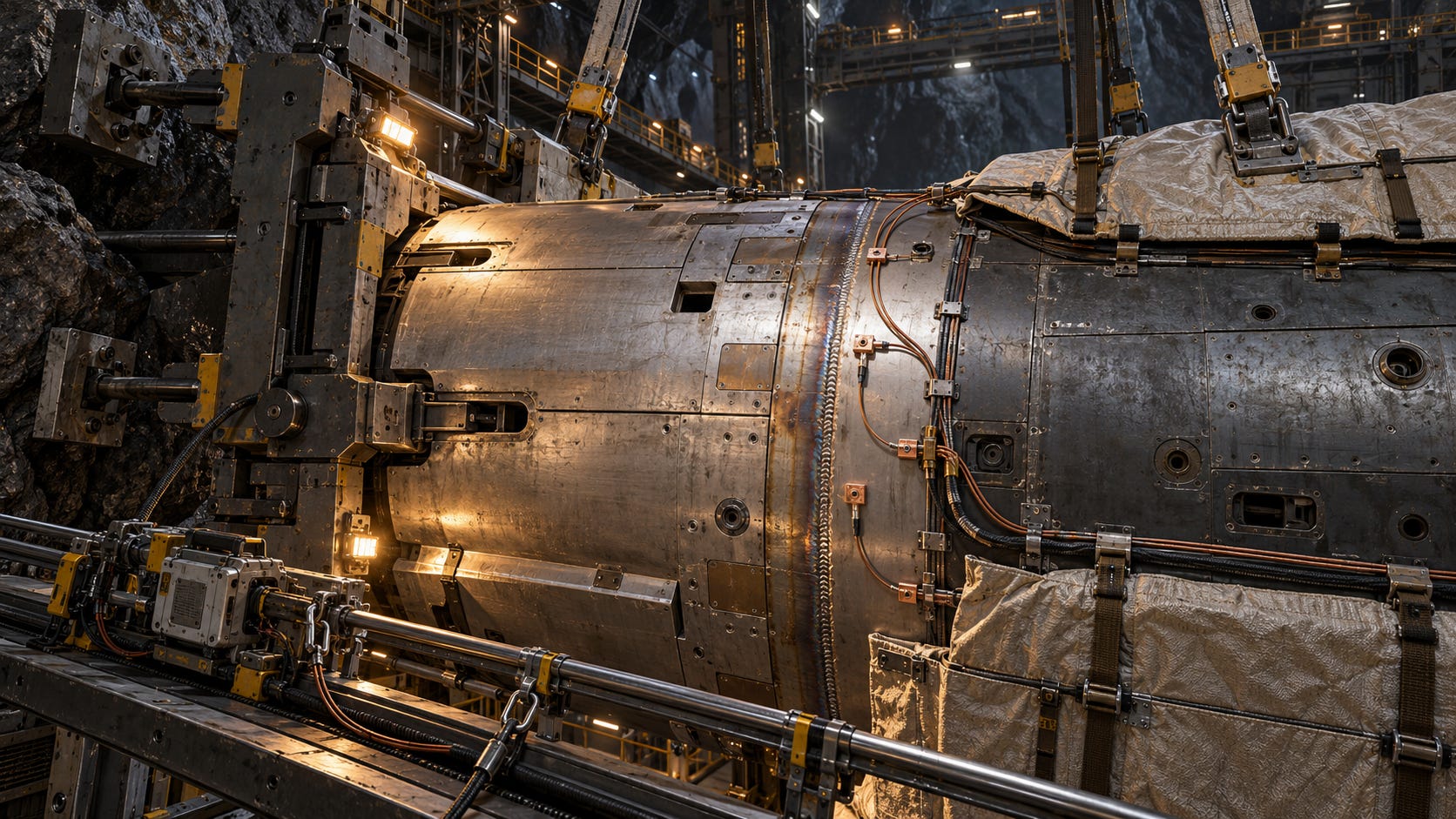
Tuva drew herself along the scaffold by its handholds and stopped beside the first replacement. A rigger steadied it with opposing restraint lines while another adjusted the fixture. Samrawit compared the recorded working direction with the physical orientation marks. The plate was turned correctly; the restraint shoes were still arranged for the convenient approach.
“Second shoe needs the other position,” she said.
The rigger looked from the fixture to the clearance beneath the scaffold. Moving it would leave less room for the welding head. Tuva brought the qualified joint drawing onto her tethered screen, checked it, and shifted a tool carrier out of the way.
“We’ll reach it from here.”
Samrawit watched the shoe settle into its approved location. She entered the check before the assembly covered the reference marks. The restraint arrangement had been part of the representative mock-up, not an accommodation to be reconsidered wherever an arm could fit more comfortably. Tuva waited for her confirmation before securing the final clamp.
The first joining pass threw a hard light across the captured tools. Samrawit followed the measured heat input rather than the brightness. Current, travel, and the temperature between passes each had a place in the procedure. A steady hand could still put an incompatible thermal path into sound material if the instructions were wrong. This time the instructions distinguished the material histories, and she could see the measurements that showed whether the work followed them.
Tuva paused at the next checkpoint. The interpass reading was inside the permitted band. Samrawit checked its channel against the sensor map, confirmed it, and released the next step. The riggers moved only the fixtures specified for that stage. At the normalized section, the treatment sequence changed. No one copied the preceding settings merely because both pieces would become the same barrel.
By the time the final joining record closed, Samrawit’s shoulders ached against the restraint harness. The replacement transitions looked ordinary beneath their leads and insulating covers. She could still identify each population from the record. The finished surface alone would never have told her enough.
The controlled-cooling display changed color at the edge of her vision. Slip Two’s available power had dropped to the next scheduled allocation. The cooling controller was still within its operating envelope, but the margin before the next yard load block had narrowed. The actual temperature trace had begun to fall more slowly than the planning curve.
Samrawit brought the channels forward. The sensor at the slowest qualified location remained above the threshold for advancing the sequence. Its neighboring channel agreed closely enough to rule out the first easy explanation. She checked the power-event timestamp against both readings and kept the stage open.
Cho’s voice arrived over the work circuit. “The tool block starts in eleven minutes. Are we finishing inside that?”
“The estimate says yes. The joint doesn’t yet.”
He pulled alongside the console using the rock-mounted rail. Samrawit moved one hand off the screen so he could see the measured trace rather than the projected completion. His boot found the vacant restraint beside hers. Beyond him, the scaffold crew had secured their tools and were waiting for permission to remove part of the cooling equipment.
“The hold has had its time,” Cho said.
“It has had the planned time.” She enlarged the remaining segment of the qualified path. “This channel has not reached the next condition. If we shorten it, we won’t have the procedure we qualified.”
“How much of it do we repeat?”
She studied the recorded temperatures before answering. The permitted path had not been exceeded. The equipment retained enough control to continue the hold. The dip had cost margin, not yet invalidated the work. Calling it a failed cycle would be as inaccurate as declaring it complete.
“None, if we keep this stage controlled until the condition is met. If we give away the remaining power now, I can’t sign that statement in advance.”
Cho held the rail while the curve added another measured point. Samrawit resisted the impulse to supply a more comfortable finish time. She could estimate the interval. She could not turn that estimate into a reading.
He opened the yard schedule and called construction control. The noncritical tool block could move; its crew would spend the interval preparing work instead of drawing the assigned load. Cho named the affected block, obtained acknowledgment, and left Slip Two’s thermal allocation in place. Samrawit attached the authorization to the running procedure record. It belonged beside the temperature history, where the next person could understand why the planned and actual times differed.
The crew on the scaffold received a new instruction to maintain the equipment configuration. Tuva clipped her tool carrier back to the rail. She did not ask Samrawit to round the remaining interval down. The smallest repairs had already consumed more attention than the original broad category had allowed for the whole joint.
A notification offered to replace the planning trace with the completed execution curve once the run closed. Samrawit left both visible. The original estimate, the power change, Cho’s adjustment, and the measurements were different kinds of information. A clean final summary could conceal how closely the schedule had pressed against the process. She added the event reference to the permanent repair package and checked that the earlier entries remained.
When the last controlling channel reached the qualified threshold, she verified the required hold conditions and completed that stage. The equipment came away in the recorded sequence. Wanjiku’s team prepared the immediate ultrasonic examination, checking their reference before moving across the rebuilt transitions. Samrawit watched from the console as the inspection coverage filled in. No reportable indication appeared in the examined repair zones.
Tuva looked over from the scaffold. “Clean?”
“Immediate examination is clean,” Samrawit said. “The interval starts now.”
She entered the completion time and set Article Four’s disposition to hold for delayed examination. The structural-release field remained untouched. Wanjiku would need the delayed examination and the complete proof sequence before that field could change. Samrawit saved the immediate results alongside the thermal record rather than allowing them to stand in for it.
Cho released the postponed tool block. Farther along Slip Two, an idle work lamp brightened over the next fixture. On Samrawit’s display the cooling curve had reached its required line. The bend where the power had changed remained visible behind it, with the yard’s waiting time recorded beside the metal’s.
Author’s note: This story continues The Yard That Wasn’t There at Site Anvil in late Year 3. Article Four remains on hold for delayed examination.
New to The Vethrak Requiem? Start with The Exodus Rush, Book 1, where humanity fights for survival after an alien invasion using technology it barely understands. These short stories explore the wider universe; the novel begins the main story.