


Cho took his hand off Slip Three’s power allocation before he could make the board look better.
Its ventilation demand occupied the same strip he needed for Article Four’s coupons. Removing it would leave room on the screen. Inside the bay, workers would still breathe the air they had used, and the filters would still need their regeneration cycle.
He locked the environmental block and moved his thumb elsewhere.
Four slip boards crowded the construction-control wall. Slip One needed the crane spine for a pressure frame already waiting in its transport restraints. Slip Two held Article Four, a short structural barrel meant to join two pressure hulls at another assembly site. Slip Three needed clean air before its next crew entered. Slip Four had labor booked against fasteners that had not arrived.
Below them, Bay Three’s propulsion-test draw cut across the next high-output block.
The reactor could supply each request. It could not supply them together.
A crane operator called from the spine. “Slip One frame remains secured. We have the rigging crew for another hour.”
“Keep it secured. No lift until I return the lane.”
“Slip Four wants the same crew.”
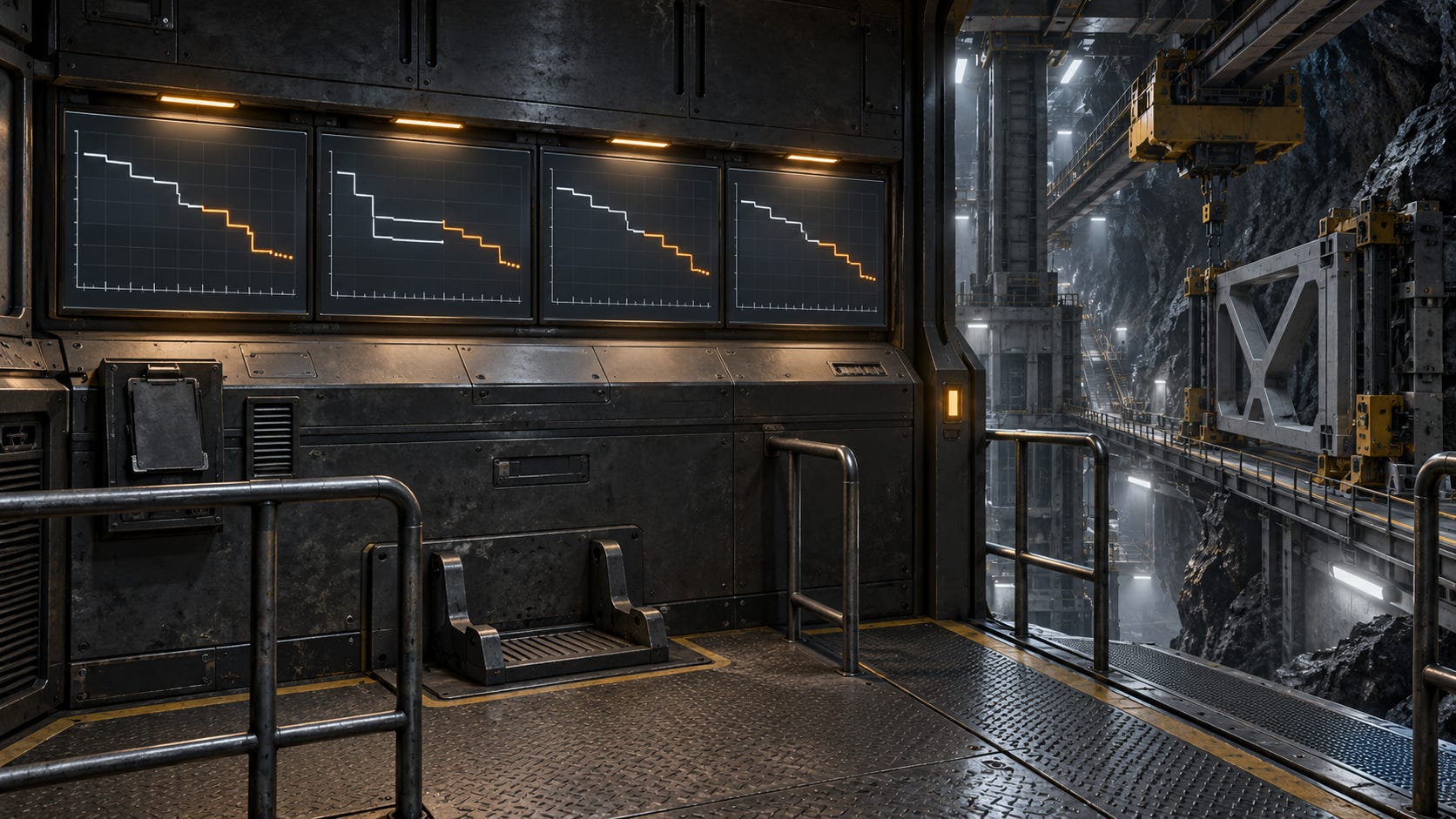
Cho pressed his boot into the control-station restraint. The worn padding pinched through his sock. “Slip Four still has no fasteners. They can keep wanting.”
The operator acknowledged. Cho opened Article Four’s work package again.
Same-lot fabrication complete. Mixed transition held. Coupon review pending.
The entries had authors, times, and limits. None offered him a fault he could order someone to correct.
He secured his slate, released the restraint, and pulled himself toward the crane spine.
The pressure frame filled the corridor-side view into Slip One. Its nearest corner stopped short of the crane’s shared travel envelope, restrained exactly where the operator had reported. A rigger waited at the rail with his gloves clipped to his harness.
Cho checked the lane interlock before passing. The crane carriage remained braked above them. Rock bolts held the track against the asteroid wall; every lift, whether it belonged to a small fixture or a hull section, had to travel through this throat.
Slip Two’s scaffold narrowed around Article Four. The barrel hung in secured slings above the main load cradle, anchored for eventual proof testing. Its transition-frame fixture was the only one in the yard large enough to keep this assembly aligned. Moving the barrel elsewhere would give Cho an empty slip and a barrel he could no longer work on.
Tuva Hawthorne clipped across to the access rail. Her torch remained parked.
“I need the fixture,” Cho said.
“I know.”
The red hold plate crossed the mixed joint. Its captive straps ran through the assembly-clamp eyes, tight enough to block a torch approach. The prepared edges remained covered beneath it.
He compared the clamp locations with the photograph in the package. Nothing had changed.
“Nobody asked you to remove it?”
“They asked whether preparation was finished. I gave them the hold entry.”
Cho brought up Samrawit Assefa’s split acceptance. Two plate rows. Two certificate links. All the written receiving limits satisfied, the hardness readings separated within those limits. She had accepted custody, not interchangeability.
The materials question carried Onur Tekin’s disposition. Origin and routing access denied. Technical question retained. No separate forming-history field available.
He could not solve that from the scaffold.
“Your seams are complete,” he said.
“The approved ones.”
“Yes.”
She kept one hand on the rail while he checked the hold’s removal condition. Materials release. The next shift could not supply it by arriving.
Neither woman had broken procedure. Neither had borrowed certainty from a deadline. Cho closed the package without changing its color.
“Keep the fixture assigned. I will find the cycle.”
Tuva’s free hand opened against her thigh, then returned to the rail. “Tell the next crew that.”
He entered the continuing fixture assignment before leaving her.
The remote schedule packet waited at construction control. Cho clipped into the station and opened it beside the four boards.
The outbound tug window had not moved. Every internal operation beneath it carried a suggested compression: preparation, fabrication, inspection, transfer. The packet allotted no additional power and no additional hands.
He expanded the outbound constraint. Approach clearance, tug endurance, remote handoff. There was no ordinary traffic desk he could call with a yard address and a request for two more days. The packet contained enough authority to fix the window and too little information to bargain with it.
The suggestions were suggestions. The tug window was real.
Samrawit answered his call from the materials station.
“What does another cycle buy?” he asked.
“A comparison using the paired stock. Preparation is queued. The proposed joint needs its full procedure window before examination.”
“Can you divide the powered part?”
“Not to fit whatever gaps remain.”
He held the slate against its bracket. “I am asking what can move, not asking you to change the procedure.”
“Preparation can move. The cycle cannot. Inspection follows afterward. A booked cycle is not a disposition.”
Cho placed her requirement on the board as one unbroken block. It overlapped Slip Three’s environmental demand and Bay Three’s next test.
He called the test controller.
“Your next high-output allocation. I need to exchange it for a coupon cycle.”
“The test crew is already assigned.”
“I will carry the lost crew time against construction.”
“We need a recovery slot.”
Cho examined the next clear block. Moving Bay Three there would push a tooling run beyond its planned shift. The tooling run could wait if its work remained restrained and the incoming crew accepted the handoff. Its operators could not work both shifts to make his change disappear.
He entered the recovery block, retained their rest interval, and sent the exchange for acknowledgment.
The controller returned it with the lost test time attached.
Cho accepted the cost. Bay Three’s block became the additional coupon cycle. Samrawit confirmed the allocation without changing the materials hold.
He pulled Slip One’s pressure-frame lift into the crane lane next. Its waiting riggers could finish that transfer inside their present assignment. Slip Four’s noncritical fixture lift slipped into the week containing the scheduled dark-state window.
The board rejected his first placement. Too much heat for the reduced-power envelope.
He shortened nothing. He chose the approved low-demand slot instead, leaving its handling time intact. The masked-radiator interval had bounded thermal storage, not a new supply of free hours. Cooling and environmental reservations remained locked around it.
Slip Four’s controller called. “We lose the scaffold crew before that lift.”
“Leave the fixture secured. Rebook them after the fasteners clear receiving. Don’t assemble around missing stock.”
“That pushes our access work.”
“Enter it.”
The board grew another amber tail.
Cho rubbed the pressure mark above his ankle. An empty square had seemed enough when the work was on a screen. In the spine it had a crew attached, a frame restrained beside a rail, a glove waiting for permission to close.
He completed the response to schedule control.
Article Four remains in sequence. Mixed transition on materials hold. Additional coupon cycle allocated. Inspection and release milestones unchanged in authority; dates contingent on disposition.
He removed the suggested compression from the inspection task and transmitted the packet.
The acknowledgment confirmed receipt. It did not grant another tug window.
Cho opened all four slip curves together. One frame advanced. One coupon block fitted. Beyond them, delayed tooling and access work extended into darker parts of the board.
He attached the exchange record to Article Four’s cost entry so the next foreman would not have to reconstruct where its hours had gone.
Four curves shifted under his hand. Every hour he saved came back as work waiting elsewhere in the dark.
Author’s note: This story continues the Site Anvil arc in late Year 3, as Article Four’s fabrication window narrows. The hidden yard can conceal its location, but it cannot conceal the cost of keeping unfinished work honest.
New to The Vethrak Requiem? Start with The Exodus Rush, Book 1, where humanity fights for survival after an alien invasion using technology it barely understands. These short stories explore the wider universe; the novel begins the main story.