


The emergency frequency went silent at 0417.
Priya Sharma had been listening to it for forty-seven days. Distress calls, evacuation orders, final transmissions from ships that would never dock again. The channel had become her heartbeat, a constant reminder that somewhere out there, someone was still fighting.
Now there was nothing. Static hissed through her headset like sand through an hourglass.
She sat in the communications bunker beneath New Delhi, three hundred meters of reinforced concrete between her and what remained of the sky. The bunker had been designed to survive nuclear war. It had survived something worse.
Her console showed the time: Day 48. The first day that wasn’t part of the Invasion.
They’re gone.
The words felt impossible. For forty-seven days, the Vethrak had burned across Earth’s surface, their ships cutting through humanity’s defenses like fire through paper. Priya had listened to Melbourne fall. To São Paulo. To the screaming static of Tokyo going dark. She had logged each transmission, catalogued each loss, because someone had to remember.
Someone had to count the dead.
Her shift had ended six hours ago. The relief operator, Lieutenant Chen, had died on Day 23 when a plasma strike collapsed the western access tunnel. There was no one to relieve her anymore. There was barely anyone left.
Priya removed her headset and set it on the console. Her ears rang in the absence of sound. She had forgotten what silence was.
The bunker’s emergency lighting painted everything in shades of amber and shadow. Water dripped somewhere in the darkness, a slow percussion that marked time the way her heartbeat no longer could. She had stopped feeling her pulse around Day 30. Stopped sleeping around Day 35. Stopped crying around Day 40.
There was a limit to grief. She had found it.
The console beeped. A new transmission, cutting through the static like a knife through fog.
“This is United Earth Council Emergency Broadcast. The Vethrak fleet has withdrawn from Sol System. Repeat: the Vethrak fleet has withdrawn. All military units stand down from active combat. Rescue and recovery operations are now priority one.”
Priya listened to the message loop three times. Her hands trembled against the console’s edge. Withdrawal. Stand down. Recovery.
We won.
The thought tasted like ash. Two billion people were dead. Every city she had ever visited existed only in memory now. The sky itself had changed color, choked with debris and smoke from fires that would burn for years.
This was what winning looked like.
She pushed herself up from her chair. Her legs screamed in protest; she hadn’t stood in eighteen hours. The bunker stretched around her, row after row of empty workstations where her colleagues had sat before the strikes began. Thirty-seven communications officers had reported for duty on Day 1. She was the last.
The corridor leading to the surface access point was dark. Emergency power had failed in the outer sections weeks ago. Priya walked by memory, her fingers trailing along the cold concrete wall. Each step took her closer to a world she no longer recognized.
The access ladder climbed forty meters to the surface hatch. Her arms burned as she hauled herself upward, rung by rung, muscles atrophied from weeks of sitting. The hatch wheel was stiff with disuse. She threw her weight against it until the seal broke with a gasp of equalizing pressure.
Priya emerged into dawn.
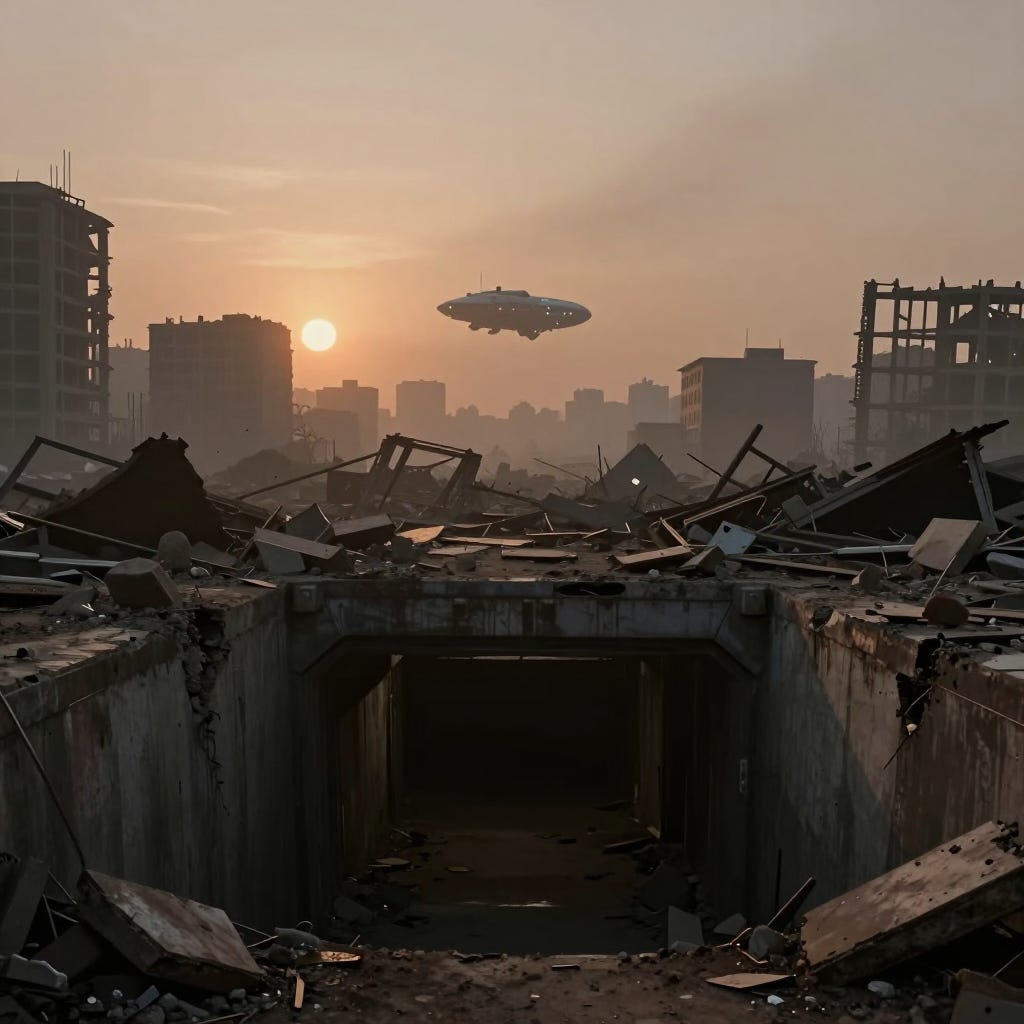
The sun hung low on the horizon, its light filtered through a haze of particulate matter that turned everything sepia-toned. Where New Delhi had stood, a field of rubble stretched to the horizon. Twisted metal. Shattered concrete. The skeletal remains of buildings that had housed twenty million people.
She had seen the satellite imagery. Watching it happen in real-time, reduced to numbers and coordinates on a tactical display.
Standing in it was different.
A wind came off the ruins, carrying the smell of char and something else. Something organic. Priya didn’t think about what that meant. She couldn’t think about it, not yet.
In the distance, a rescue shuttle descended through the haze. Its running lights blinked against the brown sky, a small point of color in a colorless world. The first responders. The body counters. The people who would spend the next decade cataloguing what humanity had lost.
Priya watched it land among the wreckage, watched the tiny figures emerge and begin their work. She should join them. She should help.
Instead, she sat down on the edge of the bunker hatch and watched the sun rise over the end of the world.
Day 48 had begun.
Somewhere beneath the rubble, her brother’s apartment building waited to be found. Somewhere in the ashes, her mother’s house had become a grave. Somewhere in the silence between transmissions, two billion voices had gone quiet forever.
Priya Sharma had counted every one of them.
Now, in the thin light of a wounded dawn, she began to count what remained.
This story takes place on Day 48 of Year 0, the first day after the Vethrak withdrawal. The bunker beneath New Delhi remained operational throughout the Invasion and served as a primary communications hub for the Indian subcontinent until proper infrastructure could be restored.