


Commander Sarah Chen settled into the pilot’s seat and tried not to think about the forty-seven engineers who’d died building this ship.
The cockpit smelled like fresh polymer and machine oil. Everything gleamed, untouched by the scars of combat or the wear of time. The flight controls responded to her grip with precise resistance, engineered tolerances that felt nothing like the salvaged Vethrak fighters she’d flown for the past eight years.
This was human work. Human design. The first military spacecraft humanity had built from scratch since the invasion.
“Flight, this is Talon One. Pre-flight checklist complete.” Her voice stayed level, professional. Twelve years of combat flying had taught her that much.
“Copy that, Talon One. You are cleared for undocking sequence.” The flight controller’s voice crackled through her helmet speakers. “Good hunting.”
Sarah triggered the docking clamps. The Talon separated from the construction bay with a gentle thump that traveled through the ship’s frame. She’d felt that same release hundreds of times before, launching into combat zones, rescue operations, desperate runs against impossible odds.
This felt different. This felt like hope.
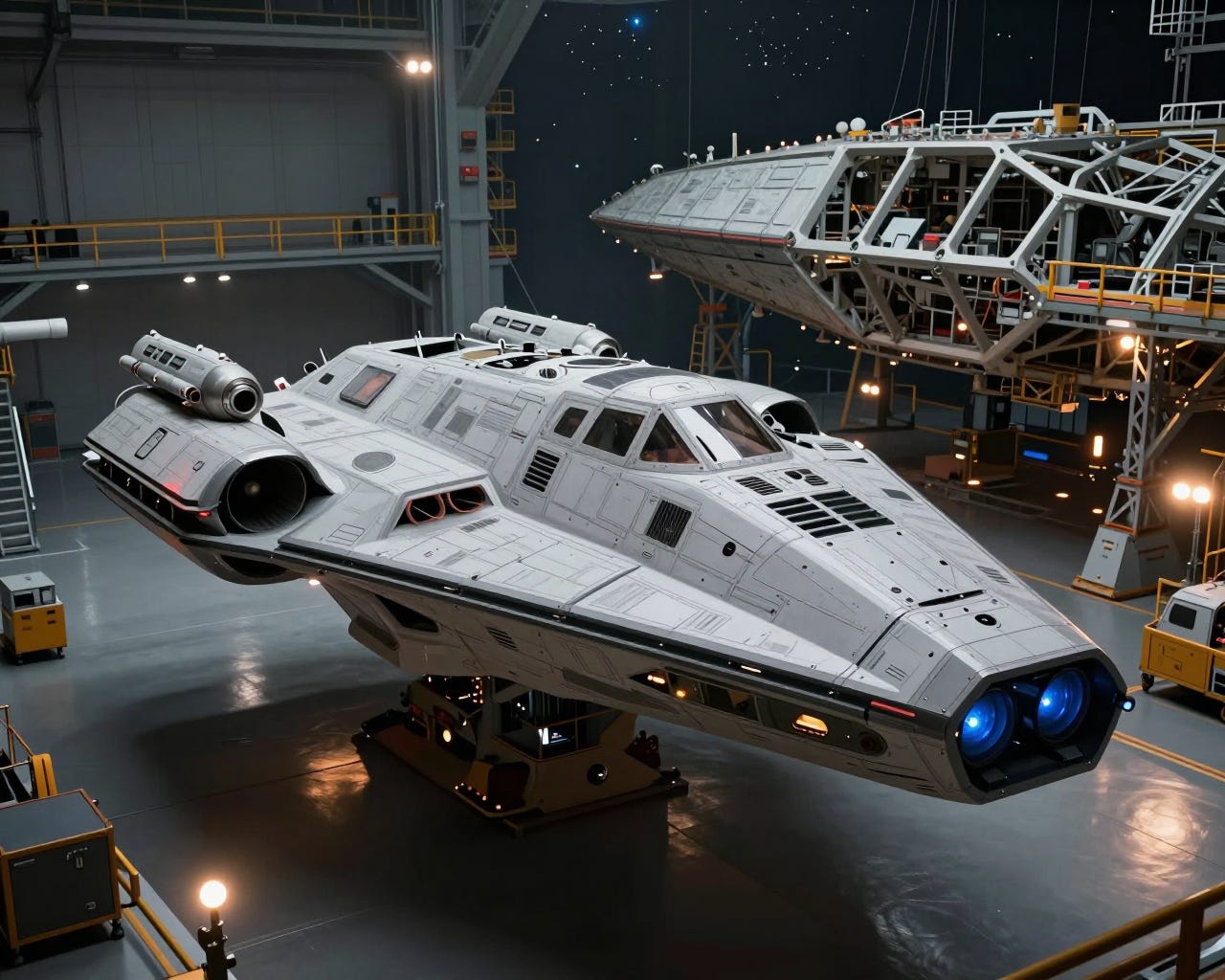
She fired the maneuvering thrusters, watching the construction station fall away behind her. The massive orbital facility had been humanity’s largest engineering project since Earth fell. Five years of work. Thousands of personnel. Resources scraped from a civilization still bleeding population with every Vethrak incursion.
All of it focused on building a single prototype. A fighter designed by humans, for humans. No salvaged alien technology. No repurposed enemy systems. Just raw human engineering, learned the hard way through twelve years of survival.
The Talon handled like a dream. Responsive, intuitive, every control exactly where it should be. Sarah ran through the basic maneuvers, testing the ship’s limits. Roll, pitch, yaw. Acceleration curves. Braking thrust. Everything responded with the kind of precision that came from proper design instead of battlefield improvisation.
“Flight, maneuverability tests complete. All systems nominal. Beginning weapons check.”
“Copy, Talon One. Weapons range is clear. You are authorized to engage practice targets.”
Sarah pulled up the targeting overlay. Six practice drones waited at three thousand kilometers, broadcasting friendly IFF signals. Standard gunnery exercise. Point, shoot, confirm hits. The kind of drill she’d run a thousand times.
She lined up the first target, finger resting on the firing stud. The Talon‘s main armament was a rapid-fire railgun, human-designed using principles reverse-engineered from Vethrak weapons. Magnetic acceleration instead of chemical propellant. Hypervelocity projectiles capable of punching through enemy shields.
In theory.
Sarah squeezed the trigger. The ship shuddered as the railgun fired, a controlled recoil that the stabilization systems absorbed in milliseconds. The targeting computer tracked the projectile, calculating impact time.
The practice drone exploded into debris.
She fired again. And again. Five more drones, five more hits. Perfect accuracy at extended range. The kind of performance that would have seemed impossible three years ago, when humanity was still flying captured enemy fighters held together with improvised repairs and desperate hope.
“Flight, weapons check complete. Target elimination confirmed.”
“Excellent work, Talon One. Stand by for reactor stress test.”
Sarah’s hands tightened on the flight controls. The reactor. The one system they’d built entirely from salvaged Vethrak technology, because humanity still didn’t understand the physics of cascade reactor design. Forty-seven engineers had died learning how to build this power plant. Containment failures, thermal runaway events, catastrophic malfunctions that turned pressurized chambers into bombs.
Forty-seven people, so that she could sit in this cockpit and prove their work hadn’t been wasted.
“Talon One standing by.”
“Increase reactor output to eighty percent. Maintain for sixty seconds.”
Sarah triggered the power increase. The reactor response was smooth, linear, exactly matching the predicted curve. She watched the temperature gauges, the containment field efficiency, the power distribution load. Everything held steady.
Sixty seconds passed. No alarms. No anomalies. The reactor purred at eighty percent output like it had been doing this for years instead of minutes.
“Flight, reactor holding stable at eighty percent.”
“Copy. Increase to one hundred percent.”
This was the moment. Full military power. The operating regime where every previous test reactor had failed. Sarah pushed the throttle forward, feeding maximum demand to the cascade reactor.
The ship surged forward, acceleration pressing her back into the seat. G-forces built, controlled by the inertial compensation system. The stars began to blur, relativistic effects creeping into her vision as the Talon pushed toward combat velocity.
The reactor held. Temperature nominal. Containment fields at ninety-seven percent efficiency. Power distribution balanced across all systems.
Sarah allowed herself a smile. The first real smile in months.
“Flight, we have successful reactor performance at one hundred percent output. All systems nominal. She’s flying like a dream.”
There was a pause on the other end. When the flight controller spoke again, his voice carried weight. “Copy that, Talon One. Welcome to the new fleet.”
She ran the rest of the test profile. Emergency maneuvers, system redundancy checks, combat acceleration profiles. Every metric came back green. The Talon performed exactly as designed, a purpose-built war machine that matched or exceeded the capabilities of the Vethrak fighters humanity had been flying for a decade.
Three hours into the flight, Sarah brought the ship around for final approach to the construction station. The facility hung against the stars, lights blazing from every section. She could see the secondary construction bay, already framing out the skeleton of Talon Two.
Twelve more ships in various stages of assembly. Enough for a full squadron, if the reactors held, if the weapons performed, if the human-designed systems could stand up to real combat instead of controlled tests.
Sarah lined up on the docking approach, flying manual because she could, because this ship responded to her inputs like an extension of her own body.
The docking clamps engaged with a solid thunk.
“Talon One secured. Shutdown sequence initiated.” She ran through the post-flight checklist, watching each system power down in sequence. The reactor dropped to standby mode, still running, still stable. Proof that humanity could build these things. Proof that they could fight back with their own weapons instead of scavenged enemy tech.
Sarah unstrapped from the pilot’s seat and floated through the airlock into the construction bay. Chief Engineer Ramos waited on the other side, gray hair pulled back, eyes red from too many sleepless nights.
“How’d she fly?” Ramos asked.
“Perfect.” Sarah pulled off her helmet, met the engineer’s gaze. “Every system performed exactly as designed. The reactor held stable through the full power profile. Weapons accuracy exceeded projections. She’s ready.”
Ramos’s shoulders sagged with relief that looked like it weighed a thousand kilograms. “Good. That’s good.”
Sarah thought about the forty-seven names on the memorial wall in the engineering section. People who’d given everything to make this moment possible. To prove humanity could stand on its own, could build weapons worthy of fighting back.
“They did good work,” she said quietly.
“Yeah.” Ramos looked at the Talon through the observation window, gleaming and pristine, humanity’s first real hope in twelve years. “They did.”
Sarah turned away from the ship, from the engineers celebrating in the background, from the proof that humanity was finally, slowly, clawing its way back from the edge.
She had forty reports to file. Telemetry to review. Performance data to analyze. Work that would help build the next ship, and the one after that.
Somewhere in the outer systems, Vethrak forces were still hunting the scattered remnants of humanity. Still killing civilians. Still burning through what remained of human civilization.
The war wasn’t over. Not by a long shot.
Sarah headed for the debriefing room, already thinking about the next flight, the next test, the next step forward.
One ship at a time. One victory at a time.
They’d get there.
Author’s Note: This story takes place in Year 12, representing a significant turning point in humanity’s technological recovery. The Talon prototype marks the first military spacecraft designed and built entirely by human engineers rather than relying on captured or salvaged Vethrak technology. While the cascade reactor still uses alien principles humanity doesn’t fully understand, every other system represents genuine human innovation. The forty-seven engineers who died during development are commemorated on the memorial wall at Orbital Construction Station Seven. Commander Sarah Chen would go on to command the first operational Talon squadron during the Battle of Proxima Station in Year 13.
If you enjoyed this story, you can follow the main story arc in The Exodus Rush, the first book in The Vethrak Requiem series.