


The coffee shop on the Prometheus civilian deck opened at oh-five-hundred. David arrived at oh-five-ten. Marcus was already there.
The corner table, the one with its back to the bulkhead and a clear line to the door. Marcus had chosen it without thinking about it, which meant he had thought about it for years. The cup in front of him was half empty and he was looking at it the way he looked at anything he had decided not to finish.
David got his own coffee from the counter. The barista was a civilian contractor who did not recognize either of them and did not care. Prometheus was full of officers now. The civilian deck had stopped noticing.
He sat across from his brother. The table was small. The distance was smaller than it had been in a long time.
“Morning,” David said.
Marcus nodded. He did not look up from the cup.
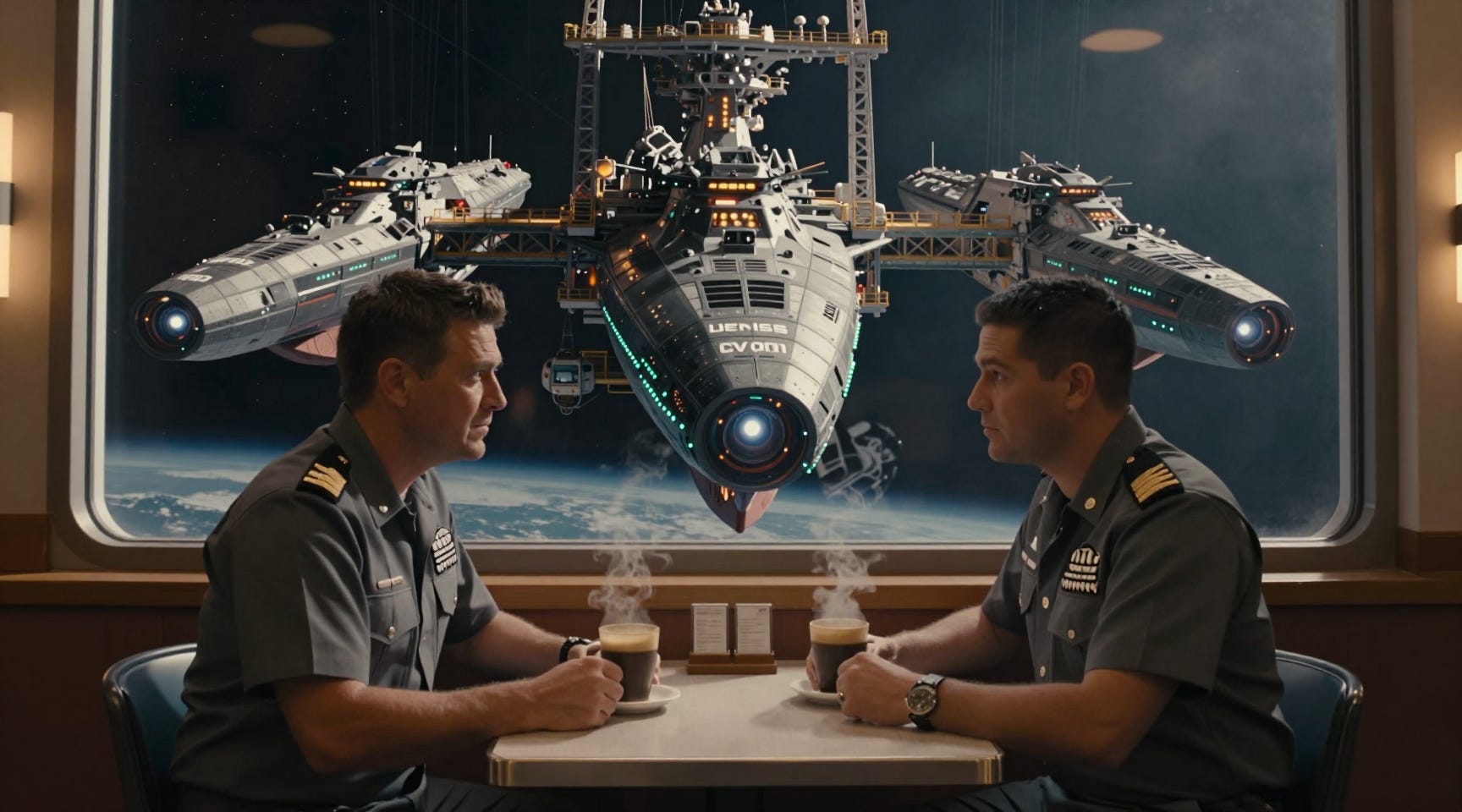
They drank coffee. The station hummed around them. The low constant vibration of a shipyard that had been running twenty-four-hour shifts for eighteen months. Somewhere three decks down, a welding team was laying plate on the Vanguard. Somewhere on the Hope, Kira Vance was probably running her third tactical simulation of the morning. The fleet was assembling itself around them in a thousand small sounds, and the Rivera brothers sat in a coffee shop and said nothing.
David was good at waiting. He had been good at it since he was twelve and Marcus was fifteen and their mother had told them both, in the kitchen of the house where they grew up, that some arguments could only be won by the person who did not need to win. David had not understood it then. He understood it now.
He had also spent twenty years learning that Marcus filled silence with decisions and decisions with forward motion and forward motion with whatever cost came next. The man across the table had not spoken first to anyone in a decade. David let him sit.
Marcus set the cup down. “You could have taken any XO billet in Fleet.”
The sentence arrived without preamble. David had expected it for three months. “I took the one I wanted.”
“You took the one with me.”
“I took the one where I could do the most good.”
Marcus looked at him. The hollow eyes did not change. They had not changed in twelve years. David had learned to read past them. The man behind the eyes was still there. He always was.
“I want you to push back on me,” Marcus said. The words came out evenly, rehearsed, the way Marcus said anything that mattered. “If something is wrong. If I am wrong. I want you to tell me. That is the job.”
David nodded. He understood the contract. He also understood the contract was not the hard part. The hard part was the moment that would come, months from now, when Marcus was running on three hours of sleep and the stimulants he would not admit he was taking and the thing that lived behind his eyes, and David would have to say no. Marcus would not want to hear it. The chain of command would collapse into two brothers in a kitchen twenty-five years ago, nineteen and twenty-two, shouting about something that did not matter because the thing they were actually shouting about was too big to name.
In that kitchen, David had won by losing. He had let Marcus storm out and he had cleaned up the broken mug and he had waited. Two days later, Marcus came back. He did not apologize. He helped their mother carry groceries. The fight was over.
That was how they argued. That was always how they argued.
“I will,” David said.
Marcus held his gaze for a moment longer. Then he looked at his coffee again.
They sat. The station hummed. A shift change passed outside the window: engineers in dark coveralls, heading toward the slips. The morning watch was beginning. David had an hour before he needed to report. Marcus had less.
He thought about the billet. He had been XO material for three years. He could have taken Vanguard. He could have taken Hope. He could have waited for a command of his own. The Fleet had offered and he had refused and they had offered again and he had named his terms. The terms were simple. He wanted Defiant. He wanted his brother.
The public reason was that Marcus Rivera was one of the best tactical minds the Fleet had produced and any ship under his command would need a steady XO who knew how to keep the bridge calm when the captain could not. The private reason was simpler and David had not said it aloud to anyone, including himself.
He said it now, silently, across the small table from his brother, who was looking at a half-empty cup of coffee and not preparing for the day ahead because Marcus prepared by sitting still and letting the weight settle into its familiar place.
I took this billet because I did not trust anyone else to be in the room with you on a bad day.
He kept that one. He kept it where he kept all the things that mattered and could not be said.
Marcus rose. He left a credit chip on the table. The coffee was still half full.
“See you aboard,” he said.
“See you aboard.”
Marcus walked out. He walked the way he had always walked: half a step ahead of wherever David was, as though the lead was not something he had taken but something that had fallen to him, the older brother, the first through every door.
David finished his coffee. He followed his brother’s back through the corridor traffic. In half an hour, they would both report to the Defiant‘s slip. Marcus would receive the command. David would assume the XO billet. The chain of command would formalize what had always been true: one brother leading, the other half a step behind, watching his back.
He rose. He left a chip of his own. The barista nodded.
He walked toward the slip.
The corridor windows looked out onto the great yard. Three ships hung in their construction cradles. Vanguard was nearly complete. Hope was still receiving her sensor arrays. Defiant sat at the center, her keel fully plated, her reactor core running at low threshold for final integration tests. She was the smallest of the three. She looked like she had been built to take a hit and keep moving.
She was his brother’s ship. She was his ship too.
He kept walking. The corridor curved. The slip doors came into view. Marcus was already there, standing at the airlock, looking up at the hull. He did not turn when David approached. He did not need to.
David took his place. Half a step behind. Right where he had always been.
If you enjoyed this story, you can follow the main story arc in The Exodus Rush, the first book in The Vethrak Requiem series.