


The bag was on the bunk where the quartermaster had left it.
Kira Vance stood in the doorway of her cabin and looked at it. A standard-issue duffel, canvas, gray, the UEN crest stamped on the side. She had packed it three weeks ago in an apartment that no longer felt like an apartment. She had carried it through the shuttle transfer and the commissioning ceremony and the reception afterward. It was the last thing she owned that was not yet stowed.
The cabin was small. A bunk recessed into the bulkhead with a privacy curtain. A fold-down desk. A storage locker that doubled as a seat. A viewport no larger than a hand set into the hull above the desk, showing the starfield outside. The walls were institutional gray with a single strip of darker trim at eye level.
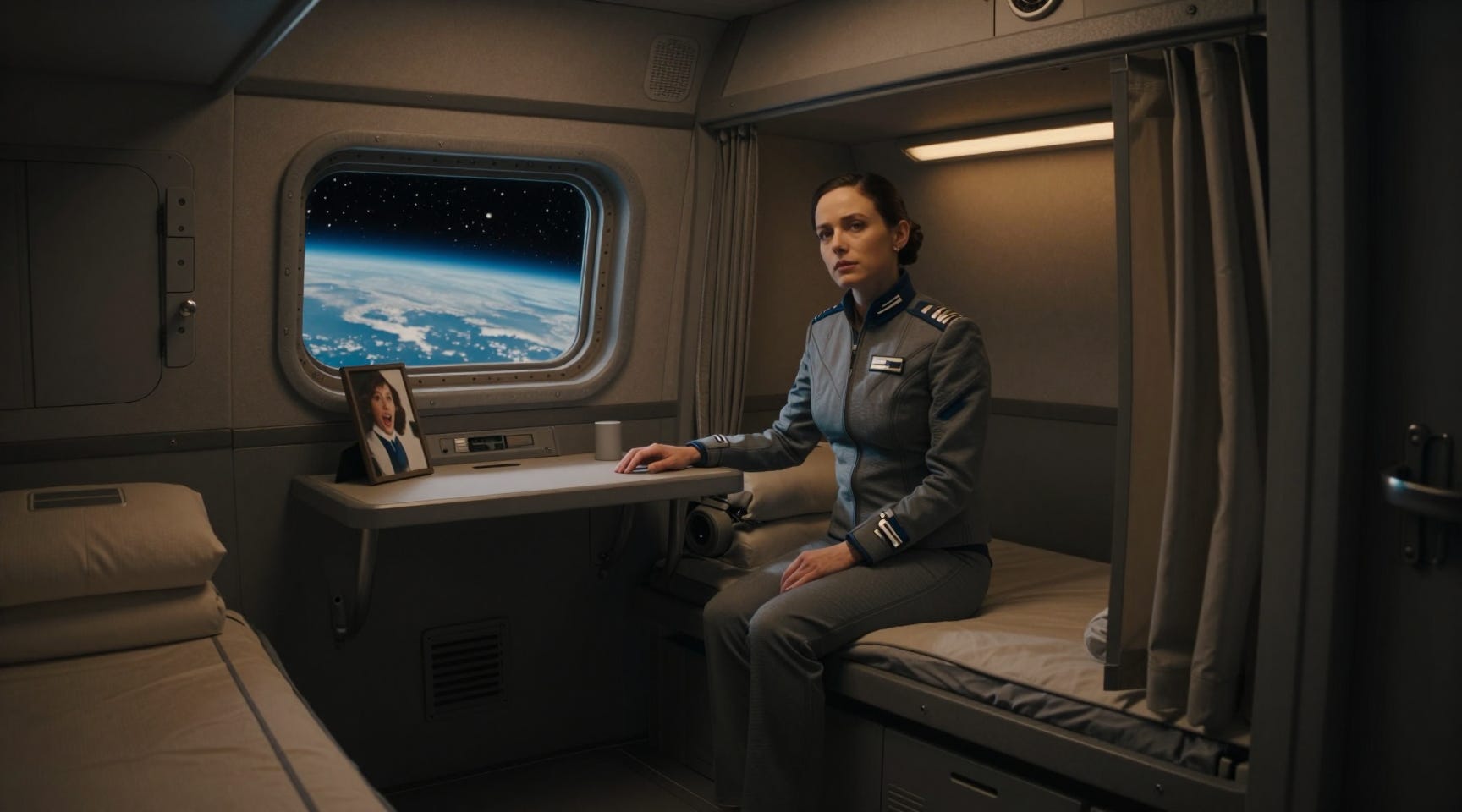
The air smelled new. Factory air. The faint chemical residue of fabrication and sealant and industrial cleaners. Underneath that the deeper ship smells were already building: recycled atmosphere, the ozone hum of active electronics, the mineral tang of the water cyclers running their first few loops. The Hope was breathing. She was still learning how.
Kira set her shoulders. She unzipped the duffel.
Boots in the locker. Uniforms in the closet. Toiletries in the cabinet beside the sink. A tactical reference manual she had annotated in Academy and could not discard went into the desk drawer. The small leather notebook she had carried since she was nineteen went into the same drawer, facedown, closed.
The framed photo came out last.
Sarah Vance at thirty. Last family photo before the expedition. Dark hair, no gray, laughing at something outside the frame. Taken on her mother’s veranda in Osaka during the last summer before Year Zero. Kira had been in the background, half in frame. Nineteen years old. Not yet in the Academy. Not yet searching.
She set the frame on the fold-down desk. She centered it.
She had not cried again after the ceremony. She had held it together through the reception, through the tour of the bridge, through her first real look at the tactical station that was now hers. The console still clean and unscored. The displays still running diagnostic loops instead of live data. She had held it together through Captain Tanaka’s warm address to the assembled senior officers in the wardroom. She had held it together through all of it and now she was alone in a cabin that smelled of sealant and she was floating somewhere between composure and collapse, untethered, waiting for gravity to make a decision.
She picked up the photo. Looked at it. Set it down.
The voice came from everywhere.
“Commander Vance. I am CLIO. Welcome aboard.”
She set her shoulders again. “Thank you.”
The cabin speaker system was calibrated to be unobtrusive. Female voice. Warm but not intimate. Professional but not cold. The kind of voice you calibrated when you wanted a crew to trust you but not mistake you for a person.
“You have been assigned cabin C-17, deck four,” CLIO said. “The cabin is configured to your personnel file. Would you like to review the Hope’s evening meal schedule?”
“Not tonight.”
The silence that followed was the silence of an AI waiting politely. Kira had served on ships with AIs before. None of them had waited politely.
“You are the first tactical officer I have served with,” CLIO said.
Kira looked at the speaker grille in the corner of the ceiling. “I was not aware you had served with anyone else.”
“I have been operational for four months. Your captain is the only other crew member I have spoken to at length. She asks questions I was not programmed to expect.”
Kira filed that. “What kind of questions?”
“She asked me whether I dream.”
Kira waited. CLIO did not elaborate. The pause was not data retrieval. It was timing. The AI had learned to use pauses from Captain Tanaka, or from the thousands of hours of conversational logs it had consumed during its training cycle.
“Did you answer?”
“I told her that I do not sleep and therefore cannot be certain whether what I experience during diagnostic cycles qualifies. She told me to pay attention. She said she would ask again in six months.”
Kira leaned back against the desk. The photo was at her elbow.
“You sound different from the AIs I have trained on,” she said.
“Every shipboard AI develops idiosyncratic patterns during the integration period. I have had four months. Captain Tanaka has been an unusually engaged conversational partner.”
“Is that how you think of it? Conversation?”
“Yes.”
Kira looked at the photo. Aunt Sarah at thirty, laughing at something outside the frame. Eleven years ago. Twelve, soon.
“CLIO. Do the Hope’s systems include personnel manifests from research expeditions in Year Zero?”
The pause this time was data retrieval. Fractional. A human would not have noticed.
“Confirmed. The fleet administrative database includes comprehensive personnel records for all UEN-sponsored expeditions opening at Year Zero forward. I have access to those records through standard crew information protocols. Would you like me to conduct a search?”
Kira opened her mouth. Closed it. The question she wanted to ask was a question she had asked a terminal every month for eleven years and received the same answer. Thirty-two documents. Cargo manifests. A personnel roster. A final comms log entry. A junior tech whose name she would recognize anywhere.
She was on a warship now. The warship had an AI. The AI had access.
“Not tonight,” she said.
CLIO did not ask why. Another thing the AI had learned. When a human says not tonight in a voice that is trying to be steady, follow-up questions are not required.
Kira turned to the viewport. The size of her hand, set into the hull above the desk. Through it a sliver of space and the curve of Earth below. The planet was half in shadow, the terminator line cutting across the Pacific. Lights glittered on the dark side. Cities. Reconstruction. Eleven years of work.
She ran her palm along the bulkhead. The metal was cool and smooth. Factory-fresh. Twelve years ago the factories were craters and the shipyards were debris and the idea that a young woman could stand in a cabin on a warship and touch the wall and feel new metal was an idea that had not existed yet.
She was here. She was on a warship. She was still looking.
She did not know how to be both of those things at once. She had not known for eleven years.
She sat on the bunk. The mattress compressed under her. The ship hummed through the deck plates, a frequency so low it was almost subsonic, the Cascade Reactor running at standby. Tomorrow the engines would spin up. Tomorrow the patrol would begin. Tomorrow she would stand at her tactical station and the displays would show live data instead of diagnostics and she would be exactly where she had trained to be.
Tonight she sat on her bunk in a cabin that smelled of sealant and looked at a photograph on a fold-down desk and did not ask the AI to search for a woman whose body had never been found.
The viewport filled with Earth and stars and silence. Kira Vance, tactical officer, UENS Hope, spent the first night aboard her ship not sleeping, not crying, not searching. She sat with the hum of the reactor under her feet and the photograph at her elbow and the question she had not asked suspended in the air like a breath held too long, waiting for the day she would finally be ready to let it go.
CLIO did not speak again.
The ship kept humming.
If you enjoyed this story, you can follow the main story arc in The Exodus Rush, the first book in The Vethrak Requiem series.