


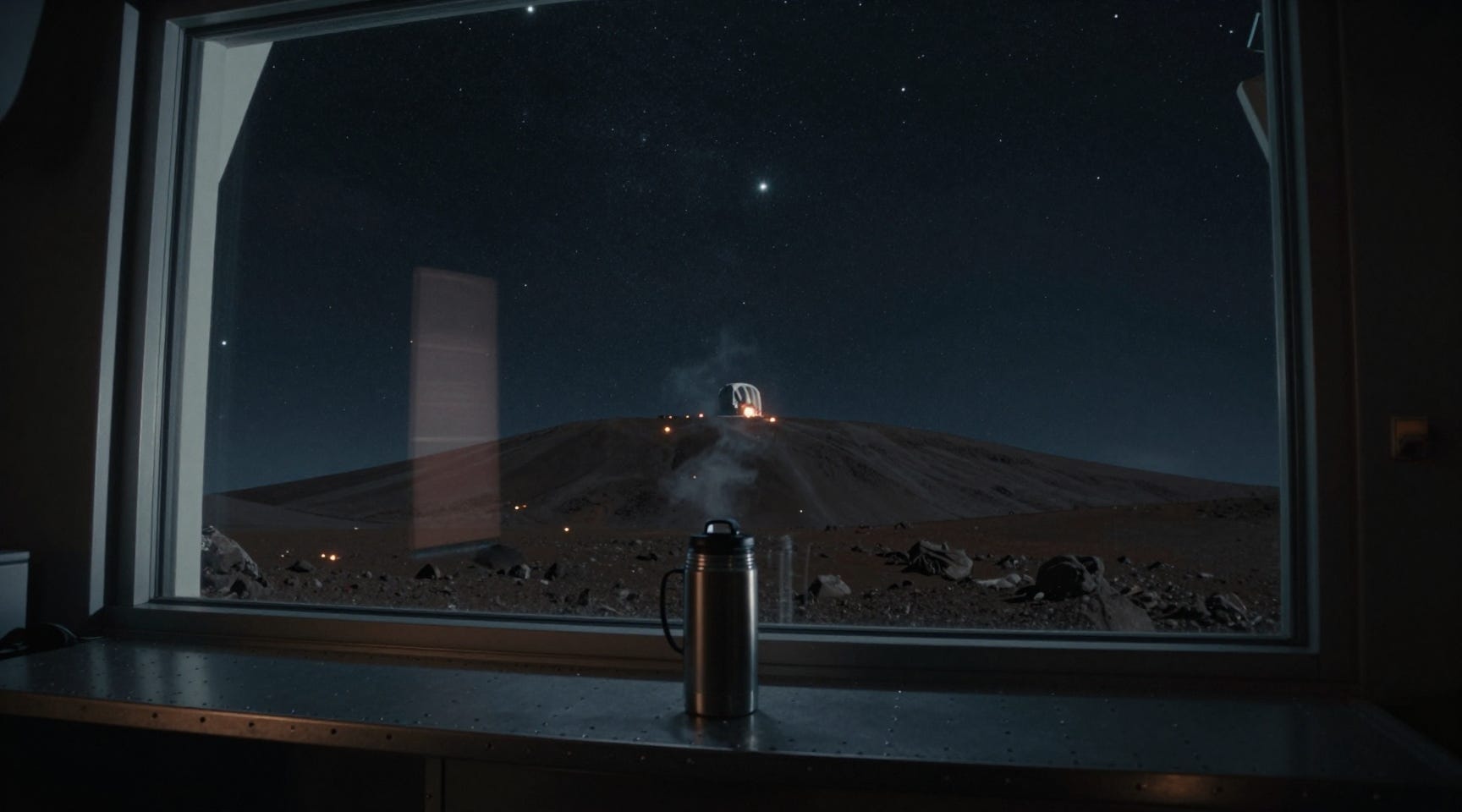
The thermos lid stuck again.
Keoni Yamashita worked his thumb around the threading, tracing the groove where the plastic had warped from years of thermal cycling. Fourteen degrees in the control room, forty below at the summit catwalk. The lid expanded and contracted, expanded and contracted, until the seal lost its memory. He should have replaced it. He had been saying that for two years.
The lid gave. Coffee steam rose into the dry cold of the control room, curling past the bank of monitors that lined the western wall. The Keck interferometer feeds scrolled in their usual cascade, the deep-space survey sweeping its assigned quadrant with the mechanical patience of a program that had been running, in one form or another, since before he was born.
20:47 local. Six hours into his shift. The mountain was quiet. The cooling system hummed its low constant note, the sound so continuous it had become architecture, part of the room itself.
He poured the coffee. Set the thermos on the instrument shelf, cap side down, the way he always did to keep the condensation ring off his logbook. Pulled the rolling chair back to the primary console.
The interferometer data populated in real time, each sweep rendered as a spectral density map across the upper display. He had been reading these maps for fifteen years. He could identify instrument noise, solar wind interference, and background gravitational fluctuation the way his grandfather had read ocean swells from the harbor wall in Hilo: without conscious thought, the pattern arriving fully formed.
The first return was wrong.
Not dramatically wrong. Not the catastrophic spike of a failing sensor or the structured artifact of a software fault. Those he would have dismissed in seconds. This was a cluster of coherent gravitational signatures at the survey’s extreme range, positioned at the system edge, exhibiting deceleration profiles that matched no catalogued phenomenon.
He set the coffee down. Pulled the chair closer. Ran the calibration diagnostic.
The diagnostic took ninety seconds. He counted them by the cooling system’s cycle. Three breaths per cycle. Thirty cycles. The diagnostic returned clean. All instruments within operational tolerance.
He re-queued the sweep.
The signatures were still there. Same position. Same coherence. Same deceleration curve. He overlaid the previous sweep’s data. The objects had moved, inward, by a margin consistent with active deceleration from a velocity that should not have been possible for any natural body at that orbital distance.
Multiple objects. Decelerating in formation.
Keoni reached for the logbook. His hand was steady. He wrote the timestamp, the coordinates, the instrument configuration, and the spectral density values, all in the same neat block print he had used since his first shift at twenty-three. The act of writing was not recording. The act of writing was thinking. Each number on the page was a question: Have I made an error?
He had not made an error.
He ran the calibration a second time. Clean. Re-queued the sweep a third time. The signatures resolved with greater clarity, the interferometer’s accumulated integration time sharpening the returns into discrete points. Eight objects. Possibly more. Each one massive enough to register gravitational displacement at interstellar range.
Fifteen minutes had passed since the first return.
In those fifteen minutes, Keoni’s body had done several things without consulting him. His breathing had slowed. His hands had stopped reaching for the coffee. His posture had shifted forward, shoulders rounded, weight on his forearms, the position he adopted when he was doing work that mattered. The position the night coordinator called his “lockdown stance.”
He picked up the internal phone and dialed the coordinator’s quarters, two hundred meters downslope.
The phone rang four times. A click. A voice thick with interrupted sleep.
“This is Yamashita in the control room.” His voice was calm. Professional. The voice of a man reporting an instrument anomaly at the start of a routine escalation chain. “I need you to come up. I have coherent gravitational returns at system edge. Multiple objects, decelerating in formation. I’ve run calibration twice. The data is clean.”
Silence on the line. Not the silence of someone processing information. The silence of someone who had understood immediately and was now doing the same thing Keoni’s body had done: recalibrating.
“How many objects?”
“Eight confirmed. The integration is still building. There may be more.”
“Decelerating.”
“Yes.”
Another silence. The coordinator’s breathing came through the line, steady, professional. Wrong in the same way Keoni’s own steadiness was wrong: the calm that comes not from the absence of fear but from the presence of training so deep it operates before fear can arrive.
“I’m coming up. Don’t touch the data. Don’t call anyone else.”
“Understood.”
Keoni set the phone down. The control room was the same room it had been twenty minutes ago. The same cold floor. The same hum. The same bank of monitors casting their pale light against the eastern wall. The coffee in his mug had stopped steaming.
He stood. Walked to the observation window at the far end of the control room. The window faced west, toward the Pacific, and at this altitude the sky was the deepest black the planet could offer, the atmosphere thinned to a membrane, the stars so dense they lost their individual identity and became texture.
He had stood at this window ten thousand times. He had pressed his forehead against the cold glass during long shifts and known the particular comfort of a man who understood where he belonged. The sky was the place he had chosen to spend his life, and the sky had always been, in its fundamental character, empty. The beautiful, immense, empty sky.
It was not empty.
He stood at the window. The sky looked the same. From this side of the glass, from this altitude, with these human eyes, nothing had changed. The stars held their positions. The Milky Way arched in its familiar geometry. The Pacific clouds far below caught the light of a quarter moon.
His grandfather had worked maintenance in this building. Had walked these floors with a mop bucket and a ring of keys, keeping the equipment clean for the astronomers who were looking, always looking, for something out there. Tomio Yamashita had never asked what they were looking for. He had kept the floors clean so they could keep looking.
Keoni pressed his forehead against the glass. The cold went through his skin and into the bone beneath.
He was the first human being who knew.
The sky outside the window did not care. The sky was occupied with other business now, the business of eight objects decelerating toward the inner system, and the sky had not asked his permission, and the sky would not wait while he stood at the window trying to remember the last moment before this one. The last moment when the thermos lid was the most important problem in the room.
Behind him, the monitors scrolled. The data built. The signatures sharpened.
Below, on the mountain road, headlights climbed toward the summit.
Author’s note: This story is part of The Day Zero Anthology, a collection of vignettes exploring the first 24 hours after humanity detected the Vethrak fleet. Keoni Yamashita was, by the accident of shift scheduling and the position of a mountain, the first human being to know. His 06:47 UTC detection at Mauna Kea Observatory is the canonical starting point of Day 1 in The Vethrak Requiem timeline.
If you enjoyed this story, you can follow the main story arc in The Exodus Rush, the first book in The Vethrak Requiem series.