


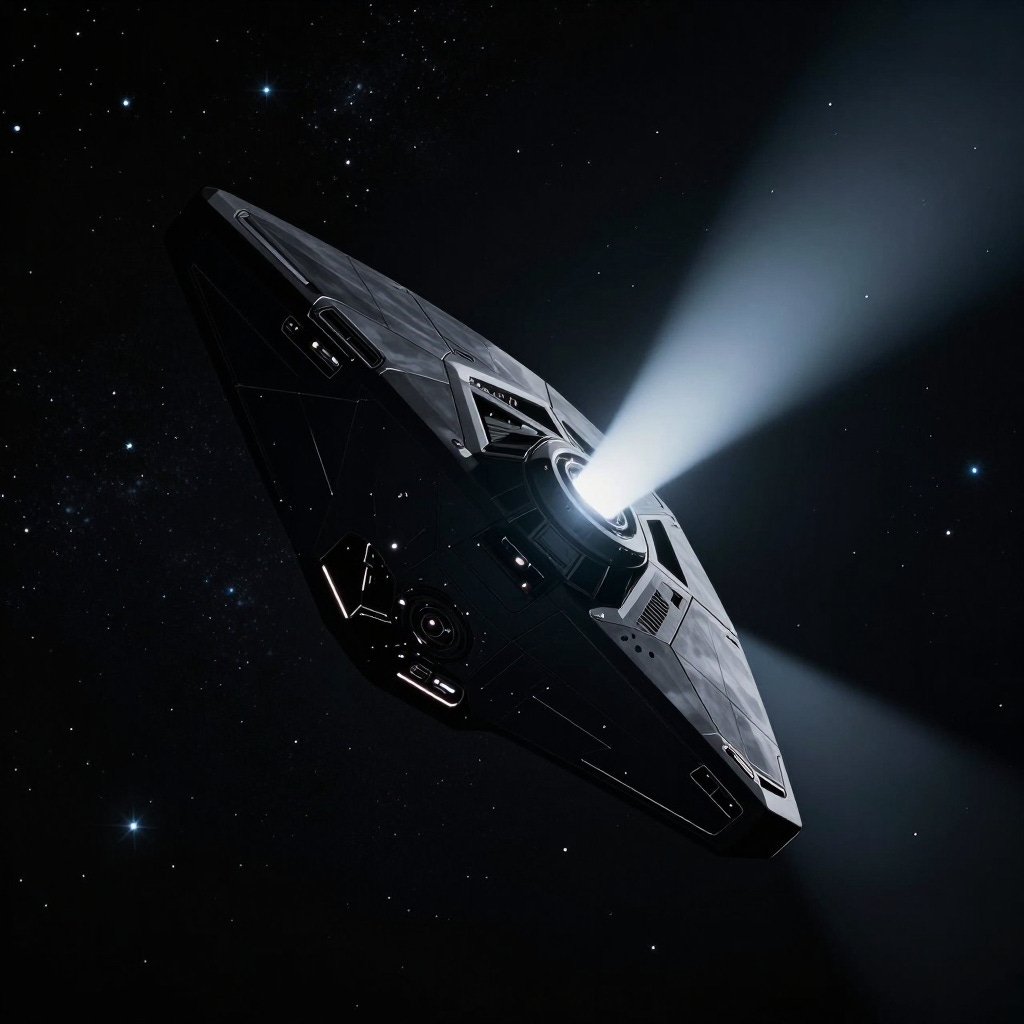
The Surveyor’s Dream was three months into a routine mapping mission when they found the object.
Lieutenant Commander Adisa Oyelaran had seen debris before. The shipping lanes were full of it: dead satellites, abandoned cargo pods, the occasional derelict from the Expansion era. This was different. This was wrong.
“It’s not tumbling,” Ensign Park said, fingers dancing across her console. “No rotation at all. Perfect stability.”
Oyelaran leaned forward in her command chair. The main display showed a shape that defied easy description. Angular, asymmetric, black as the void around it. Roughly the size of a cargo shuttle, though the comparison felt inadequate. Cargo shuttles were built by human hands, designed with human logic. This thing looked like it had grown.
“Any emissions?”
“Nothing on standard frequencies.” Park frowned at her readings. “Wait. There’s something in the low bands. Repeating pattern.”
“A beacon?”
“Maybe. It’s...” Park trailed off, her face pale in the console glow. “Commander, I don’t think this is human-made.”
The bridge went silent. Seven crew members, all veterans of deep space operations, and not one of them breathed.
Oyelaran’s training kicked in. Decades of protocol, drilled into her at the Academy, practiced in a hundred simulations. First contact scenarios. She’d always thought they were theoretical exercises, relics of optimistic thinking from the early colonial period.
“Navigation, hold position. Comms, begin recording everything. I want full spectrum analysis on that signal.” Her voice was steady. Her hands were not. “Park, wake up Dr. Vasquez. If this is what I think it is, we need a xenolinguist.”
“Commander.” Chief Engineer Tanaka spoke from his station near the back of the bridge. His voice carried the weight of thirty years in space. “Should we be getting closer?”
It was the question everyone was thinking. The smart move was obvious: log the coordinates, maintain distance, report to Fleet Command. Let someone else make the decisions. Let someone with more authority, more resources, more answers take the risk.
Oyelaran looked at the object on her screen. Black and angular and impossibly still.
“We’re a survey vessel,” she said. “This is what we do.”
The Dream crept closer. Ten kilometers. Five. One.
At five hundred meters, the object changed.
Panels shifted along its surface, reconfiguring in patterns that hurt to watch. The black material rippled like water, like skin, like nothing Oyelaran had ever seen. A seam appeared along what might have been its bow, widening into an aperture that could have been a door.
Or a mouth.
“Commander, the signal’s changed.” Park’s voice cracked. “It’s... I think it’s responding to us.”
“What’s it saying?”
“I don’t know. The patterns are complex. It could take months to decode, maybe years.” Park looked up from her console, eyes wide. “It knows we’re here.”
The aperture continued to widen. Inside, Oyelaran could see movement. Shapes in the darkness, geometry that slid between angles, forms that suggested intelligence without confirming it.
Her hand hovered over the emergency acceleration command. One touch, and the Dream would burn hard for the nearest relay station. They could be in Fold space within the hour, safe, away from this thing that watched them with apertures that were definitely not eyes.
The shapes inside the object shifted again.
Oyelaran made her choice.
“Open a channel,” she said. “All frequencies. Broadcast our standard greeting package.”
“Commander—”
“They reached out first. It’s only polite to respond.”
The transmission went out: mathematics, music, images of Earth and her colonies, the universal constants that humans had always hoped would serve as a bridge to other minds. A message in a bottle, cast into the void on the assumption that understanding was possible.
The object fell silent. The aperture closed. The strange vessel hung motionless for one long moment, two, three.
Then it vanished.
Not Fold transit, not conventional thrust. One frame it existed; the next, it did not. Gone without trace, without explanation, without response.
Oyelaran stared at empty space for a long time.
“Did we...” Park swallowed. “Did we do something wrong?”
“I don’t know.” Oyelaran finally allowed herself to breathe. “Log everything. Triple-encrypt the data package. And Park?”
“Yes, Commander?”
“Note for the record: first contact, Year Negative-Three, Day 219. Outcome...” She paused, searching for the right word. “Inconclusive.”
Three years later, the Vethrak would return.
They would not be interested in greetings.
This account was reconstructed from the flight recorder of the UES Surveyor’s Dream and the personal logs of Lieutenant Commander Adisa Oyelaran. Commander Oyelaran served with distinction throughout the Invasion and is credited with evacuating over twelve thousand civilians from the Kepler Sector. The Oyelaran Protocol for unexpected contact remains standard procedure in UEN exploratory operations.