


Ayanda Molefe placed the published collapse report beside the annex it had left behind.
Both lay flat on the fatality-review table in the habitat spin. The public report carried the Helios release seal, a clean revision number, and one sentence centered beneath Tunnel 3-Bravo: unforecast localized shear event. Her annex carried a hospital registry mark, her signature, and a longer chain of words nobody had been willing to broadcast.
Extended cycles. Prior related strain injuries. Delayed rescue under staffing scaled to an average incident. Contributing operational fatigue: confirmed.
The patient identifiers remained restricted. The findings did not.
Helios counsel stood at the opposite rail with the settlement draft open on a slate. “The final reporting clause needs one authoritative version. Public agencies cannot act against a stack of competing drafts.”
“This is not a competing draft.” Ayanda touched the hospital registry mark. “It is a signed finding from the same event.”
“The final report can incorporate the finding.”
“It can summarize it. That is how this one disappeared.”
Ji-woo Han sat beside the table under the same medical limits she had carried into the previous sessions. Seated work. No manual load. No tunnel entry. Her fingers rested near the read-only control without touching it.
Ayanda rotated the public report toward counsel. “Which sentence tells a future medical chief that the affected shift had been extended?”
Counsel did not answer.
“Which one tells a rescue coordinator that the surge column failed to fill?”
“Those details belong in supporting records.”
“Then the supporting records are part of the authoritative record.”
The distinction landed without heat. Ayanda had protected the sentence since the public broadcast. Anger had no place in her voice. It remained in the word she would not replace.
Confirmed.
Ji-woo opened the version chain.
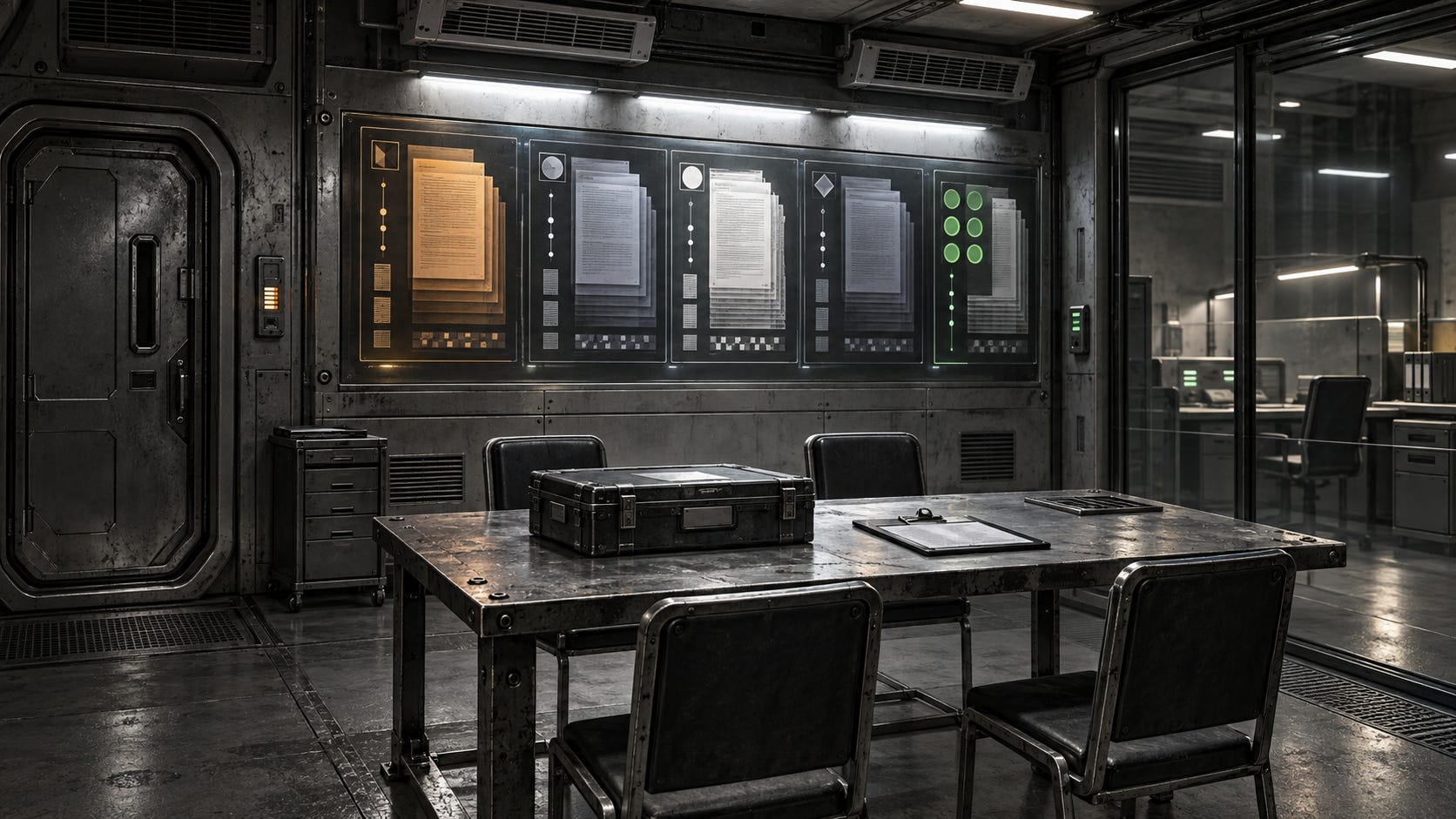
Four panes appeared above the table. The first held her signed amber maintenance recommendation: Pause extraction before further loading. The second carried the production-review revision: advisory pending validation. The third showed the final-cycle authorization. The fourth held the public collapse report.
No arrows accused anyone. No color declared intent. Each pane displayed its authoring credential, creation time, revision time, source checksum, and custody transfer.
The sequence did the work.
“One final report would still cite these,” counsel said.
Ji-woo kept the history in read-only mode. “A citation proves a record existed. It does not preserve what changed, who changed it, or when the change entered the operating board.”
Ayanda moved her annex into the same chain. The public report did not expand to absorb it. The archive placed the medical finding beside the engineering hold and gave each its own custody line.
“Authority comes from a traceable record,” she said. “Not from deleting disagreement after one office wins the release field.”
The arbitration room carried the same files into the final drafting session.
Kavita Nair locked the sixth demand beside the first five. Four green marks already held the provisional clauses in place. The fifth and sixth remained open.
Mateusz Zieliński joined from the Fleet Construction position with three destination fields masked on his copy. The proposed external inspection panel occupied the remote wall, each member identified by role rather than home office.
Helios counsel opened the privilege objection. Internal annotations, controller logs, and access histories could expose legal advice, security practice, patient information, and classified construction routes.
Mateusz separated the fields one at a time.
“Patient identifiers stay restricted to medical and authorized review,” he said. “Unrelated classified destinations stay unnamed. Neither protection changes an exposure time, a maintenance status, a sensor value, a controller command, an access event, or the person who authored a safety revision.”
He released his own pane. The three destination fields remained masked. The loading times, material classifications, receipt delays, and schedule pressures around them stayed visible.
“A redaction hides protected content,” he said. “It does not rewrite the event around the protected content.”
The panel chair answered from the wall. “We can accept confidentiality obligations for personal medical data and unrelated classified material. We cannot inspect through summaries selected by the operation under review.”
The panel’s access clause filled the central slate.
Independent inspectors would receive unedited safety, maintenance, sensor, controller, and access logs. Source records would remain in their original custody chain with authorship, timestamps, revision history, and checksums intact. Access restrictions could limit who viewed protected fields. They could not alter the source or remove safety-relevant facts.
Ayanda read the reporting rule aloud before the mediator locked it:
“Fatality and serious-injury records preserve original findings, all revisions, authorship, timestamps, and dissenting technical opinions in an accessible record.”
The room stayed quiet after the sentence. No one used the dead as an argument. The cost had been recorded before the negotiation began.
Kavita drew the fifth green line.
Counsel advanced to the inspection remedy. “Access is acceptable under those restrictions. Suspension authority remains an operational function. An external inspector may recommend a halt to the independent Ceres safety authority.”
“A recommendation does not stop a cutter,” Kavita said.
“The authority can act on it.”
“After the next production meeting?”
Sigrid Hedlund sat with the reduced restart model clipped beside her settlement copy. The old target no longer appeared on it. Solid maintenance blocks interrupted the ore lanes. Rescue coverage limited the active faces. Her name remained on the shortfall.
“Define the inspector’s scope,” she said.
Kavita turned the clause toward her. “The affected tunnel, machine, route, or system. No wider than the written hazard finding supports. No narrower than the hazard reaches.”
“Release conditions?”
“Written corrective conditions in the finding. Verified by the inspector or an independent qualified reviewer named under the authority’s rules.”
Counsel opened a time limit. “Operations needs an automatic review if a suspension threatens station supply.”
“Review, yes,” Kavita said. “Automatic restart, no.”
The panel chair added a review clock. A suspension would receive prompt technical review. Delay would escalate the review to the full safety authority. Time alone would not satisfy a corrective condition.
Sigrid read the complete paragraph. “Helios can challenge the finding in the independent process.”
“With the affected operation stopped,” Kavita said.
“With the affected operation stopped.”
Sigrid removed the unilateral release field from the management copy.
The mediator read the sixth rule into both channels:
“Independent inspectors receive unedited log access and authority to suspend affected operations until written corrective conditions are met. Helios Ceres Operations may not restart the affected tunnel, machine, route, or system unilaterally.”
The sixth green line entered the record.
Nobody unlocked their chair.
The mediator assembled the settlement page and read all six outcomes together. Independent authority with protected funding and shared representation. Immediate worker stop power for documented imminent hazards. Maintenance time production could not take without written safety concurrence. Rescue readiness tied to active tunnels on every shift. Fatality and serious-injury records that kept originals, revisions, authorship, timestamps, and dissent. Independent inspection with unedited access and bounded suspension power.
Temporary scrubbers still served the station. The damaged branch remained isolated. Normal load remained uncleared. Compensation remained on its own schedule. The strike still occupied its twentieth day.
“Recommendation of the negotiating team,” the mediator said. “All six safety outcomes advance together to the Strike Day Twenty-One ratification vote. Labor?”
“Recommend,” Kavita said.
“Ceres Operations?”
“Recommend,” Sigrid said.
The mediator marked the negotiating-team recommendation unanimous. Counsel’s legal objections remained intact and attributed beside it.
Mateusz entered Fleet Construction’s concurrence. Ayanda signed as medical witness to the record rules and nothing beyond them. The external panel acknowledged the access and confidentiality terms.
The archive accepted the package without flattening it.
The original collapse report stayed visible. Every revision opened beside it. Ayanda’s annex kept its signature. Ji-woo’s amber hold kept its first sentence. Counsel’s objections remained attached to the clauses they challenged. Six provisional agreements occupied a separate pane marked for tomorrow’s vote.
No version overwrote another.
The record finally had room for the truth to disagree with itself and still remain whole.
If you enjoyed this story, you can follow the main story arc in The Exodus Rush, the first book in The Vethrak Requiem series.