


The plate Tuva wanted was already in the right rack.
Its width would cover the mapped cutback. Its thickness matched the replacement drawing. A pale scrape along one edge would disappear in preparation, and moving it to Slip Two would cost no one else a crane slot.
She caught the receiving rail and brought its local tag against Samrawit’s reader.
Chemistry accepted. Dimensions accepted.
Below them, the new process field stayed unresolved.
Through the access opening, Article Four hung captured in its proof cradle. Three transitions had looked sound before loading opened microcracks beside the welds. Normalized plate and worked, accelerated-cooled plate had passed through one blind category and received one treatment. Nothing Tuva could see at the torch had told her they were different.
Now a difference stood between her hand and the convenient piece.
“The old receipt says accepted,” she said.
“The old receipt is still there.”
Samrawit secured her slate beside the reader. “Open what it accepted.”
Tuva expanded the record.
The receiving assay, thickness readings and custody signatures remained intact. None answered how the plate had been formed or which final condition its joining limits belonged to. An attached summary offered a grade. The chain behind its process entry stopped before a governing revision.
“Can you recover it from the answer?” Tuva asked.
“Not by making this piece belong to a certificate it doesn’t match.”
The answer from upstream had distinguished the two histories used in Article Four. It had not supplied every missing history in the racks.
Tuva ran her glove along the plate’s captive edge. It was cold and straight. She had spent years judging preparation by touch, finding the small raised lip that light would miss. Her hands had nothing useful to say about an absent thermal record.
She selected hold for replacement selection.
The reader asked for a reason. She entered incomplete process record, then attached the gap rather than the green chemistry result.
“Not rejected for every use,” Samrawit said.
“Not selected for mine.”
Tuva fastened the removable hold tag without releasing the rack restraint. The convenient plate stayed where it was.
At the materials terminal, Samrawit opened the live engineering copy.
The old security category had not vanished. It sat beneath persistent local lot identifiers, retained as a receiving reference rather than a promise that everything beneath it could be joined alike.
Forming method. Principal working direction. Thermal state. Qualified joining range.
Tuva followed each entry into its technical source. The signed response supported the known populations. Where another rack position lacked the required chain, the new lot record kept the gap instead of borrowing acceptance from its neighbor.
“If you correct the direction?” she asked.
Samrawit changed a demonstration view, not the live value. The revision pane retained the earlier entry beside the proposed correction, with an author and time.
“The previous cut plan stays attached to what it used.”
“Even if it was wrong.”
“Especially then.”
Tuva returned to the live copy. Inspection records had their own signatures. Each revision carried its checksum, and the local piece links reached through cuts and retained tags to the plate still in its restraint.
At the edge of the engineering pane, a sealed linkage token stood in place of an origin.
Onur caught the adjoining handhold.
“That won’t open from here,” he said.
“I wasn’t asking it to.”
She checked that the working direction remained visible when the identity pane was closed. The arrows on the cut layout stayed. No source name appeared.
This time, the thing withheld was not the thing she needed.
The normalized replacement came from a narrow bay farther along receiving. Tuva matched the physical tag, dimensions and retained inspections to the new lot record before marking its place in the selection.
The worked piece was less cooperative.
Its surface looked no different from the plate she had held. The process record distinguished it, and the layout required her to turn the proposed cut relative to the long direction of the rack. In the first orientation, the piece nested neatly around stock already promised elsewhere. In the permitted orientation, the nesting failed.
Tuva brought the plan closer.
A more generous blank would fit. It occupied the next restrained position under Slip Four’s reservation.
Cho arrived before she asked for it. He clipped his slate where both women could read the allocation.
“You can take the first piece without touching their reserve.”
“I can’t qualify its missing history by moving it.”
“The second layout uses less.”
“In the wrong direction for this cut.”
He opened both layouts. Tuva kept her finger beside the relationship between the plate’s recorded working direction and the replacement’s load direction. The shorter arrangement had passed a fit check. It had not passed that comparison.
Cho studied the larger blank.
“Slip Four already lost a lift to us.”
“This is stock,” Tuva said. “They lose the stock too.”
The words came out harder than she intended. She loosened her grip on the rail.
“I don’t want the cost put under a different name.”
Cho left the displaced reservation visible. He entered the transfer against Article Four and retained the earlier allocation rather than making Slip Four appear never to have owned it.
Tuva checked the corrected selection again. Normalized and worked pieces, separately identified, each in its documented condition. Their approved joining limits remained different.
“Selection only,” Samrawit said. “This doesn’t qualify the corrected joint.”
“No torch,” Tuva replied.
The words cost her less than pretending the next gate had disappeared.
The riggers secured the handling cradle before releasing the rack captures. Tuva checked the local identifiers against the move record, then checked them again when the selected plates reached the separate cradle beside Slip Two.
Article Four’s hold remained where it had been. No cut opened in the damaged transitions. The new stock occupied space near the barrel without becoming permission to repair it.
Cho stayed at the rail until the receiving position and the destination agreed on what had moved. On his slate, Slip Four’s reservation had a signed displacement. Its loss had not dissolved into a corrected total.
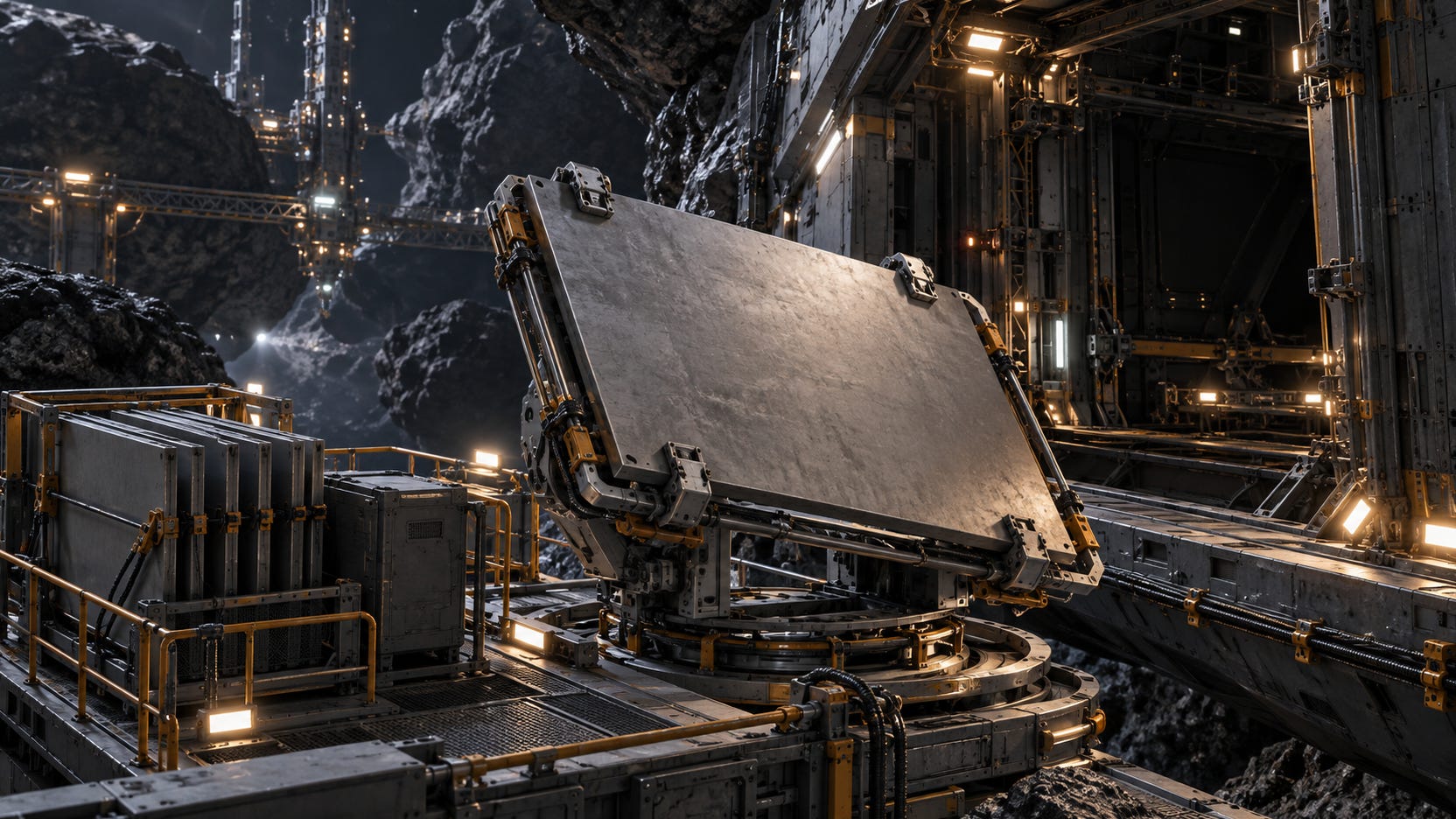
Tuva fitted her boots beneath the cradle station and opened the worked piece’s layout. The handling frame had presented the broad face conveniently toward the access rail. Convenient was not the required orientation.
She took the captive rotation control. The plate moved slowly within its restraints, carrying its inertia through the frame. She stopped short of the alignment and checked the retained datum against the cut layout before continuing.
Behind her, Samrawit’s record remained open to the same local lot. Forming history, direction, thermal state, joining limits. Each fact had survived the journey from the source answer to the work position without bringing an address along.
The cradle settled into its next lock. Tuva verified the orientation at the physical reference and signed the positioning step, not a weld completion.
Tomorrow there would still be questions. Oversight had not approved the full procedure. A corrected representative joint still had to earn its qualification before the damaged barrel could receive production work.
Today the wrong plate had stayed in its rack, and the right pieces had arrived with a cost nobody could hide.
Tuva rested her glove against the blank steel. No arrow showed on its face. She had turned it by a direction the record could finally carry all the way to her hands.
Author’s note: This story returns to Tuva Hawthorne in late Year 3 as Site Anvil applies its separated technical record to real replacement stock. Material selection and positioning do not qualify the corrected joining procedure or release Article Four.
New to The Vethrak Requiem? Start with The Exodus Rush, Book 1, where humanity fights for survival after an alien invasion using technology it barely understands. These short stories explore the wider universe; the novel begins the main story.