


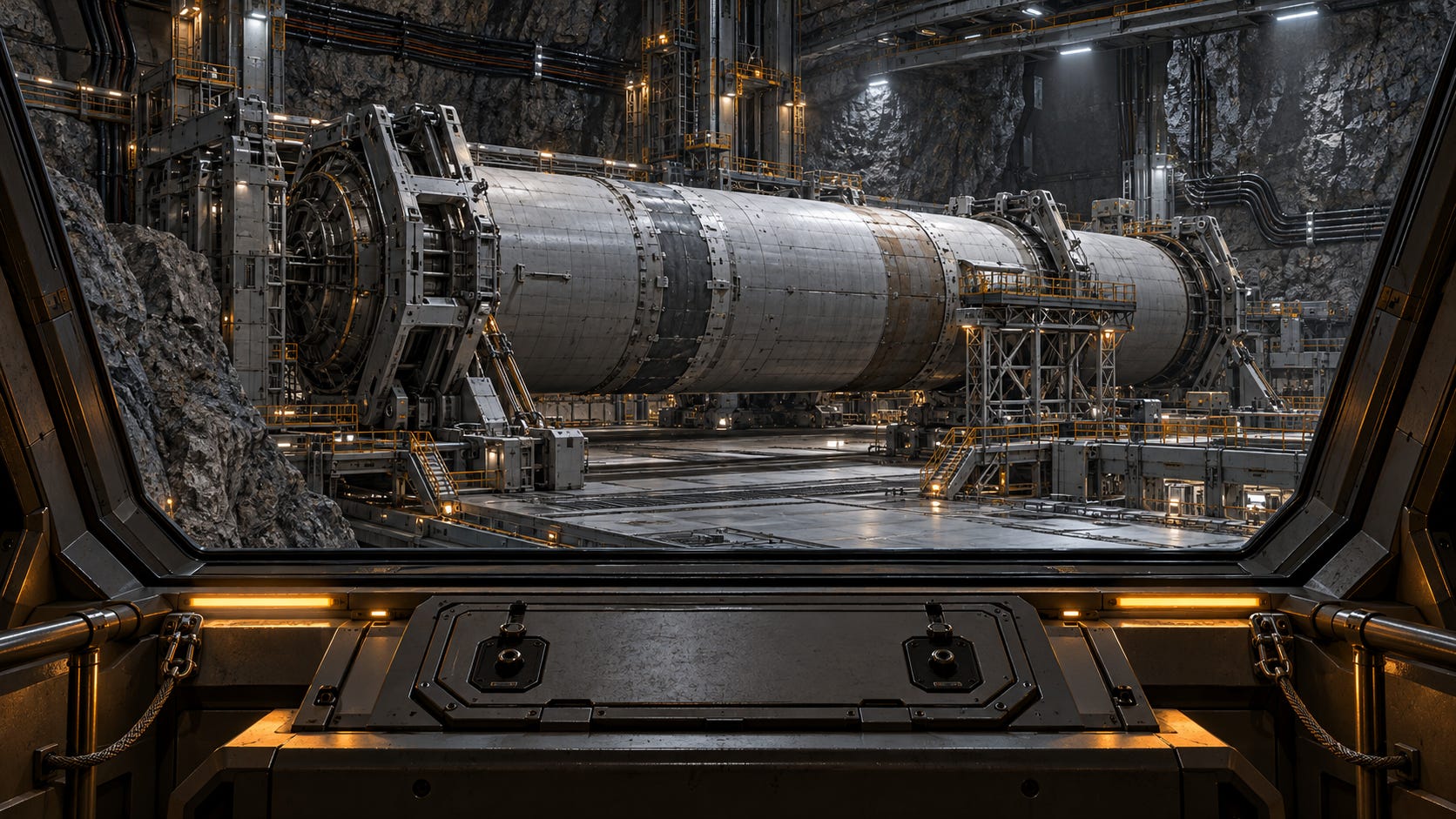
Foreman Cho caught his tablet before its tether pulled tight. The elastic brought it back against his knuckles, turning the completion summary sideways. Through construction control’s window, Article Four rested in its capture cradle beneath the work lamps. Yesterday’s proof fixtures were isolated. The barrel had held. Cho had slept four hours, and the first document waiting for him made the repair look as though nobody had needed him at all.
Weld execution. Materials disposition. Examination. Structural release.
Every line carried a work reference and a qualified role. His place was a small box at the bottom: construction acknowledgment.
Onur waited beside the sealed record station, one foot secured in a restraint. “That is the cover summary. The underlying decisions remain in construction.”
Cho rotated the tablet upright. “Linked to whose name?”
“The present authority record.”
“Present.” He opened the first power change. The shift code was there, along with the allocation and the signed decision. “When somebody inherits my console, this needs to keep pointing to me.”
Onur pulled himself nearer without touching the tablet. “The retention exception permits that. It does not happen because you acknowledge the summary.”
Cho’s thumb rested over the box. He had been about to press it.
He withdrew the submission and retained the incomplete version with the review finding. The final seal would wait. Nothing on the ordinary production board changed: shifts, roles, assignments, the familiar arrangement that let people work without exposing the yard’s personnel map. Inside the restricted station, the builder roll had more to keep.
Tuva arrived carrying her execution references on a tethered reader. A thin pale line marked the skin where her glove cuff had rubbed. She secured herself at the verification position and brought up the original joining package before the repair record.
Cho recognized the conditional signature. He remembered wanting a simpler answer from her, a clean assurance he could fit inside the next power block. She had given him what her work supported and left the rest unsigned.
“This one stays attached?” she asked.
“The original and the replacement,” Onur said. “With the qualifications that applied on each date.”
She checked the displayed work references against her reader. Her protected identity confirmation appeared only at her position. Cho could see that she accepted the association; he could not read her personnel record from his console.
“Scope?” she asked.
“Execution as signed.”
Tuva read it once more before confirming. Her reader clicked against its tether clip as she freed a hand. “Good.”
Cho selected his own record. Construction held the decisions and their work references. Compartmentation held the protected legal-identity association. The bounded verification joined them for the approved personnel purpose, with both authorizations recorded. Neither side’s ordinary access opened the complete roll. Medical contacts remained outside it.
Onur closed his authorization. The joined view shut, leaving Cho with construction references alone. Cho tried the record again and received the refusal. Onur then verified that his own access could not recover the complete association without construction’s matching authorization. They recorded both checks before reopening the bounded verification.
The precautions took time. Cho had put time against nearly every disputed line in the yard. He left both checks in the sealing record.
His schedule changes came first. He linked the displaced test allocation, the fixture reservation, the lost windows still carried in the schedule. Each decision kept its date and the authority he had exercised then. He did not move the cost to the repaired barrel’s new release date, where a later reader might mistake it for work nobody could have planned around.
The replacement-stock entry took longer. The earlier transfer and reservation had to remain distinct from the later priority change for the qualification stock. He followed each reference back to its signed disposition. The summary had compressed them into a single line called repair support.
Cho separated the entries.
Tuva shifted her grip on the rail. “They’ll know which pieces we used?”
“The pieces, the work, and who authorized their use.”
He added the repair authorization after the accepted procedure qualification. His signature had released resources and bounded work. Wanjiku’s acceptance and subsequent structural release stayed in their own scopes. He could not sign the barrel sound. She had not ordered Slip Four’s work displaced.
The cooling adjustment waited near the end. Samrawit’s measured trace showed why the planned interval had been insufficient. Cho’s record showed the noncritical tool block he had moved to protect the actual cooling condition. The original allocation remained visible beside the change.
He remembered the tool crew’s acknowledgment arriving while he watched Slip Two consume the margin. They had accepted the delay without a complaint he could answer. The cost still belonged somewhere.
Onur checked the revised associations. “Your acknowledgment can remain on the cover.”
“It can.”
“It cannot replace these.”
Cho confirmed the distinction. His own protected identity appeared for his verification. He checked it against the retained authority dates, then signed. The name he rarely needed in the bay was now bound to the things he had asked other people to carry.
Tuva waited until the receipt showed her work references accepted. “Does any of this go with the barrel?”
“The engineering package carries the required technical record,” Onur said. “This roll stays here.”
Cho checked the separation himself. The sealed personnel record was excluded from the outbound package. Its retention authority remained attached locally; neither a cleared weld nor a future transfer would erase it. The remaining outbound gates were still open.
He submitted the corrected completion summary. This time the coverage included construction decisions as well as joining, inspection, materials and release. Onur verified the compartmentation disposition against the same revision. They completed the local seal together.
The joined display closed. Cho received a sealed-record receipt instead of a list of names.
Tuva secured hers and pushed gently toward the hatch. Work waited in Slip Two even with the proof complete. Cho followed as far as the window, taking the rail to stop himself.
The barrel’s outer surface was blank beneath the lamps. He could still pick out the repaired transitions. Farther along the scaffold, a tool carrier waited where its crew had clipped it after the delayed block.
Cho checked that crew’s next allocation, then secured his tablet. Behind him, the protected record held Tuva’s name against the work her hands had done. His was there too, against the decisions that had brought her to it.
Author’s note: This story takes place at Site Anvil in late Year 3 (2128), after Article Four’s repeated structural proof. The builder roll keeps accountability inside a yard whose location and personnel must remain protected.
New to The Vethrak Requiem? Start with The Exodus Rush, Book 1, where humanity fights for survival after an alien invasion using technology it barely understands. These short stories explore the wider universe; the novel begins the main story.