


The crates arrived before dawn.
Emre Çelik counted them from the supply depot entrance, breath fogging in the cold, his ledger tucked under one arm. Eleven crates. The manifest had promised seven.
He counted again. Eleven.
His first thought: someone had made an error. His second: errors in the supply chain ran one direction. They almost always ran short, not long.
He pried open the nearest unmarked crate. Antibiotics. Amoxicillin and azithromycin, sealed in vacuum packaging with dates that gave him eight months of viable use. His hand stayed on the packaging longer than necessary.
The next unexpected crate held wound dressings. The one after that, saline.
Four extra crates of medicine and supplies, sitting in the cold predawn air of Camp Horizon’s supply depot, real and unopened.
Emre sat down on the nearest crate and opened his ledger.
Six months of this ledger. Six months of morning allocations: the same columns, the same categories. What they had. What they needed. The gap between those numbers, which was always there, always the same shape. Too much need on one side, not enough supply on the other.
He already knew today’s list. He had written it the night before, because he always wrote it the night before: working through the patient files in order of urgency, calculating who needed what, making the smaller choices that meant the larger choices wouldn’t have to be made out loud.
Today’s list had two patients who needed amoxicillin. He had enough for one.
He opened the extra crate again.
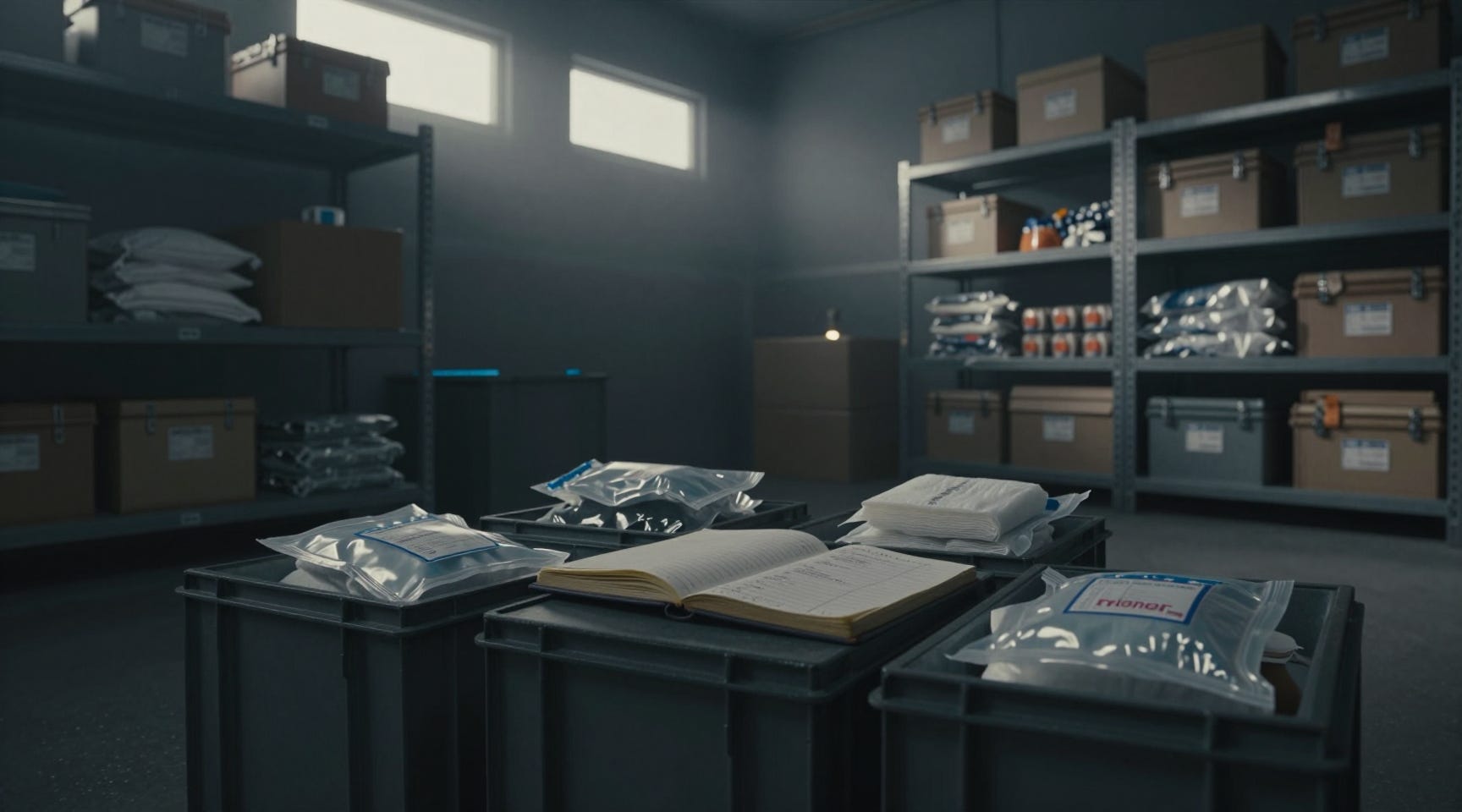
Dr. Saga Dahlberg found him at 0700, still sitting in the supply depot.
“The count’s wrong,” he said.
She stopped. Six months had worn her down to efficiency. She did not waste expressions anymore. “Wrong how?”
“Wrong in our favor. Four extra crates.”
She looked at the crates. Looked at him. He watched her recalibrate, cycling through the same disbelief he had gone through an hour ago, the same careful recount, the same arrival at something that was not quite relief. Something more complicated.
“Both pneumonia patients get antibiotics,” Emre said.
“Yes.”
“And the three wound infections in Pod Seven.”
“Yes.”
“And we’ll end the day with a reserve.” He tapped the ledger. “For the first time since I started this ledger, we will end the day with something left over.”
They sat in the cold for a moment. The morning count carried through the depot walls, the familiar cadence of numbers being called and confirmed.
“The ones who were going to go without,” Saga said. “What happens to them?”
“They get their medicine.”
“And you?”
He looked at the ledger. The morning light came through the depot’s narrow windows, catching the dust in the air. “I don’t know what to do when the answer is yes.”
She said nothing. She understood.
“Six months of writing the list every night, figuring out who gets what and who waits. I know how to do that. I have gotten good at it.” He turned a page in the ledger: column after column of neat numbers, each row a day, each gap a small cruelty carried out quietly. “I don’t remember how to write a row where everything balances.”
Saga stood. “Try.”
He distributed the morning allocations at 0800, same as always. The medical staff came to the window in the same order. He handed out the supplies in the same sequence.
The difference was the list.
The child in Pod Three got her amoxicillin. Eight-year-old Tomas in Pod Seven got his as well. Pod Seven’s wound cases received their dressings without anyone having to calculate which infection was worst.
By 0930, Emre had distributed everything on the morning list and still had supplies remaining.
He checked the numbers three times.
Then he opened his ledger to a clean page and wrote the date. Year 1, Day 187. Beneath it: Surplus. Four crates unmanifested. Origin unknown. All morning allocations fulfilled. Reserve established: 14 days amoxicillin, 21 days dressings, 30 days saline.
He stared at the word surplus for a long time.
He had written it before, in inventory shorthand. Supply surplus, resource surplus. Technical terms. Categories on a form.
This felt different.
Reserve established.
Not depleted. Not allocated until zero. Reserve. A word that meant there would be enough tomorrow without borrowing from today.
Saga stopped by the window at 1400.
“Young Tomas is breathing better,” she said.
“Good.”
“You know what I notice?” She leaned against the supply window frame. “You’re not going to have to write the hard part of the list tonight.”
She meant the column he filled in first, before all the other columns. Who got less than they needed. He built the rest of the list backward from there, working toward whatever allocation the shortage permitted.
Tonight, the answer to that column was: no one.
“It’ll feel like relief,” Saga said, reading him with the precision of someone who had watched his face across this window for half a year. “And then tomorrow the ordinary shortage will return and you’ll remember you know how to do this.” A pause. “One day of enough gives you more strength than a week of barely. I’ve seen it.”
After she left, Emre turned to a fresh page.
He wrote the evening count. He wrote the reserve numbers. He built tomorrow’s tentative allocation from abundance for once, constructing it forward from supply rather than backward from shortage.
The numbers balanced.
He had forgotten what that looked like.
At the bottom of the page, below the columns and figures, he wrote something he had never written in this ledger before.
No one went without today.
He closed the ledger.
Outside, Camp Horizon continued its work. Counts and calls and the ordinary machinery of survival, the same as every other evening. Tomorrow the supplies would run short again in the ways they always ran short. Tomorrow he would write the hard list.
Tonight, the reserve sat in the depot, sealed and real.
He left it there and went to find his dinner.
Authors note: Supply allocation in Year 1 was a job that rarely came with a name. Someone had to maintain the ledger, calculate the gap between what existed and what was needed, and make the smaller choices so the doctors didn’t have to make them openly. In the chaos of the first months after the invasion, that work fell to whoever could hold a pen and keep a column straight. Emre Çelik is one of the uncounted people who kept that ledger. His story is not about extraordinary courage or sacrifice. It’s about what happens to a person who has spent six months making impossible choices in the quiet, and what it costs, and gives, to have a single day where the answer is simply: enough.
If you enjoyed this story, you can follow the main story arc in The Exodus Rush, the first book in The Vethrak Requiem series.