


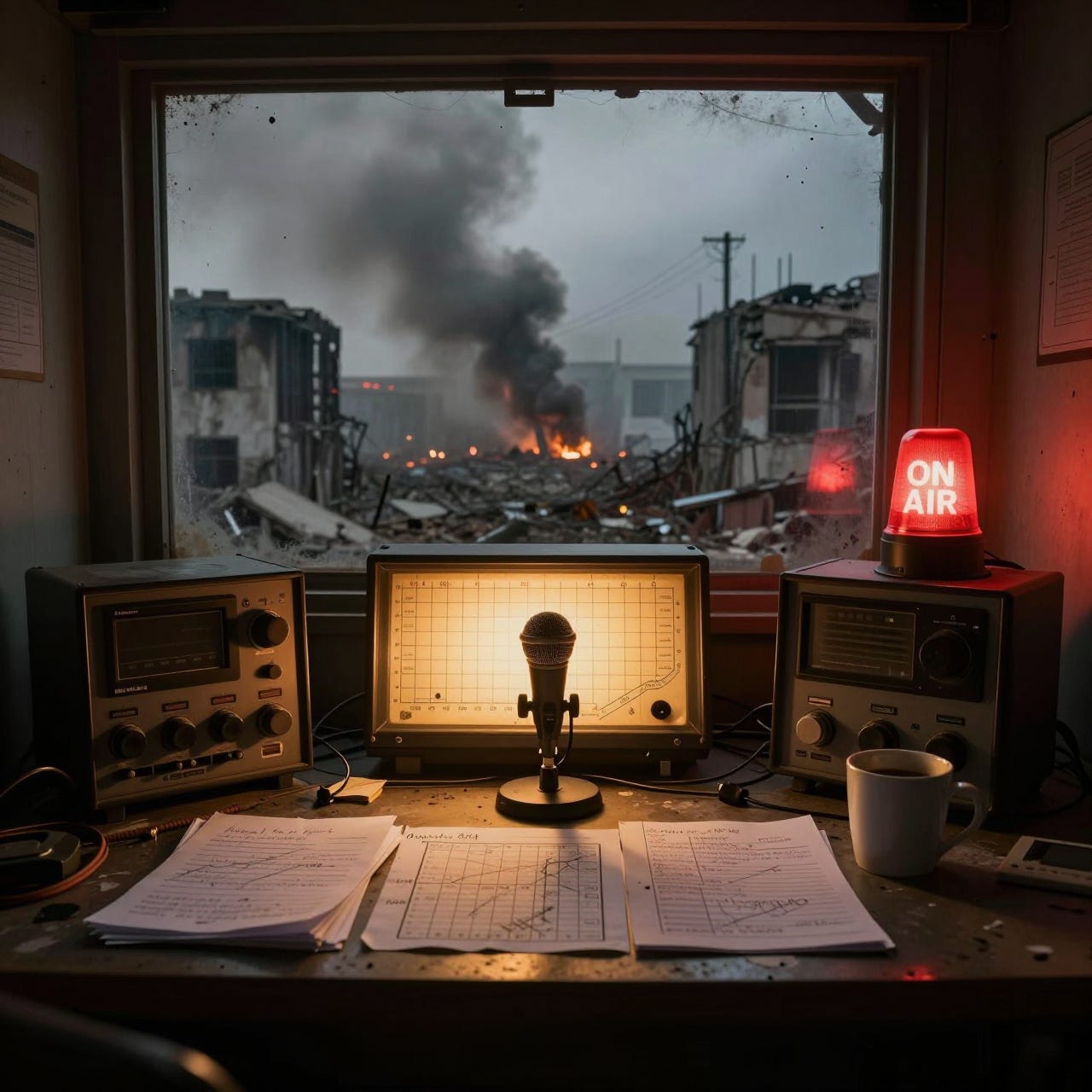
RECOVERED AUDIO TRANSCRIPT
SOURCE: Radio Station WKRH-FM, Portland, Oregon
DATE: 12 October 2125 (Year 0, Day 81)
DURATION: 8 minutes, 14 seconds
RECOVERY STATUS: Partial; salvaged from automated backup server
CLASSIFICATION: Public Record
BEGIN TRANSCRIPT
[Static. Interference. A woman’s voice, steady despite audible exhaustion.]
This is Emergency Broadcast 16 from WKRH. I’m Natalia Whitmore. If you’re hearing this, you’re still alive. That counts for something.
[Pause. Papers rustling.]
Today is October 12th. Day 81 since they came. I’ve been broadcasting from this station for sixty-two days now. Every morning at 0600. Every evening at 1800. Same frequency. Same message: you’re not alone.
I don’t know how many of you are out there. I don’t know if anyone’s listening. The feedback counter stopped working three weeks ago, and the regional network went dark forty days before that. For all I know, I’m talking to empty air and abandoned receivers.
I’m doing it anyway.
[Brief pause. Sound of liquid being poured, a mug set down.]
Here’s what we know today. The fires in southeast Portland finally burned out. Took eleven days. No one left to put them out. They just ran out of fuel. You can see the smoke from the roof here. Black column reaching up like it’s trying to touch something that isn’t there anymore.
The water treatment plant is still operational. Someone, I don’t know who, has been keeping it running. If you’re the one doing that, thank you. Clean water matters. It’s the difference between surviving and just dying slower.
[Papers again. Her voice drops, becomes more clinical.]
Supply drops continue in Sector 7, near the old fairgrounds. Yesterday’s drop included medical supplies, water purification tablets, and MREs. No blankets this time. Winter’s coming. We’re going to need blankets.
If you’re mobile, if you can move safely, the collection point is the northwest corner of the fairgrounds. They mark it with orange smoke at noon. You have about twenty minutes before the drones move on. Twenty minutes. Don’t be late.
[A longer pause. When she speaks again, her voice has changed. Quieter. More personal.]
I got a message yesterday. Someone out there has a working transmitter. They didn’t give a name, didn’t say where they were. Just… three words. “Still here. Still fighting.”
I cried when I heard it.
I’m not supposed to tell you that. Emergency broadcasts are meant to be factual, clinical, authoritative. Give people the information they need to survive. Don’t burden them with your emotions. Stay professional.
[A bitter laugh.]
Professional. Like any of this is professional. Like there’s a manual for what to do when the world ends and you’re the only voice left on the radio.
There isn’t. I checked.
[Sound of a chair creaking, as if she’s leaning back.]
Before all this, I was a morning show host. Traffic updates and weather forecasts. Interview segments with local business owners. Listener call-ins about their weekend plans. I complained about the early hours. I complained about the commute. I complained about the coffee in the break room.
I would give anything to complain about coffee again.
[Pause. A deep breath.]
Sixty-two days. That’s how long I’ve been here. Sixty-two days of broadcasting to silence. Sixty-two days of wondering if it matters. If any of this matters.
Then someone sends three words. “Still here. Still fighting.”
It matters.
[Her voice strengthens.]
Listen to me. Whoever you are. Wherever you are. It matters. Every day you survive matters. Every time you help someone, every time you share food or water or shelter, every time you choose to keep going when it would be easier to stop: it matters.
They tried to erase us. They tried to burn us off this planet like we were nothing. Inconvenient. In the way.
We’re still here.
[Papers rustling again.]
All right. Back to business. Here’s the information you need.
Sector 12 remains compromised. Do not approach. We’ve had confirmed Vethrak ground units operating there for the past week. They’re not aggressive unless provoked, but that doesn’t mean safe. Stay away.
Highway 26 westbound is blocked at mile marker 31. Collapsed overpass. If you’re trying to reach the coast, take the southern route through Sector 9. Longer, but passable.
The community at the Riverside School is accepting refugees. They’ve got space for about thirty more people, but resources are limited. If you can bring supplies, do it. If you can’t, they’ll take you anyway. That’s the kind of people we’re rebuilding with.
[Another pause. Softer now.]
Emma Zhao, if you’re listening: your brother made it to the Riverside group. He’s safe. He’s looking for you.
Marcus Chen: the supply cache you left at Grid Reference J-7 was found. Probably saved six lives. Thank you.
To whoever’s keeping the water plant running: we see you. We appreciate you.
[Silence. Just breathing and distant static.]
Sixty-three days. Tomorrow will be sixty-three days. I’ll be here again at 0600, same frequency. I’ll give you the information you need. I’ll tell you where to find supplies, where to avoid danger, how to stay alive one more day.
I’ll keep doing it until the transmitter fails, or they find this place, or I run out of reasons.
I haven’t run out yet.
[A chair scraping. Footsteps.]
This is Natalia Whitmore, Emergency Broadcast 16, signing off. Stay alive. Stay human.
We’re still here. Still fighting.
[Static. Silence. End of transmission.]
RECOVERY NOTE:
Radio Station WKRH continued emergency broadcasts for 147 days following the initial invasion. Broadcaster Natalia Whitmore maintained daily transmissions until January 2126, when the station’s backup generator failed.
Whitmore successfully evacuated to the Riverside School community and continued coordinating relief efforts throughout the Crisis Period. She later served as Communications Director for the Pacific Northwest Recovery Zone.
Emergency Broadcast recordings have been preserved in the United Earth Archives as part of the First Year Testimonial Project. The broadcasts reached an estimated 4,000-7,000 survivors across the Portland metropolitan area during the collapse period and are credited with saving hundreds of lives.
Whitmore was awarded the Civilian Service Medal in Year 8 for “extraordinary courage and dedication in maintaining vital communications during humanity’s darkest hours.”
In her acceptance speech, she said: “I just kept the lights on. Everyone else did the hard part.”
Author’s Note: This story takes place during Year 0 of the Post-Invasion calendar, in the immediate aftermath of the Vethrak assault. When institutional structures collapsed and global communications went dark, countless individuals stepped into the void. Emergency broadcasters, ham radio operators, and local volunteers became lifelines for scattered survivors. Natalia Whitmore represents thousands of ordinary people who became extraordinary when circumstances demanded it. They kept transmitting, kept broadcasting, kept reminding isolated survivors that they weren’t alone. In those first terrible months, that made all the difference.
If you enjoyed this story, you can follow the main story arc in The Exodus Rush, the first book in The Vethrak Requiem series.