


The drill alert arrived at 0847 precisely.
Captain Elizabeth Shaw was in her ready room, three hours into the morning paperwork, when TYCHE’s voice came through the overhead speaker.
“Captain. Fleet Command has initiated a synchronized fold-drive emergency drill across all three vessels. Commencing in six minutes. All senior officers are reporting to stations.”
Shaw set her pen down. The pen her father had given her, the one she used only for orders that mattered. She had not been using it for orders. She had been reading a supply requisition from the galley.
“TYCHE. Confirm receipt. I am on my way.”
The bridge of the UENS Vanguard was a tight semicircle of fourteen stations arrayed around the central command position. The lighting was cool and functional. The air smelled of recycled atmosphere and the faint ozone tang of tactical displays running hot. By the time Shaw stepped through the aft hatch at 0850, twelve of those stations were occupied. The thirteenth officer was running from the mess. The fourteenth arrived before Shaw had settled into the command chair.
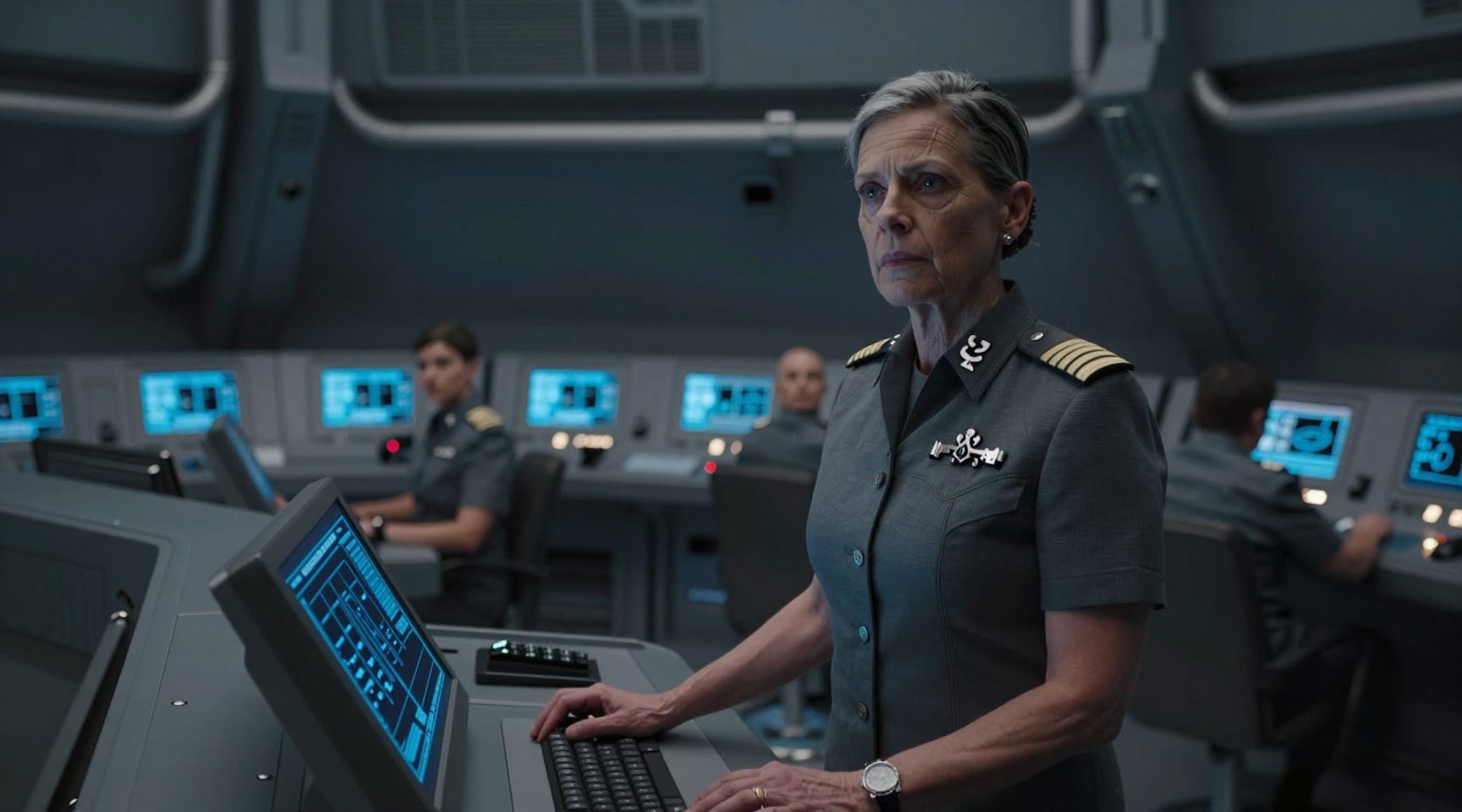
Her tactical officer was Lieutenant Commander Rachel Osei. Nigerian, late twenties, three commendations for simulation accuracy. She had been aboard Vanguard for five days. Shaw had not yet decided whether she was fast enough.
“Lieutenant Commander Osei. Fold-readiness drill. You have the board.”
“Aye, Captain.” Osei’s hands were already on the console. “Initiating cold-start protocol. Reactor spin-up to operational threshold. Fold Drive safeties disengaging.”
The data cascaded across the main display and fourteen console screens simultaneously. TYCHE generated a real-time overlay, probability distributions mapping the crew’s response cadence against simulation benchmarks. Shaw tracked the numbers the way she had tracked the lifeboat’s reactor output during the invasion. The way you track something that will kill you if you look away.
“Reactor at threshold,” Osei said. “Fold Drive coming online.”
Shaw’s eyes found the navigation console. Lieutenant D’Souza was running the handoff protocol from tactical to nav. The handoff was simple in theory. Tactical identified fold-safe vectors based on sensor sweeps and stellar cartography. Navigation loaded them and plotted the jump. The protocol existed to prevent a ship from folding into an asteroid, another vessel, or a gravity well. It had existed since the first Fold Drive was salvaged from Vethrak wreckage. It had been refined every year since.
“Vectors locked,” Osei said.
“Navigation has the board,” D’Souza said.
There was a pause.
It was not a long pause. TYCHE would log it later at four point seven seconds between vector lock and navigation confirmation. In the simulation bay, four point seven seconds was within Fleet tolerance. In combat, four point seven seconds was a dead ship.
Shaw did not call it out during the drill. She filed it away the way she had filed away every flaw she had ever seen in a crewmember she intended to keep.
“Fold plotted,” D’Souza said. “Suite reports green. Four. Three. Two. Mark.”
The Fold Drive indicator on the main display shifted from amber to green. The drill was a cold-start drill. Nothing actually activated. The Fold Drive remained offline. The purpose was to measure how fast the bridge crew could bring it from cold silent to fold-ready under alert conditions. Fast enough was not a number. Fast enough was survival.
“TYCHE. Time to fold-ready.”
“Four minutes and seventeen seconds, Captain. All three ships have reported. Defiant at four minutes fifty-one seconds. Hope at four minutes thirty-four seconds. Vanguard posts the best time. Fleet Command congratulates.”
The bridge crew exhaled collectively. Someone at the rear station let out a short, quiet laugh. Osei glanced back at Shaw with an expression that was not quite a smile but was definitely a request for approval.
Shaw did not provide it.
“Well done,” she said. Because it was well done. “Lieutenant Commander Osei. Lieutenant D’Souza. My ready room in ten minutes. Bring the timing data.”
The ready room was small. A desk. Two chairs. A viewport that showed the curve of the patrol zone, dark and empty, stars sliding past at patrol thrust. Shaw stood at the port. She did not sit when they entered.
“Show me the handoff.”
Osei pulled the data up on the wall display. The timeline rendered in clean horizontal bars: reactor spin-up, safeties disengaged, vector lock, tactical-to-navigation handoff, navigation confirmation, fold-ready. The handoff bar was thin. The lag was visible only if you knew what you were looking for.
“The gap between vector lock and navigation confirmation,” Shaw said. “TYCHE logged it at four point seven seconds.”
Osei’s expression did not change. That was good.
“Four point seven seconds is within Fleet tolerance,” Osei said.
“It is.” Shaw did not turn from the viewport. “What is Fleet tolerance for a fold into contested space during an active engagement?”
Osei did not answer. They all knew the answer was zero.
D’Souza said, “Captain, the handoff is a verbal confirmation protocol. Tactical calls the lock. Navigation audibles the receipt. The lag is the time it takes for a human voice to cross seven meters of bridge. It is inherent.”
“Is it.” Shaw turned. “TYCHE. How fast can you confirm a fold-navigation handoff without waiting for audible verification from the officer at the nav console?”
“Approximately zero point three seconds, Captain. I can intercept the tactical lock directly from the sensor feed and confirm alignment with the navigation solution before the nav officer verbalizes receipt.”
“Zero point three seconds instead of four point seven.” Shaw looked at Osei. “Next time we run this drill, I want forty-seven seconds off the total. Four point four of those seconds will come from the handoff protocol. The rest from reactor spin-up improvements I will address with Engineering. Build a sub-drill for the handoff. Run it tomorrow. Run it the day after. Run it until TYCHE opens the confirmation channel and the time to fold-ready drops by the difference between a machine and a human voice crossing a room.”
“Aye, Captain.”
Osei and D’Souza left. The door sealed behind them with a soft pneumatic hiss. Shaw stayed at the viewport for another minute. The patrol zone was dark and quiet and utterly empty. She had learned to distrust silence the way a sailor distrusts a calm sea. The silence was not confirmation of peace. The silence was the absence of data.
She looked at the timing data one more time on the wall display. Four minutes seventeen seconds. The best of the three ships. Fast enough to be proud of. Not fast enough to survive what she remembered from twelve years ago, when the sky filled with bone-colored hulls and the world ended, and the only thing she could do was load three hundred people onto a lifeboat and run.
We are fast enough to be dangerous to ourselves, she thought. That is a problem I can work with.
She turned back to her desk. The pen her father had given her was where she had left it. She picked it up. She started on the next stack.