


The biometric review took eleven minutes.
Dr. Irene Reyes sat at the small desk in her office aboard the UENS Defiant, morning data scrolling across the screen in columns she had been reading for two decades. The numbers told a story. The numbers always told a story, if you knew how to read them.
Captain Rivera’s heart rate during rest period: elevated by 14 percent above fleet baseline for his age cohort. Cortisol trend: rising over seventeen days, not yet at clinical threshold, but rising in a straight line that had not flattened. Sleep cycle: fragmented. Average duration four hours twelve minutes. Deep sleep: negligible.
Reyes pulled up the file from commissioning week. The baseline had been better. Not good, but better. Seventeen days aboard had made it worse.
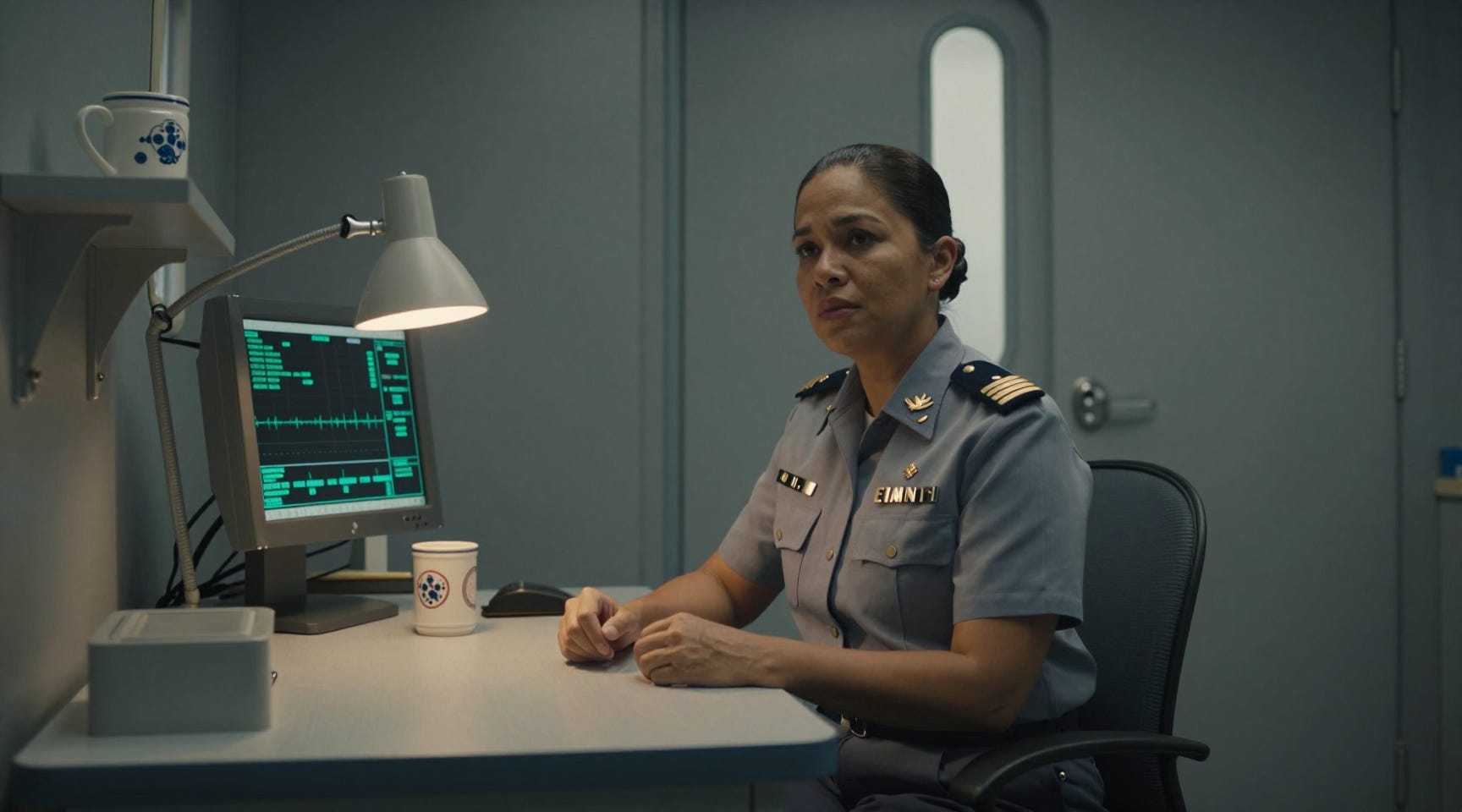
She closed the display and sat back. The office was small by design -- a desk, a terminal, a single shelf holding a small ceramic cup that had been her grandmother’s, the only personal object she had brought aboard. The walls were the same gray as every other compartment on the ship. The air carried the faint antiseptic smell of the sickbay just beyond the door.
Yellow. Not red. Yellow that was staying yellow and trending the wrong direction.
Reyes had been a physician for twenty-two years. She had been a fleet medical officer for fourteen of them. She had served on six ships: a science vessel, a long-haul transport, two construction tenders, a short-range patrol cutter that had been decommissioned before she finished her tour, and now Defiant -- the first warship she had ever been assigned to. She had seen captains burn out. She had seen captains hide it. She had seen what happened when nobody caught it in time.
The last command that had gone wrong was a science vessel with a captain who had refused to sleep, refused to delegate, refused to admit that his judgment was fraying. Reyes had flagged the biometric trend to the fleet medical board. They had asked her for more data. She had spent three weeks collecting it. In the fourth week, the captain had made an engineering decision that killed a junior crewmember -- a fluids engineer named Samara Veil, twenty-four years old, three years out of Academy, who had been standing in the wrong compartment when the captain overrode the safety lockout because his judgment was too tired to read the schematic correctly.
Reyes had written the report. The report had been thorough. The report had not brought Samara Veil back.
She opened the display again. Captain Rivera’s numbers. The same pattern, early stage. Not crisis. The kind of data that a competent CMO could monitor for weeks before deciding to act.
She logged the biometric review. Routine. Nothing to escalate.
The corridor outside sickbay was empty when Reyes stepped out. The ship was in standard watch rotation. The deck vibrated with the engine rhythm she was still learning to read as normal -- Defiant’s Cascade Reactor had a slightly different hum than the ones she had known on other ships, a half-cycle resonance that the engineers said was nothing, and she believed them, but the difference was there every time she walked through a bulkhead.
Commander Rivera was coming down the corridor from the opposite direction. He was carrying a datapad and walking with the measured pace of someone who was not in a hurry but never stopped moving. He caught sight of her and did not slow down, but his attention shifted.
“Doctor.”
“Commander.”
They had spoken maybe a dozen times since commissioning -- the standard interactions of a ship’s XO and its chief medical officer. A crewmember with a respiratory infection. A supply order for sickbay. The small administrative architecture of keeping four hundred fifty people alive.
“How is everyone settling in?” Reyes asked.
David Rivera stopped. He was good at being stopped. Most officers the corridor, gave the impression of impatience. He did not. He simply paused, present, ready to resume moving when the conversation ended.
“Settling in well,” he said. “The crew is finding their rhythm.”
“And the captain?”
The question hung in the corridor for a beat. David’s expression did not change. Reyes had not expected it to. She had not asked it as a trap. She had asked it as a data point.
“The captain is finding his rhythm too,” David said. “It takes longer for some.”
“It does.”
David looked at her for a moment. There was something in his face -- not suspicion, not defensiveness, but the alert stillness of someone who had been asked a question and was deciding whether to answer the one that had been asked or the one beneath it.
“He is not sleeping,” David said. “I suspect you already know that.”
“I do.”
“He is eating. He is working the ship. He is doing the job.”
“I understand.”
David nodded. He did not ask her whether she had flagged the data. He did not ask her what she planned to do about it. He simply stood in the corridor with the small ceramic cup that had been her grandmother’s.
The conversation moved on. David was needed on the bridge. Reyes needed to check on a supply order. They parted in the corridor without having said anything about Marcus Rivera by name for the second half of the conversation, and both of them understood exactly what the second half of the conversation had been about.
Back in her office, Reyes sat down at the terminal. She opened Captain Rivera’s medical file. She did not flag it. She did not escalate it. She typed a single line into the notes section:
Wave 1: biometric trend observed and logged. Next review: 72 hours.
Not a flag. Not an alarm. A bookmark. A note to herself that she would come back to this data with more context in three days, and three days after that, and for as long as the numbers kept trending wrong.
She closed the file. She opened a private memo to Admiral Chen.
She typed four sentences. She read them once. She deleted them without saving.
She was not ready. Not yet. But she was watching.
The corridor outside was empty. The ship hummed around her. Dr. Irene Reyes sat at her desk with her grandmother’s cup and the biometric data of a captain who was not yet in crisis but was not going to get better on his own, and she did the hardest thing a medical officer could do: she waited, with her eyes open.
If you enjoyed this story, you can follow the main story arc in The Exodus Rush, the first book in The Vethrak Requiem series.