


Mira Okonkwo checked her tether for the third time before pushing off from the airlock. Old habit. Her father had taught her that a loose tether was a dead salvager, and eight years in the debris fields had proven him right more times than she cared to count.
The wreckage of the Battle of Earth spread before her, a graveyard of metal and memory stretching across thousands of cubic kilometers. Somewhere in this mess were the remains of humanity’s first stand against the Vethrak, the desperate defense that had cost millions of lives and bought the survivors time to regroup. Somewhere in this mess was also her next paycheck.
“Mira, I’m reading a power signature bearing two-seven-zero, elevation minus fifteen.” The voice in her helmet belonged to Deshi Yuen, her partner of three years. He was back on the Fortunate Son, running sensors while she did the dangerous work of hands-on recovery.
“Copy. Moving to intercept.”
She fired her maneuvering thrusters, a brief pulse that sent her drifting through the void. The debris field was deceptively still. Nothing moved unless something moved it, and the objects that tumbled past her viewport had been tumbling for eight years, locked in their slow dance since the day the world ended.
A chunk of hull plating spun past, close enough to touch. Human manufacture. She could tell by the welding patterns, the distinctive scarring where plasma cutters had shaped the metal. Someone had built this. Someone had died when it came apart.
She kept moving.
The power signature led her to a Vethrak component half-buried in a tangle of wreckage. It was cylindrical, about two meters long, covered in the distinctive scaling pattern that marked all their technology. The scales were dark now, inactive, but the faint energy reading meant something inside was still functional.
“I’ve got eyes on it,” Mira reported. “Looks like a power distribution node. Maybe a secondary capacitor array.”
“Condition?”
She circled the object, her helmet lights playing across its surface. “Intact. No visible damage. Scales are dormant.”
“That’s a Category Three find. Salvage Protocol is going to want that.”
Mira smiled inside her helmet. Category Three meant a substantial bounty, enough to cover the Fortunate Son’s operating costs for two months. Enough to justify the risk of being out here, floating through the bones of the dead.
She pulled her cutting laser from its holster and began the delicate work of freeing the component from the surrounding debris. The key was patience. Rush the job, and you might activate something that shouldn’t be activated. The Salvage Protocol training videos were full of cautionary footage: salvagers who cut too deep, moved too fast, triggered dormant systems that didn’t appreciate being disturbed.
Fourteen researchers had died in Year 3 alone, learning those lessons.
Mira took her time.
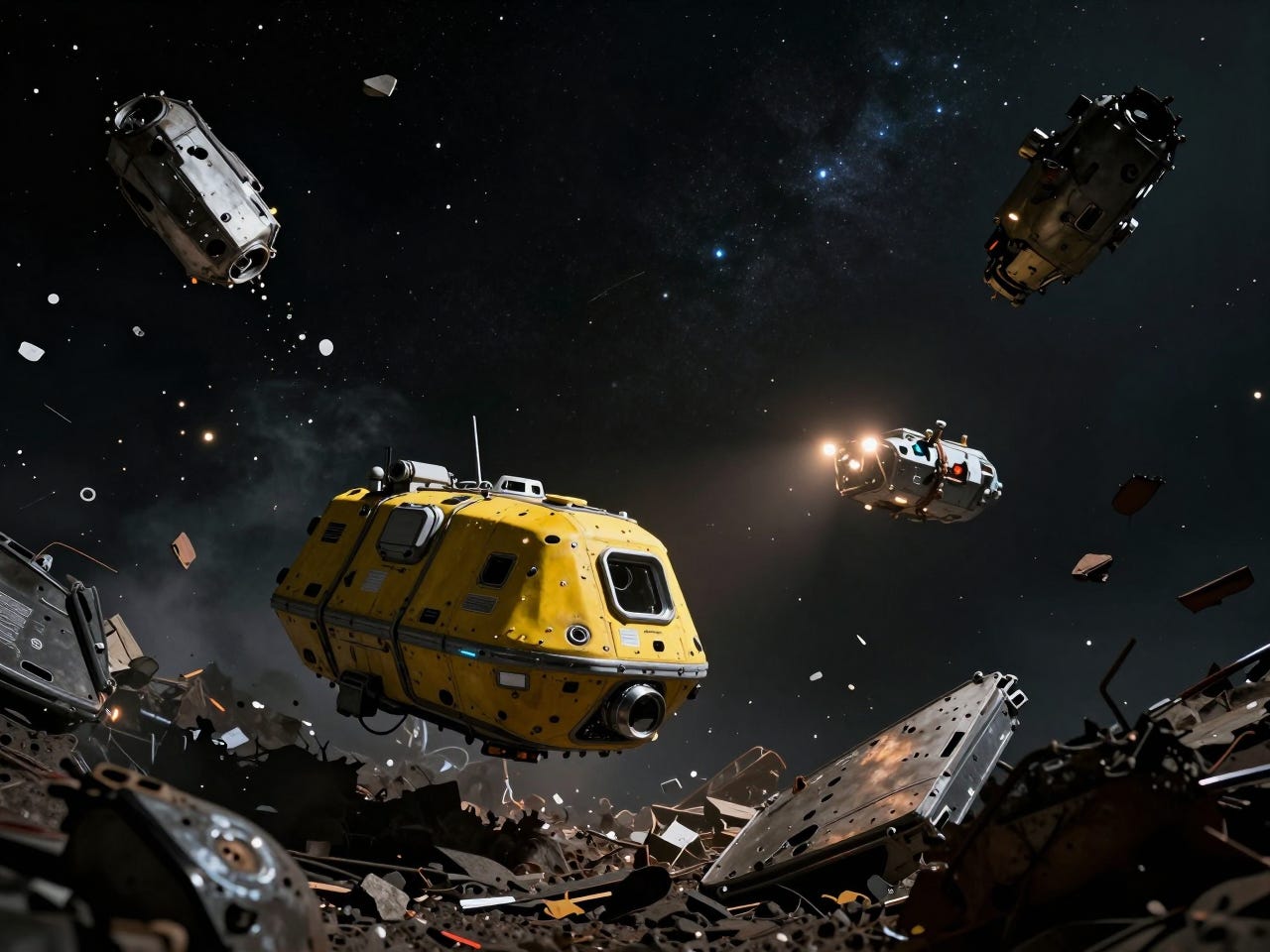
Two hours later, the component was free and secured in a recovery pod. Mira guided the pod back toward the Fortunate Son, her tether playing out behind her like a lifeline to the living world.
The ship hung against the starfield, a converted mining vessel that had seen better decades. Her hull was patched and re-patched, her engines rebuilt twice, her life support systems held together by salvage wire and stubborn optimism. She wasn’t pretty, but she was home.
“Nice work,” Deshi said as she cycled through the airlock. He was waiting in the cargo bay, his thin frame silhouetted against the work lights. “Clean extraction. Protocol is going to be happy.”
“Protocol is always happy when we bring them toys.” Mira unsealed her helmet and took a breath of recycled air. It smelled like home: machine oil, coffee, the faint tang of ozone from the atmospheric processors. “What’s our fuel status?”
“Twelve hours of maneuvering thrust. Maybe fourteen if we’re careful.”
“Then we’ve got time for one more sweep before we head back.”
Deshi raised an eyebrow. “You want to push it?”
“I want to make rent.” Mira stowed her helmet and began checking her suit’s seals. “One more pass through the secondary field. There’s supposed to be a concentration of debris near the old defense platform wreckage.”
“That’s deep territory. Lots of tumbling mass.”
“Lots of potential salvage.”
Deshi considered for a moment, then nodded. “Your call, Captain.”
The secondary field was denser than Mira remembered. Debris clustered here, drawn together by micro-gravitational interactions over the years, forming loose aggregations of metal and plastic and death. She navigated carefully, her thrusters firing in short bursts to avoid the larger pieces.
“Deshi, I’m seeing something at bearing one-eight-five. Large object, minimal rotation.”
“I see it. Sensors are having trouble getting a clear read. Too much interference from the surrounding debris.”
Mira adjusted her course, weaving between a tumbling engine cowling and what looked like half a command chair. The object resolved as she approached: a human escape pod, its hull scorched but intact, its emergency beacon long since depleted.
Her stomach tightened.
“It’s a life pod,” she said quietly.
“Mira…”
“I know.” She floated closer, her lights playing across the pod’s surface. The designation markings were still visible: UEN Defiant, Pod 7. A ship she’d never heard of, from a battle that had killed millions.
“Mira, we should mark it and move on. Let the recovery teams handle it.”
“I know,” she repeated.
She reached the pod’s viewport and looked inside.
Empty. The harness was unbuckled, the emergency supplies depleted. Whoever had been inside had either been rescued or had died trying to reach safety. Eight years ago, this pod had carried someone’s hope. Now it was just another piece of debris.
Mira touched the viewport with her gloved hand. A moment of silence for whoever had been here, whoever had fought and fled and maybe survived. She’d never know their name. She’d never know their story. She could only acknowledge that they’d existed, that they’d mattered, that their desperate escape was worth a moment’s recognition.
“Marking coordinates for recovery,” she said finally. “Let’s move on.”
They found two more Category Three components before their fuel margins demanded a return to port. Mira guided the Fortunate Son out of the debris field, leaving the graveyard behind them as they set course for Luna Station Alpha.
Deshi joined her in the cockpit, carrying two cups of coffee. He handed her one and settled into the co-pilot’s seat.
“Good haul today,” he said.
“Good haul,” Mira agreed.
They sat in comfortable silence, watching the stars slide past. Somewhere behind them, the debris field continued its slow drift, thousands of pieces of the battle that had saved humanity tumbling through the void. Every piece had a story. Every fragment had once been part of something larger, something that had mattered.
Mira thought about the empty life pod, about the unknown person who’d buckled into that harness eight years ago. Had they made it? Had someone found them, pulled them to safety, given them a chance to rebuild? Or had they drifted until their air ran out, one more casualty in a war that had killed billions?
She’d never know. That was the hardest part of salvage work. You found the remains of lives, the fragments of stories, but you never got the endings. You just marked coordinates, filed reports, and moved on to the next find.
“We’re doing good work,” Deshi said, as if reading her thoughts. “The stuff we bring back, it helps. Every component, every piece of technology, it gets us closer to being ready.”
“Ready for what?”
“For when they come back.”
Mira sipped her coffee. It was bitter, over-extracted, perfect. “You think they will?”
“Everyone thinks they will. That’s why the Protocol exists. That’s why we’re out here, picking through the bones of the last war, learning everything we can.”
“So we can win the next one.”
“So we can survive the next one.” Deshi shrugged. “Winning would be nice. Surviving is the minimum.”
The Fortunate Son flew on, carrying its cargo of alien technology and human hope. Behind them, Debris Field 7 faded into the darkness, a monument to the dead that the living kept returning to, again and again, searching for the tools to prevent another catastrophe.
Mira finished her coffee and began planning tomorrow’s salvage run.
Author’s Note: This story takes place in Year 8 of the Post-Invasion calendar, during the heart of the Salvage Protocol era. Civilian salvage crews like Mira and Deshi formed the backbone of humanity’s technology recovery efforts, spending months in the debris fields left by the Battle of Earth. Their work was dangerous, lonely, and essential. Every component they recovered brought humanity one step closer to understanding the enemy that had nearly destroyed them.
If you enjoyed this story, you can follow the main story arc in The Exodus Rush, the first book in The Vethrak Requiem series.