


Tuva stopped with the cutter still dark.
The first coordinate matched the mark on Article Four. The second matched Wanjiku’s map. The work-package revision on her cuff did not match the one clipped beside the tool carrier.
“Hold,” she said.
The rigger secured the removed-section capture against the scaffold. Nothing had been cut. Beyond his shoulder, the barrel’s three completed transitions curved through the cold work light, seams she could still follow with her eyes closed.
The carrier held a preparation copy. The protected package held the approved cutback.
Tuva called Wanjiku before touching either record.
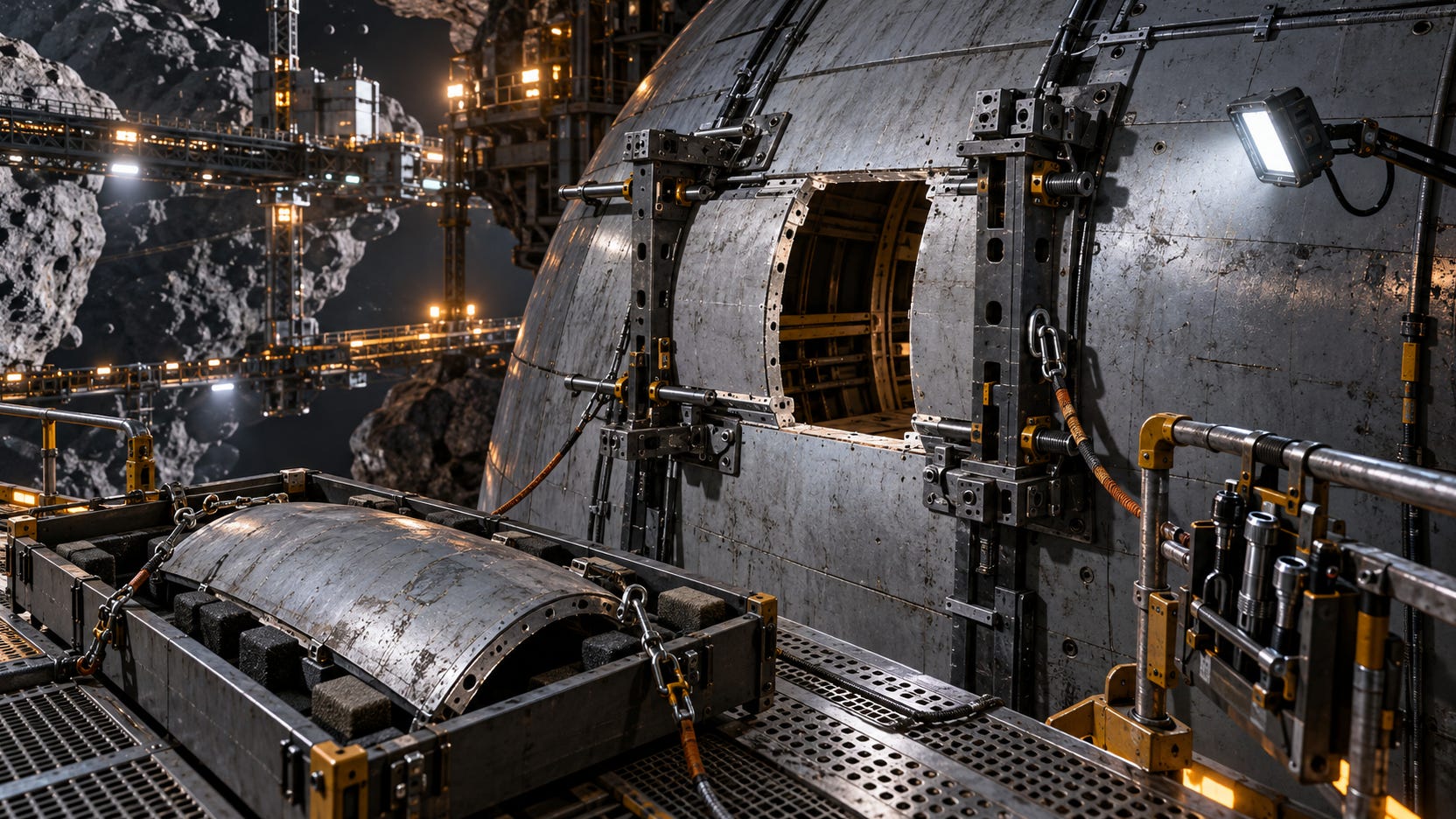
Wanjiku arrived along the fixed rail and caught a restraint beside her.
“Same coordinates,” the rigger said.
“Different authority,” Tuva replied.
The preparation copy had described the proposed envelope. Cho’s authorization now depended on the closed procedure qualification and Wanjiku’s bounded zones. Identical marks could not carry those conditions by themselves.
Wanjiku compared both records, retained the preparation copy as superseded, and bound the carrier view to the approved revision. She read the stop conditions aloud. Tuva answered each against the physical datum.
The barrel remained supported in its anchored fixture, isolated from proof load. Temporary capture would hold each section before its final ligament came free. No cut could cross the approved boundary without a new disposition.
“Even if it looks clean,” Wanjiku said.
Tuva checked the cutter’s captive lead. “Especially then.”
She had spent too many power windows making these transitions look complete. Now a clean-looking surface could persuade the hand to go faster, or to stop before the hidden damage ended.
Neither decision belonged to appearance.
The first cut ran beside the seam, not through its center.
Tuva fixed both boots and brought the tool against its guide. Extraction drew the fine cuttings into the captive collector. The reduced-power setting gave her time to feel the resistance through the handle without driving an unnecessary heat load into the retained edge.
The steel parted slowly.
She kept the guide’s reference inside her lamp beam. Samrawit’s specimen plan required the removed material to keep its orientation and its relationship to the original weld. A fast cut across the easiest path would have made a shorter shift and a worse answer.
Her cuff offered the remaining power block.
She did not look away from the guide to calculate how much of the second transition might fit inside it.
At the first stop coordinate she killed the tool, latched it into its holder, and read back the position.
The rigger’s capture held the section. A narrow uncut bridge still joined it to the barrel.
Wanjiku brought the probe to the exposed access surface.
Waiting with idle hands was harder than making the cut. Tuva kept one glove around the rail while the examination repeated from the registered positions. The reference response held. The indication ended before the conservative limit on the map.
“Shorter than predicted,” the rigger said.
“Within the uncertainty we allowed,” Wanjiku replied.
Tuva traced the approved margin with her lamp, not her glove. The earlier end did not authorize a smaller clearance by intuition. Wanjiku checked the examination coverage and retained the specified sound-metal allowance before releasing the next movement within the zone.
Only then did Tuva return the cutter to its guide.
The last bridge gave through the tool, a small change in resistance rather than a falling weight. The captured section moved against its restraint. The rigger arrested its rotation before unclipping the carrier from the scaffold.
A gap showed where her seam had been.
Samrawit received the section in a fitted cradle.
Tuva kept her tether short while they compared the attached local identifier, position, orientation and cut sequence with the protected package. The rigger did not release his capture until the receiving clamps had taken custody.
“This face,” Tuva said, moving the lamp.
The opening exposed a fine line beside the fused center, on the side their maps had named. Not a dark inclusion running through the weld metal. Not the broad tear her hand had imagined during the first failed proof.
Samrawit positioned a shield over the face before the carrier moved.
“Consistent with the mapped heat-affected zone,” she said. “The section keeps the evidence. It doesn’t replace the examination.”
Tuva checked the old execution reference still attached to it.
Her name remained there, scoped to the work she had actually done. The record now held the instruction that had failed the two plate histories as well. Cutting the steel apart would not make either signature vanish.
“Do you need more of the center?” she asked.
“What the specimen plan preserves. Not another cut to make it persuasive.”
The cradle locked. Samrawit recorded receipt.
Tuva returned along the rail without taking the little strip for a last look.
At the next transition, the indication used all the room they had allowed.
Tuva reached the second mandatory stop with the capture already secured. The cutter went dark. Wanjiku repeated the boundary examination while the remaining power allocation shortened on the cuff.
A probe cable brushed Tuva’s wrist. She clipped it clear and moved her lamp to keep the coupling surface visible.
The first pass put the endpoint close to the approved limit. The registered return and the corroborating view held it there.
Tuva’s thumb pressed into the cutter latch.
One extra sweep would open the line. It would also cross the disposition she had just verified, taking steel from a frame the repair was meant to preserve.
“At the full boundary,” Wanjiku said.
“Beyond?”
“No. The retained side meets this examination’s sound-boundary requirement. Keep the approved allowance. No extension.”
Tuva repeated it back before releasing the tool.
Cho’s voice arrived on the work channel. “Will the remaining allocation finish it?”
“Not the whole cutback,” she said.
A pause followed.
“Record the stop. The next block stays on the same package.”
She checked the restart condition, then finished only the movement Wanjiku had released. The captured piece separated without taking the frame edge with it.
The sound metal had no different color. It offered no clean bright line that a tired welder could trust instead of the scan.
Tuva covered the prepared boundary and saved the exact stopping point.
The later block carried the work through the remaining approved zones.
Each removed section went into capture before separation, then through the same identifier and orientation readback to Samrawit. Tuva kept the interruptions in the execution record. She did not fold the first short indication and the second full-boundary one into a single field called removed.
When the final affected material was out, Wanjiku accepted the retained-boundary record within the cutback disposition. Article Four had not become a released structure. It had become a structure they were permitted to rebuild.
Tuva transferred to the replacement cradle.
The worked plate’s physical datum matched its recorded direction. The normalized piece retained its separate condition. She brought the proposed edge preparation against those records, then against the qualified joining package. The new record showed what the gray surfaces could not: which history belonged to each side and which limits would govern the next heat.
She prepared the edges without striking a joining arc.
Across the scaffold, the last specimen carrier closed around the metal she had taken away. No anonymous scrap bin received it. Its old seam, the adjacent damaged zone, her cut path and Samrawit’s receipt remained connected.
Tuva secured the cutter, signed cutback complete within the bounded disposition, and left the joining line open.
Three gaps crossed Article Four where her finished seams had been. Her lamp passed through each one into the dark. At either edge, the fixture held metal the evidence still allowed them to trust.
Author’s note: This story follows Tuva Hawthorne in late Year 3 as Article Four’s affected transitions are removed under bounded repair authority. Cutting back to verified sound boundaries prepares the barrel for rebuilding; it does not complete the corrected joining, delayed examination, proof or release.
New to The Vethrak Requiem? Start with The Exodus Rush, Book 1, where humanity fights for survival after an alien invasion using technology it barely understands. These short stories explore the wider universe; the novel begins the main story.