


The press box was a narrow platform welded to the observation deck’s upper tier, forty meters above the amphitheater floor. Fernanda Oliveira had been standing on it for ninety minutes. The deck plates hummed through her shoes. The air tasted of recycled oxygen and the sharp chemical tang of fresh sealant. Prometheus Station had been finished in a hurry, and every bulkhead reminded you of it.
She was twenty-three, a UEN press officer six months into her career. She had drawn this assignment because her senior colleagues had looked at the commissioning ceremony on the schedule, looked at the appropriations bill that would hit the floor next month, and decided the real story was in the money. The ships were a symbol. The budget was the war.
Fernanda had read the briefing packet three times. She knew the captains’ names and the ships’. She had prepared questions nobody would let her ask. She had not prepared for the ships themselves.
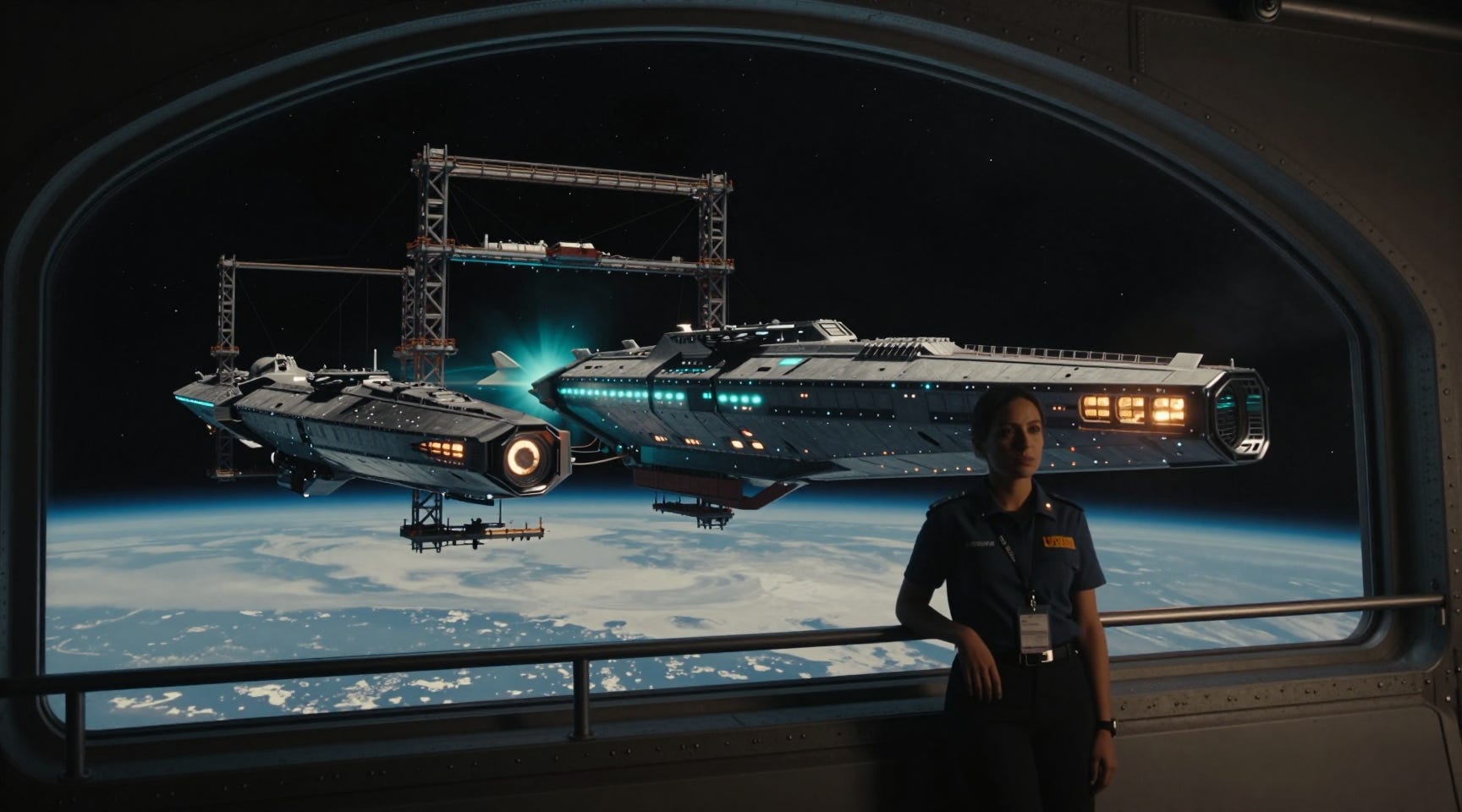
The observation deck’s viewport was two hundred meters of reinforced glass and salvaged steel. Through it, Earth turned slowly against the stars, blue and white and impossibly fragile. Three warships hung in their orbital frameworks beyond the glass: dark charcoal gray, elongated angular silhouettes, cyan running lights tracing their hulls like veins of fire. Vanguard. Defiant. Hope. The First Three. The first warships humanity had built since the invasion.
Fernanda’s press badge hung crooked on her collar. She straightened it. She checked her recorder. She did not look away.
Admiral Helena Chen took the podium at ten-hundred hours.
The amphitheater held three hundred commissioned officers and a thousand crew. The broadcast held billions. Chen stood at the center of the stage in an immaculate dress uniform, every insignia precisely placed, her gray hair cut short and functional. She did not greet the audience.
“The silence has lasted long enough to fool us into thinking it is peace.”
Her voice carried to every corner of the amphitheater without amplification. The deck plates did not hum any louder when she paused. The weight of the pause landed anyway. She wrote the quote down in her notebook. She did not look at the recorder to check that it was running. She trusted it.
“Do not mistake the absence of an attack for the presence of safety. The Vethrak came once. They will come again. When they do, they will find that we are no longer a planet. We are a fleet.”
The three ships through the great window had not moved. Their running lights traced steady cyan paths along their hulls. The construction frameworks had been retracted the night before. The ships were waiting.
Chen spoke for four minutes. Fernanda wrote down two more quotes. The rest she let the recorder catch. From the press box she could not see the captains’ faces, but she could see their shoulders. None of them moved while Chen was speaking.
The three captains received their colors one at a time.
Shaw was first. The oldest of the three, gray-streaked dark hair, lines carved deep around her eyes. She walked to the podium with the precision of someone who had spent a lifetime in zero gravity. When she accepted the colors of Vanguard, she did not smile. She said something to Chen the press microphones did not catch. Fernanda followed the shape of her lips. It might have been a promise.
Marcus Rivera was next. Younger than Shaw by at least fifteen years. He walked to the podium like a man who was already fighting someone and had not decided who. Hollow eyes. Shoulders coiled with a tension that looked like pain. He took the colors of Defiant and did not look at the audience. He looked at the ship through the great window, and Fernanda had the sudden wrong impression that he was looking at something he had already lost.
Tanaka was last. Where Shaw was precise and Rivera was coiled, Tanaka seemed to flow. She reached the podium with an ease that made the walk look choreographed, and Fernanda knew immediately that it was not. The woman was Japanese, a former scientist, the only one of the three captains who had volunteered. She accepted the colors of Hope and she did not smile, but something in the set of her face changed. Fernanda wrote: the one who wanted this.
The moment of silence for the eleven billion lasted sixty seconds.
Fernanda counted them. She had counted them every year since she was eleven years old, standing in a school gymnasium in São Paulo with three hundred other children who had all lost someone. The habit had never left her. She counted to sixty in her head as the officer block bowed their heads in unison.
A woman in the third row caught her eye. Lieutenant Commander’s insignia. Dark hair pulled back in a practical style. She was not looking at the podium or the ships through the great window. She had her head bowed, but Fernanda could see the line of her jaw, her lips pressed together, the small tremor in her left hand she was straining to still. The woman was crying silently, without making a sound.
Fernanda did not know her name. She did not know why this one woman in a formation of three hundred officers was falling apart while the rest held steady. She only knew that the moment of silence was ending and the woman’s hands were still shaking, and something about the image lodged in her chest and would not dislodge.
The press scrum was in a conference room off the amphitheater. Fifteen reporters, four chairs, standing room only. The captains had agreed to take questions for twenty minutes. Fernanda’s senior colleagues had told her to ask about the appropriations bill. She had written that question down. She had not decided whether she would ask it.
Shaw spoke first, and she spoke formally. She talked about the crew, the training, the twelve years of preparation that led to this moment. She did not mention the invasion. She did not need to.
Rivera spoke second, and he spoke brief. He answered four questions in sixteen words total. When a reporter from the Pacific feed asked him what he was looking forward to most about the first patrol, he said: “Silence.” The reporter laughed. He did not laugh. Fernanda tracked him as he left the room three minutes early. She did not follow him because she knew it would look like she was chasing a story.
Tanaka spoke last, and she spoke warmly. She told the reporters that her crew had spent the last three months running drills in simulation, and that the thing she was most looking forward to was finding out what the drills had missed. A reporter asked her what made her volunteer. She paused. Her voice was softer than the other captains, but it carried.
“Because I am a scientist,” she said. “And because I know what happens if we are not ready.”
The observation deck was empty at twenty-two-hundred hours.
Fernanda had filed her first piece at eighteen-thirty. Ceremonial. Quotes. Color. Everything her editor wanted. She had closed her terminal and walked back to the observation deck because she was not ready to leave.
The great window was dark now. The ships were still there, silhouettes against the starfield, their running lights pulsing in slow cyan rhythms. A faint luminescence was building around their hulls: the reactor spin-up, the first stage of bringing the ships to full operational power. The glow started low and blue-white around the engine sections and spread slowly forward, tracing the armor plating, the weapon hardpoints, the bridge viewports that would soon be lit amber with the faces of their crews.
Fernanda leaned on the rail. The metal was cold. Her press badge was still crooked.
She had been given an assignment. She had written the story her editor wanted. She had seen three captains accept their colors. She had counted to sixty during the moment of silence. She had not asked the question about the appropriations bill. It was not the right question.
She thought about the woman in the third row. The shaking hands. The tears that made no sound. Rivera’s hollow eyes. Shaw’s precision. Tanaka’s ease. The eleven billion dead. The three ships glowing now, reactor-level power bleeding off their hulls in a shimmer that bent the starlight around them.
The piece she had filed was a ceremonial color piece. The piece she would write tonight was something else. She did not know yet what it was. She knew what it was not.
She straightened her press badge. The ships kept glowing until the light faded into the deep. Tomorrow the First Three would leave their slips. The patrol would begin. The silence that had lasted twelve years was ending.
She had stopped counting at sixty. The world had kept going.
If you enjoyed this story, you can follow the main story arc in The Exodus Rush, the first book in The Vethrak Requiem series.