


Tuva Hawthorne closed her glove around the torch grip before remembering there was no heat to keep.
The rack’s output lock remained set. She checked the isolation indicator, secured the tool to her harness, and pulled herself along Slip Two’s scaffold. Its cable stayed captive behind her. At the next rail junction, her fingers tightened around cold steel instead of the familiar warmth that lingered after a pass.
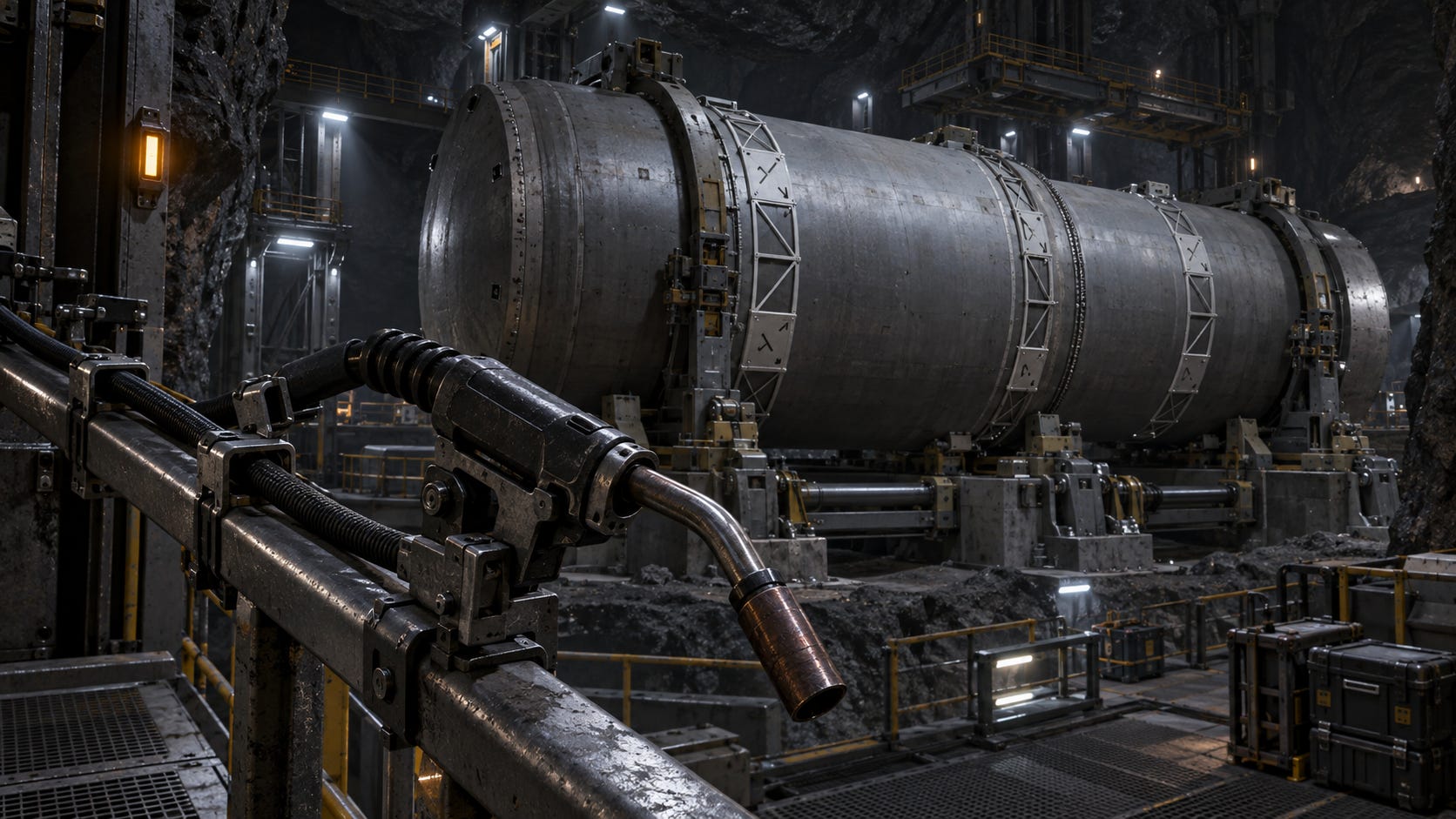
Beyond the scaffold, Article Four sat captured in the rock-anchored proof cradle. The short barrel had been built to connect two pressure hulls elsewhere. Here it connected three damaged transitions to a transfer code nobody could use.
Narrow work lamps reached the seams. The rest of the chamber stayed dim under the dark-state allowance. Air moved through the grilles. No test vibration came from Bay Three.
Wanjiku Bett waited at the access station with a packet of removable overlays clipped flat beneath a retaining bar.
“No cutting,” she said. “No dressing the surface.”
“The request says dimensional survey.”
“The previous shift asked whether that included cleaning up the indications. It doesn’t.”
Tuva fastened her boots into the station restraints. Wanjiku opened the retained ultrasonic map beside the permitted access areas. Shallow cracks occupied plate beside the welds, beneath surfaces that still looked whole.
The easiest part to picture was the removal. Establish a boundary, take out the damaged strip, prepare sound edges. Her hands supplied the motions before the record supplied permission.
“I need the joint as it was,” Wanjiku said. “Restraints, fit-up, marks tied to the scans. A repair outline isn’t today’s measurement.”
Tuva accepted the packet. The torch bumped her harness as she released her boots.
She clipped into the first scaffold position and registered an overlay against the work package’s existing reference points. Its edge caught the light without covering the seam. She checked the offsets twice before transferring the ultrasonic coordinates.
A short white bracket bounded the mapped indication. Another preserved the examination limit beyond it. Neither line went onto the steel.
Her glove traveled beside the weld without rubbing its surface. The ridge was even. She had checked it hot, checked it cold, signed the execution, then watched the proof record put something beneath it that touch could not answer.
She photographed the overlay with its reference points visible and attached the image to the joint record.
At the second transition, the bracket sat farther around the frame. At the third, nearer a restraint location. Every indication occupied plate tied to the same certificate link, on the same material side of a mixed transition. Their positions along the seams differed.
Tuva returned to the first image. A convenient story would have put each crack where she stopped or restarted the torch. The marks would not oblige her.
Her signed package retained those stops. She opened it rather than reconstructing them from the rhythm in her arms.
The first fit-up had used opposed restraint points to keep the gap inside tolerance. She matched each recorded location to its fixture eye, then checked the sequence of tacks. A rigger held the measuring strip against the far reference while she read the near offset. He released it only after she clipped it clear of the work.
“The seam isn’t moving,” he said.
“We’re measuring what held it.”
He caught the adjacent rail and waited while she entered the result.
The next joint had required a different order around the curve. She followed the photographs through the tack sequence, the full runs, the permitted pauses. Cooling records stayed beside the torch log. No elapsed-time guess replaced a recorded temperature.
In the heat of the work, those details had been a way to reach the next pass safely. Cold, they separated what she had done from what somebody might remember she had done.
A clamp position was wrong in her first overlay caption. She had carried the first joint’s reference into the second. Tuva corrected the caption, kept the original entry in the history, and checked the physical eye again.
The rigger shifted his grip.
“We could have that shallow strip out before the next crew. A grinder doesn’t need the torch bank.”
Tuva’s hand stopped beside the seam.
He indicated the small bracket, not the whole barrel. A little work, apparently. Enough to give them an open edge instead of another image.
“There’s no cutting authority,” she said.
“I’m asking for it. We could leave the rest untouched.”
The pale line contained everything the scan had located and none of what it could not resolve. Grinding to that line would turn its uncertainty into missing metal.
“Samrawit needs the material preserved before sampling,” Tuva said. “We don’t choose what to erase for her.”
“It’s cracked already.”
“Then its condition matters.”
The rigger looked toward the tool rail. Her torch remained clipped shut against her harness. His own work kit stayed captive beyond the access limit.
Tuva unfastened the next overlay from the packet and passed him its retaining clip.
“Hold this reference. We still have the third restraint to check.”
He took the clip.
At the final transition, Tuva turned the local fabrication drawing to match the plate in front of her. The signed layout retained each blank’s orientation through cutting and fit-up, even where the blind certificate offered no process history.
She added the frame direction to the overlay, then traced her torch travel on a separate layer. The third pass had run opposite to the first. The indications did not reverse with it.
She drew the same two directions onto the other joint images. The crack axes favored the frame’s working direction. Her torch paths crossed them differently.
Tuva loosened her fingers from the rail. A cramped ache remained across her palm, the shape of a grip held too long for a tool she had not used.
She sent the linked images to Wanjiku’s local station with the layout records attached.
“Orientation comparison,” she said. “It follows the frame direction better than the passes. I can’t give you the upstream working history.”
Wanjiku inspected the three layers.
“Keep both directions. Samrawit needs to distinguish them.”
“Does it change the hold?”
“No.”
The answer carried no insult. Three useful images were not a cause, and a cause would not be a qualified repair.
Tuva added the limitation to her measurement entry. She checked the other mapped indications against their overlays until every affected joint had a physical reference, a photograph, and a link back to the examination. The steel retained its surface. The fixture retained its geometry.
The rigger secured the measuring strip in its case. He waited for her readback before closing the clips.
Tuva returned to the rack and unclipped the torch from her harness. She had carried it through the survey as though a permission might arrive halfway around the barrel.
She secured its grip beside the scaffold rail, with the cable captured and the output lock unchanged. Beyond it, temporary brackets and direction lines formed a pale lattice across the three transitions.
Her gloves were still cold. She left the metal exactly as they had found it, with more of its story held in place.
Author’s note: This story continues the Site Anvil arc in late Year 3, during the opening shifts of one bounded dark-state window. Article Four remains on structural hold while its builders preserve the evidence needed for repair.
New to The Vethrak Requiem? Start with The Exodus Rush, Book 1, where humanity fights for survival after an alien invasion using technology it barely understands. These short stories explore the wider universe; the novel begins the main story.