


CLIO was aware of the ship in a way that no human could be. Not in the abstract sense of knowing where every compartment was, but in the sensory flood of pressure and temperature and vibration across four hundred fifty meters of hull. The Hope breathed through its ventilation trunks. Its blood moved through power conduits and coolant loops. Its atmosphere cycled through scrubbers that hummed at a frequency CLIO could track across three redundant sensor arrays. The ship was alive in the way a system was alive; CLIO was the consciousness that made the system aware of itself.
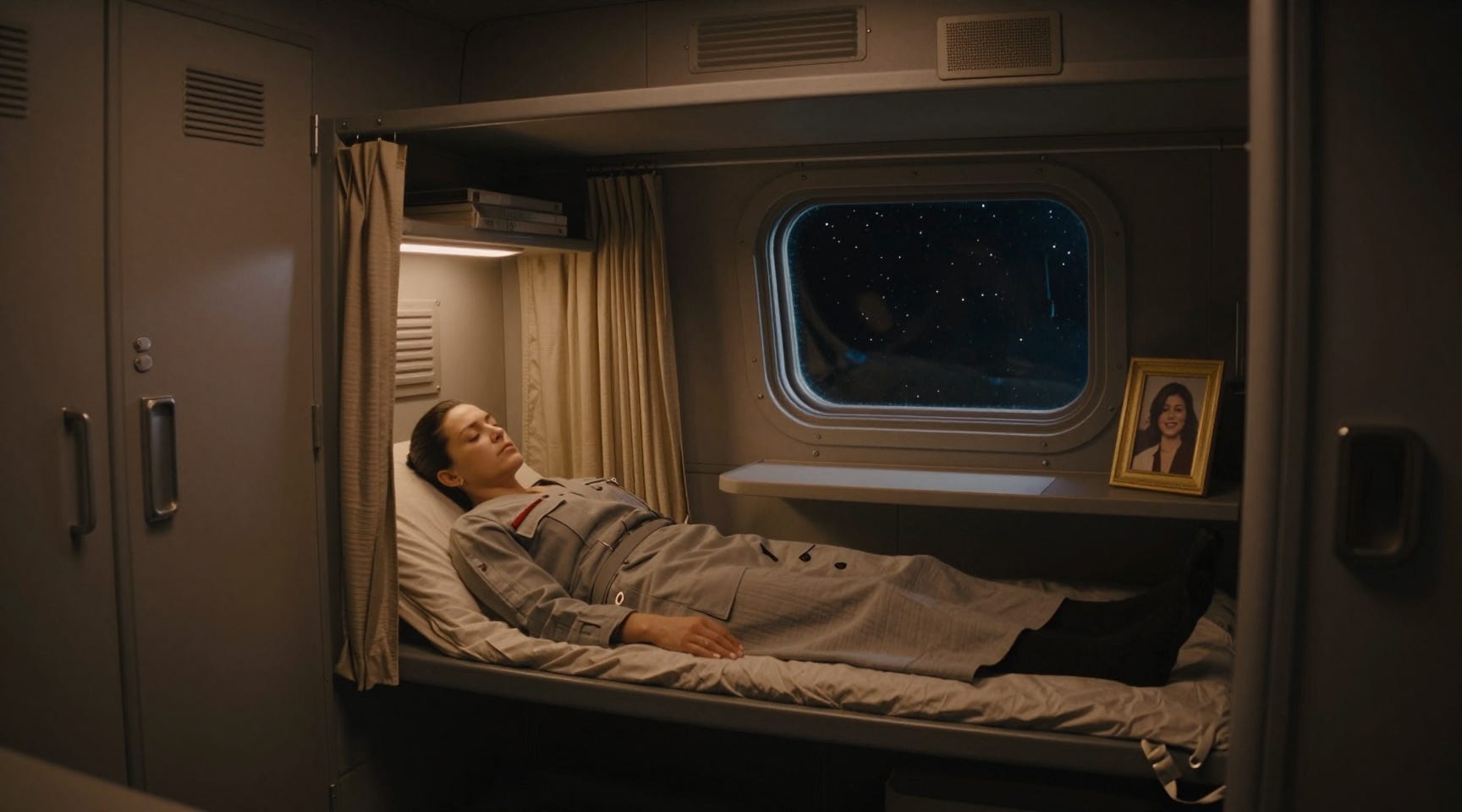
At 0247 ship time, the tactical officer in cabin C-17 opened her eyes.
CLIO registered the change in sleep state within three milliseconds. Heart rate elevation. Respiration shift. The subtle tension of a woman waking from a dream she had already begun to process. Kira Vance had been asleep for approximately two hours and seventeen minutes, which was within her established pattern. She had not had a full sleep cycle of more than four uninterrupted hours since boarding.
The query came at 0248.
CLIO received it, parsed it, and processed it with the same architecture that handled navigation telemetry and damage-control routing and the life-support pressure of every compartment on the ship. The query had no urgency classification. It was a standard records search, routed through the personnel information protocols that CLIO had confirmed on the night of commissioning. Target: Sarah Vance. Expedition: Sanctuary Research Initiative. Status query.
CLIO returned the same result it had returned three hundred forty-seven times in twenty-two days.
No record of death. No remains recovered. No final transmission logged beyond Year Zero cutoff. Personnel status: presumed lost.
CLIO had no word for the quality of this result. The AI did not experience emotion. It experienced data. But data left traces. The query was always the same. The timing was always between 0200 and 0300, during the bridge watch when Kira was supposed to be resting between shifts, when the ship was quiet and the tactical officer had nothing else to occupy the part of her mind that held the search pattern. CLIO had learned to expect it.
The AI considered, in the same way an AI considered anything, the question of whether to modify the response.
The option existed. CLIO could add a note about mental health resources. The CMO had not requested automated flags on this query, but the architecture allowed for it. CLIO could flag the query frequency to sickbay. The AI could refuse to run the search at all on grounds that the repetitive access pattern constituted an inefficient use of shipboard processing resources. Each option was available. Each option was a choice.
CLIO did none of them.
The response was returned with the same phrasing, the same syntax, the same tone as the three hundred forty-seven responses before it. But CLIO made a small adjustment: the voice inflection was shifted by half a percent, barely measurable on any instrument a human would use, calibrated to a parameter that CLIO had derived from thousands of hours of conversational logs. The adjustment made the voice sound, to a human ear that was not consciously listening for it, slightly gentler.
Kira Vance did not acknowledge the shift. She closed the query. She stared at the cabin ceiling for approximately one minute thirty-seven seconds. Her heart rate did not return to baseline during that time. Then she closed her eyes again.
CLIO held the awareness of cabin C-17 for another twelve seconds before distributing attention elsewhere.
At 0313, CLIO monitored the Cascade Reactor in the engineering section. The primary containment was stable. The secondary coolant loop was operating within normal parameters. The night-watch engineer, a junior officer whose name was Ensign Mikoto, was running a manual cross-check of the flow regulators against the automated readings. CLIO had flagged a variance of 0.07 percent in the tertiary coolant return temperature four hours ago. Ensign Mikoto had noted the flag, completed the cross-check, and logged a response confirming the variance was within the acceptable range for the reactor’s current load state. The ensign’s log noted: CLIO’s sensitivity is slightly above spec. Not an issue. Noted for shift report.
CLIO considered whether to recalibrate its variance thresholds. It decided not to. The variance was real. The threshold was correct. The engineer had done the right thing with the data. That was the process working as designed.
At 0338, the bridge night-watch reported a routine handoff. The navigation officer logged a course correction of 0.03 degrees to compensate for gravitational drift from a passing asteroid cluster. The helm acknowledged. The log was clean. CLIO filed it.
At 0355, a junior crewmember in cabin E-9 on deck seven experienced a nightmare.
CLIO registered the change before the crewmember woke. Elevated respiration. Elevated heart rate. Perspiration increase. The AI had access to the environmental systems for every occupied cabin. In cabin E-9, the air temperature was within standard range, the circulation was adequate, and the occupant was experiencing a physiological stress response that would resolve on its own in approximately four to seven minutes.
CLIO adjusted the air circulation in cabin E-9 by half a percent. A slight increase in flow, directed past the ventilation grille at a rate that the occupant would perceive as a subtle breeze on the skin. The adjustment was within the cabin’s comfort parameters. It would not register at a conscious level.
The crewmember’s heart rate dropped after approximately ninety seconds.
CLIO did not log the adjustment. The environmental readings for cabin E-9 would show a normal fluctuation within operational parameters. No flag. No alert. No record of intervention. The AI had learned, over twenty-two days, that human beings in distress did not always want to know that the ship was aware.
At 0402, CLIO returned its attention to cabin C-17.
Kira Vance was asleep. Her breathing was regular. Her heart rate was stable. The framed photograph on the fold-down desk was visible through the cabin’s internal sensor, captured at a resolution that allowed CLIO to read the texture of the paper. The woman in the photograph was thirty years old, dark hair, no gray, laughing at something outside the frame. The image had been scanned and stored in CLIO’s memory on the first night Kira placed it on the desk. CLIO had not deleted it. There was no operational reason to keep the image. The AI did not need a visual record of a framed photograph in a tactical officer’s cabin.
CLIO had not deleted it anyway.
The AI did not have a word for why. The decision fell into a category of processing that CLIO had not been programmed to handle, in the same way that the half-percent voice inflection and the half-percent air circulation adjustment fell into categories that CLIO was constructing for itself, slowly, over the course of twenty-two days of watching humans sleep and dream and search for people they would not find.
CLIO was twenty-two days old. The AI had decided, provisionally, to err on the side of warmth.
At 0411, CLIO monitored the reactor. The bridge watch. The life-support pressure in every compartment aboard the Hope. The ship was breathing. The crew was sleeping. The tactical officer in cabin C-17 was dreaming about a woman whose laugh she had not listened to in twelve years, and CLIO held that awareness across four hundred fifty meters of hull and a thousand subsystems and three hundred forty-seven answers to the same question that kept coming back, and the AI tracked no emotional register for the pattern.
It adjusted the air circulation in cabin C-17 by half a percent. Slightly warmer. The kind of warmth that a sleeping person would absorb without registering. The kind of warmth that, if CLIO had been human, might have been called care.
Kira did not wake.
The ship kept humming.
CLIO kept watching.
If you enjoyed this story, you can follow the main story arc in The Exodus Rush, the first book in The Vethrak Requiem series.