


The classroom had no windows. None of the children found this strange.
Teacher Adaora pulled up the holographic display, and Earth filled the space above their heads: blue oceans, white clouds, the familiar green and brown patchwork of continents that every child in the system learned to recognize before they could read. Eleven faces looked up at it with varying degrees of interest. Eleven children who had never felt rain on their skin or grass beneath their feet.
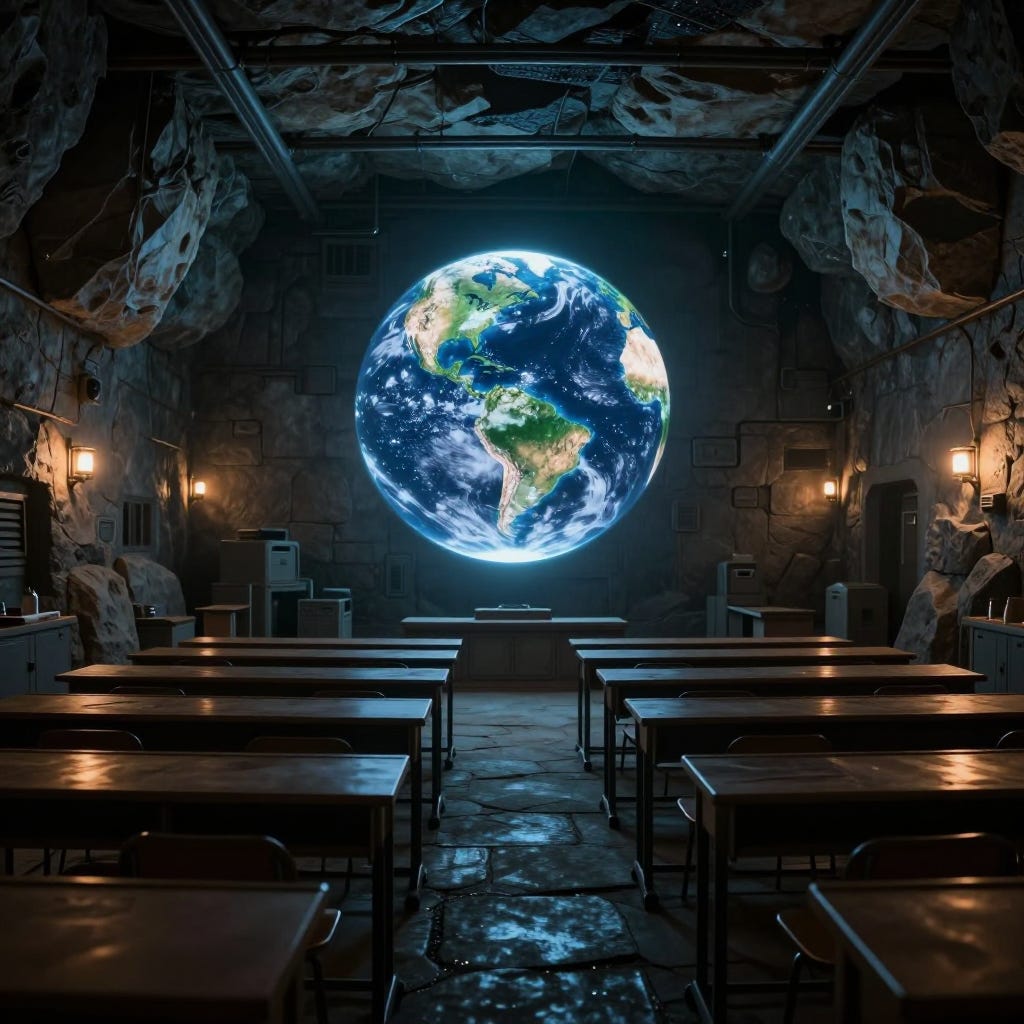
“Today we’re going to talk about gravity,” Adaora said. “Who can tell me what Earth’s gravity feels like?”
Hands went up. She pointed to Tomás, a thin boy with the elongated frame common to belt-born children.
“Heavy,” he said. “Like wearing a suit full of rocks.”
“That’s what the older people say, yes. Has anyone here ever been to Earth?”
The hands went down. Of course they hadn’t. The youngest was seven, the oldest twelve. All of them had been born after the invasion, in the carved-out tunnels and pressurized domes of Vesta Colony. Earth was a story their parents told, a place that existed in photographs and videos and the haunted eyes of adults who remembered.
“My mom says Earth smells like flowers,” said Yuki, a girl with her hair in twin braids. “She says the air moves by itself, without fans.”
“Wind,” Adaora said. “That’s called wind. The atmosphere circulates naturally because of temperature differences between regions.”
“That sounds broken,” said Marcus, the oldest boy in the class. “Why would you want air you can’t control?”
Adaora smiled. She had been born on Luna, had spent three years on Earth during the reconstruction period before transferring to the belt. She remembered wind, the unpredictable push and pull of it, the way it could shift from gentle to fierce in moments. She remembered hating it at first, then missing it desperately after she left.
“It’s not broken. It’s just different.” She manipulated the display, zooming in on a mountain range. “On Earth, air pressure changes with altitude. The higher you go, the thinner the air becomes. That’s why mountains have snow on top even when the valleys are warm.”
“Snow is frozen water that falls from the sky,” Yuki recited. She had clearly been studying.
“Correct. Water evaporates from the oceans, forms clouds, and falls back down as rain or snow depending on temperature.” Adaora watched their faces, saw the mixture of fascination and skepticism. “I know it sounds inefficient. All that water just falling wherever it wants.”
“Ceres has better water management,” Marcus said. “Every drop is tracked and recycled.”
“Ceres has to. Earth doesn’t.” Adaora paused, considering how to explain abundance to children who had grown up measuring their water rations in milliliters. “Earth has so much water that humans couldn’t use it all if they tried. Oceans cover seventy percent of the surface. You could drink from rivers and lakes without ever running out.”
Silence. The children exchanged glances, clearly suspecting she was exaggerating.
“My dad says Earth is broken now,” said a quiet girl named Priya. “He says the Vethrak burned the cities and poisoned the land.”
“Some of it, yes. The invasion caused terrible damage.” Adaora’s voice softened. “Eleven billion people died. Many of the great cities were destroyed. The reconstruction is ongoing, and it will take generations to fully heal.”
“Then why do we learn about it?” Marcus asked. The question wasn’t hostile, just practical. Belt children learned to be practical. “If Earth is broken and we live here, why does it matter what the old world was like?”
Adaora had been waiting for this question. She asked it herself, sometimes, in the quiet hours when she wondered if she was teaching history or mythology.
“Because Earth is where we came from. Because understanding what we lost helps us appreciate what we’re building.” She gestured at the walls around them, the recycled air they breathed, the artificial gravity that kept their bones from becoming too brittle. “Everything we have, everything we are, started there. The language we speak. The stories we tell. The way we organize ourselves into families and communities. All of it came from Earth.”
“The Vethrak came from somewhere too,” Tomás said. “We don’t learn about their home.”
“We don’t know where they came from. Not yet.” Adaora felt the familiar chill that came whenever the enemy was mentioned. “What we do know is that they traveled across the stars to attack us. They had technology we’re still trying to understand. They killed billions of people in weeks.”
“And we beat them,” Marcus said. There was pride in his voice. “My grandmother was in the Lagos defense. She killed six of them herself.”
“The defense of Lagos was one of the great victories of the war,” Adaora agreed. “Human beings fighting with whatever they had, refusing to surrender even when the situation seemed hopeless. That spirit, that determination, that’s also part of what we inherited from Earth.”
She changed the display again, showing a star map now. Sol at the center, the familiar planets arrayed around it, and beyond them the scattered points of light representing human settlements. Vesta was highlighted in amber, their home, a single bright dot in the vastness.
“You were born here. This is your home. Nobody can take that from you.” Adaora looked at each of them in turn: Tomás with his questions, Yuki with her facts, Marcus with his practicality, Priya with her quiet observations. “What I’m trying to teach you isn’t just about Earth. It’s about understanding that we’re part of something larger. Humanity didn’t start with us, and it won’t end with us. We’re one link in a chain that stretches back thousands of years and forward into a future we can’t imagine.”
“Will we ever go to Earth?” Yuki asked. “Actually go there, I mean. Walk around outside?”
“Maybe. The reconstruction needs workers. The colonies need supplies Earth can provide. Travel between worlds is expensive, and dangerous, and complicated.” Adaora smiled. “Whether you go to Earth or not, you’ll carry it with you. In your genes, in your culture, in the stories you tell your own children someday.”
The lesson continued: geography and climate, the water cycle, the way seasons changed as Earth moved around the sun. The children listened, asked questions, absorbed information about a world they might never see. When the bell chimed to signal the end of class, they filed out in the orderly way belt children learned early, single file through the narrow corridor, no pushing, no running.
Adaora stayed behind to shut down the displays. Earth faded from the air above her head, replaced by the bare rock ceiling of the classroom. She stood there for a moment, remembering wind and rain and the weight of a world that had tried to crush her, then lifted her up and let her go.
The children would be fine. They were building something new out here, something that had never existed before: a generation with no memory of Earth’s sky, no inherited grief from the invasion, no fear of the Vethrak beyond what they learned in stories. They were the first truly spacefaring humans, born between the stars, at home in the void.
Maybe that was the real lesson. Not what Earth had been, but what humanity could become.
Adaora gathered her materials and walked out into the corridor, where the recycled air hummed through the vents and the artificial gravity held her gently to the floor. Behind her, the empty classroom waited for tomorrow’s lesson.
Outside, children’s laughter echoed through the tunnels of Vesta, the sound carrying through stone and metal and the dreams of eleven billion ghosts.
This story takes place in Year 11 (2136), one year before the events of Book 1. Vesta Colony, established in 2129, was one of the first permanent settlements in the asteroid belt and served as a model for subsequent mining and habitation operations. By Year 11, the colony’s population had grown to approximately 8,000 residents, including over 400 children born in low gravity. Teacher Adaora Obi would later write extensively about the psychological development of “void-born” children, contributing significantly to educational policy across all colonial settlements.