


Scrubber Bank C dropped off the environmental board at 0413, and Bank D carried the whole station’s breath for eleven minutes before the transfer logic caught up to what had already happened.
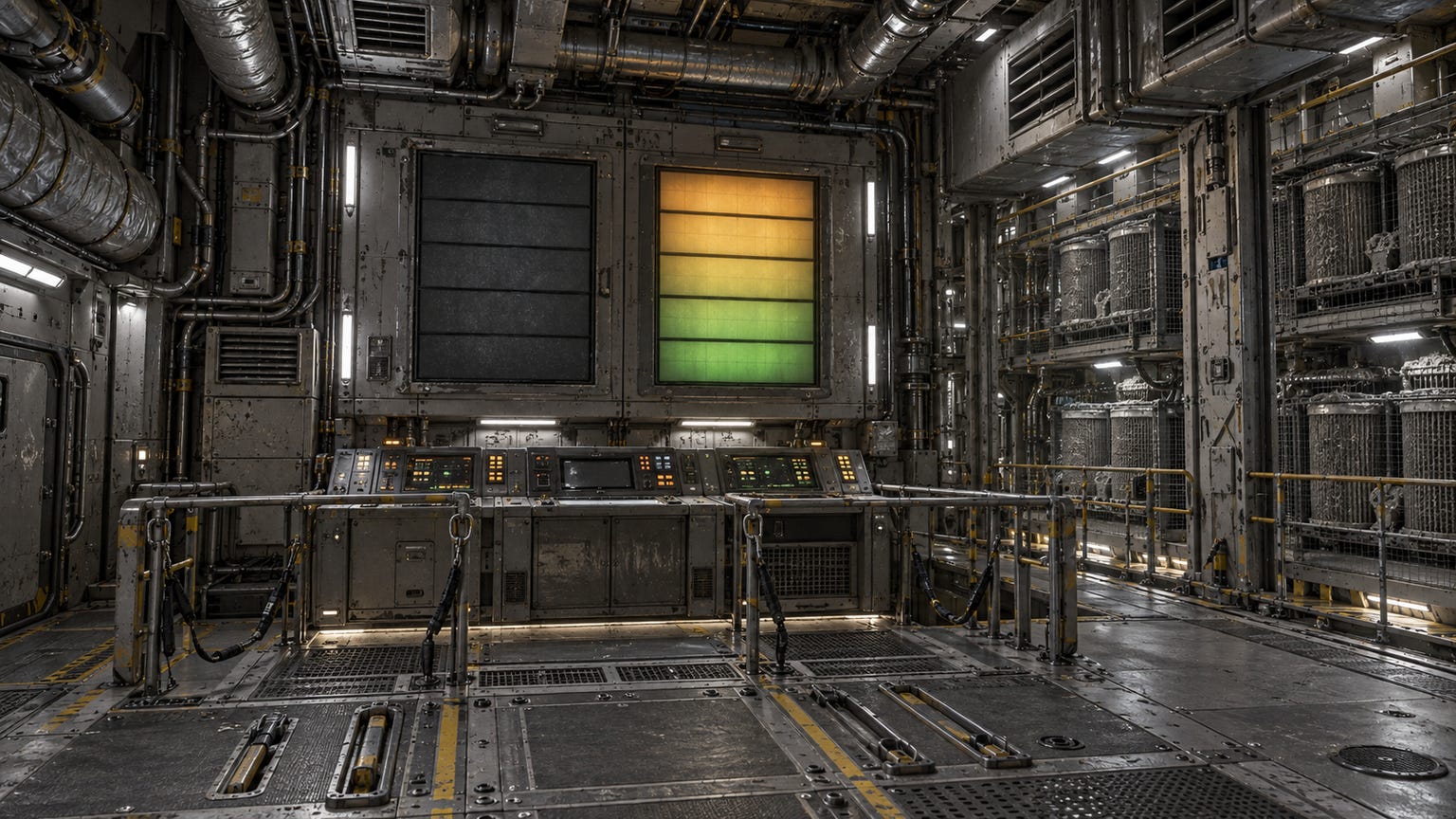
Sigrid Hedlund reached the operations control rail before the shift supervisor finished the callout. She hooked a boot under the deck strip and pulled herself to the environmental console, the low gravity turning the last meter into a matter of aim. The board showed Bank C isolated, a gray tile where a green one belonged, and Bank D beside it swollen to full intake. The air-quality trace under both banks held flat. Carbon dioxide partial pressure, nominal. Oxygen fraction, nominal. Nobody on Ceres had taken a bad breath.
Eleven minutes was the number that stayed with her. Eleven minutes of a bank offline before the automatic load shifted. The redundancy had done its work. The timing had not.
“Walk me through it,” she said.
The shift supervisor kept both hands on the console rail. “Isolation command hit Bank C at 0413. Clean shutdown, valves sequenced in order, nothing forced. D ramped on its own logic and stabilized. C came back to standby at 0424. No air event, no injuries, no ward calls.”
“A clean shutdown.” Sigrid turned the phrase over. “Not a fault. A command.”
“A command,” the supervisor said.
A fault was rock. A command was a hand. She had spent eleven days on the wrong side of that distinction already, and the memory of it sat under her sternum where the coffee never reached.
Ten days the faces had been dark. Ten days of buffers drawing down toward the number where Fleet Construction stopped sending schedules and started sending lawyers. She read the board every morning for the shape of an ending, and every morning the board returned the same standoff. A scrubber bank down on union credentials was not a standoff. It was a lever.
The operations security manager came through the hatch with a slate open, boots finding the strips in the smooth economy of a man who had crossed the station fast and chosen not to show it.
“Director. The isolation did not originate at the environmental desk.” He turned the slate toward her. “It came from a maintenance terminal on the union emergency circuit. Terminal seven, west habitat spur. The credentials on the command belong to a Spacers Union pressure crew.”
Sigrid checked the board clock. Twenty-two minutes since Bank C returned to standby. A terminal ID, a circuit, a credential set, a named crew, all of it assembled and packaged inside twenty-two minutes on a station where she had waited eleven days for a raw sensor file that lived one tap from an array.
The speed should have been a comfort. She held it at arm’s length and could not have said why.
“You are telling me a union crew took a scrubber bank offline during a strike.”
“I am telling you the credentials on that command belong to a union crew.” He did not blink at the difference, and she took in only the half she wanted. “They hold the emergency circuits under the safety carve-out. That access was the concession. This is what the concession bought.”
The sentence had a shape she recognized. It was the shape of relief. A sabotage story would lift the weight of 3-Bravo off her desk and set it on the line, and every incentive she carried leaned toward picking it up. She had signed the cycle that killed those miners. A union that would foul its own air was a cleaner story than a director who had trusted curated assurance over an amber hold.
She distrusted the cleanliness on principle and reached for it anyway.
“No accusation leaves this office,” she said. “Not to the station, not to Fleet Construction, not to Houston. A credential is not a confession. You bring me the terminal access log, the badge sequence, and whoever stood on that circuit at 0413, and you bring it verified.”
“Understood.”
“Restrict the circuit while you verify. Terminal seven locked to supervisor authorization. Union emergency access logged live to my desk.”
“Copy, Director.”
Ayanda Molefe arrived from the medical spur before the manager cleared the hatch, moving hand over hand along the ceiling rail, her slate clipped to her hip.
“You had an air event,” she said. It was not a question.
“We had a scrubber isolation. No air event. D held it.”
“D held it.” Ayanda brought herself down to the console and put the environmental board through a filter Sigrid had not opened. “Bank D is rated for full station flow. It is not rated for full station flow at current dust loading.” She flagged a maintenance line and left it on the pane. “The strike stopped extraction. It did not stop the dust already in the ducts settling into the filters. The cleaning rotation went out with the production crews. D has been carrying more than its plan since 3-Bravo sealed. You asked it to carry the whole station.”
“It carried it.”
“For eleven minutes. With a trace that stayed flat.” Ayanda’s voice held level, the way it held over a body. “Redundancy on a schematic is two banks. Redundancy in this station tonight is one healthy bank and one that is closer to its own margin than that green tile admits. Do not read the flat trace as reserve. Read it as luck that has not spent itself.”
Sigrid held her eyes on Bank D’s tile. Green. Full flow. Steady.
The deeper maintenance screen was one tap under the tile. The load figure would be there against the plan figure, the same way the raw traces had been one tap away on the morning she signed the exception. She had not spent that tap. Her cursor sat over the tile and did not move.
“Note it into the medical record,” she said. “Filter loading, cleaning rotation, reserve margin. Signed and dated.”
“It is already signed.” Ayanda unclipped from the rail. “I am telling you before it becomes a document, so you cannot say later that it arrived too late to matter.”
She left the way she had come, along the ceiling rail, and the flagged maintenance line stayed on the pane after her, one amber row under a wall of green.
The security manager’s follow-up came onto her slate an hour into the next shift. Bank C restored to full service. Board status, green across both banks. Terminal seven locked. Union emergency access flagged for review. The summary read, in the flat grammar of a system report, that the isolation command had carried Spacers Union credentials.
Carried. The report was precise where she was not. It proved which credentials had opened the valves. It did not prove which hand had held them. She read past the gap the way she had read past the empty safety chair on the morning of the review, because the story on the near side let her keep moving and the story on the far side did not.
She opened the access restriction the manager had drafted and read it clause by clause. Terminal seven under supervisor authorization. Union emergency crews escorted on the environmental circuits. Joint staffing on life support reduced to a single monitored station.
The joint arrangement had kept medical, habitat, and rescue crewed while the faces stayed dark. She was about to thin it on the strength of a credential and a story she wanted to be true.
A verified sabotage finding would do more than thin the staffing. It would put an injunction in Houston’s hand, a court order to reopen the faces and break the line on grounds no arbitrator would refuse. The incident had arrived shaped to that use, cut to fit it, and the neatness of the fit should have slowed her hand. Ten days of a falling board argued the other way.
Bank D held its green tile above the drafted order, full flow, steady, one tap from the number Ayanda had put in front of her.
Sigrid signed the restriction.
If you enjoyed this story, you can follow the main story arc in The Exodus Rush, the first book in The Vethrak Requiem series.