


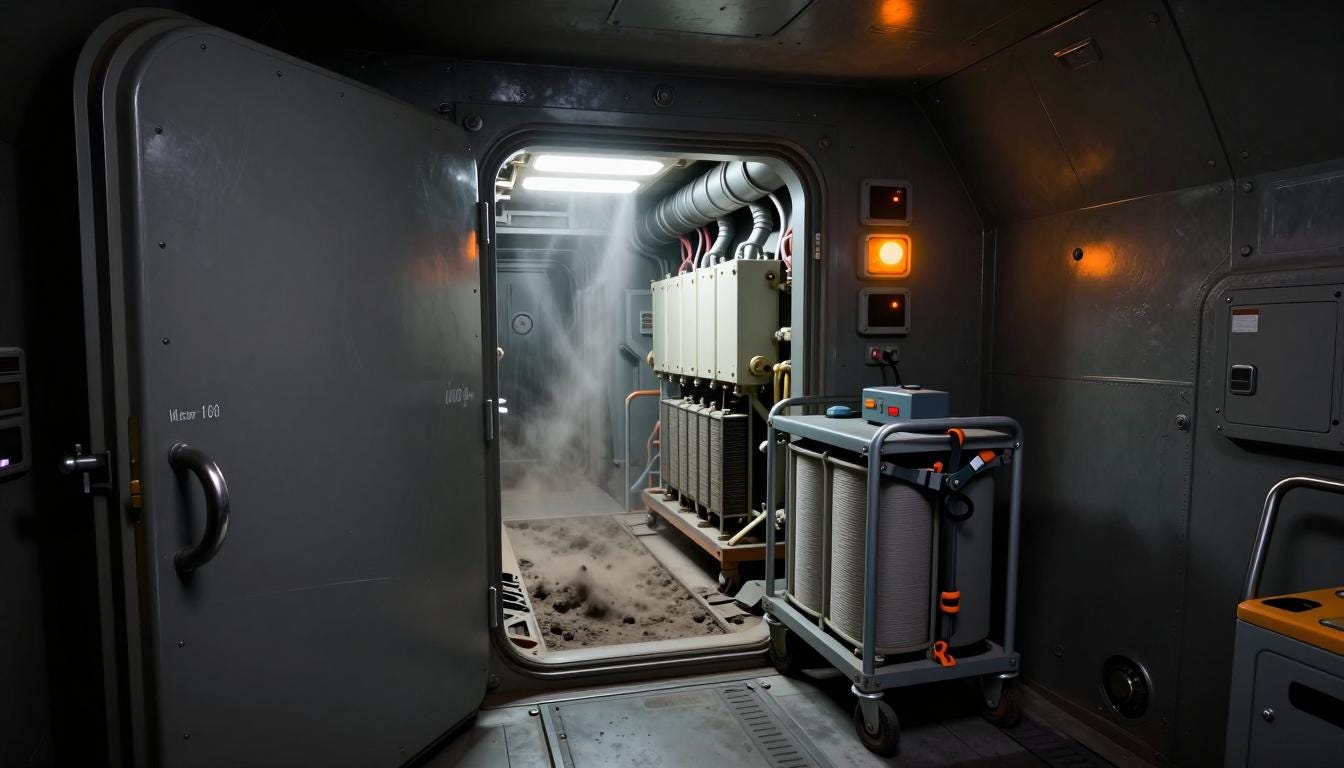
The pressure door closed before Lena could get the filter trolley through.
She caught the trolley’s restraint, locked her boots, and let the load pull against the strap instead of her shoulder. Beyond its nose, the door settled onto a slow pneumatic seal. Loose gray dust trembled along the floor strip. A few grains lifted and stayed above the metal after the vibration stopped.
The gallery fans ran down together.
Lena brought her handheld meter to the return-air sampling socket. Its environmental link showed two scrubber trains stopped, both on Bank D’s labor-ring branch. The pressure reading barely moved. Nothing had opened to vacuum. People could keep breathing this air while it grew worse around them.
Thirteen days of stopped extraction. Fourteen now, with the evening shift arriving along the rail behind her and fresh filter packs still strapped to the trolley. The crew had spent the afternoon waiting for a management escort.
Yesterday’s medical warning remained on her meter. Reduced activity in east industrial and the lower processing spur. Those sectors shared this return trunk. The labor ring lay farther along it, beyond another pressure boundary, full of people who had already finished work.
Ji-woo Han clipped beside her and coupled a second instrument to the socket.
“Not the earlier isolation,” she said. “New command. These two trains.”
Lena set her palm against the door frame. The fan vibration had gone, but a slower tremor crossed the metal beneath it. She shifted her glove to the next bolt. The tremor weakened there.
“Keep that sample running.”
The service hatch beside the pressure door retained its red access lamp. An environmental technician waited beneath it with a harness full of portable carbon-dioxide traps. His filter tools hung on short restraints, each one polished where a glove closed around it.
“Supervisor release,” he said. “Still.”
Lena pulled up the shutdown receipt on the local indicator. Eighteen sixteen and four seconds. Remote isolation, accepted. Both train addresses sat beneath the same command signature, followed by acknowledgments from the valves and the door.
No overload trip. No local emergency pull. The machinery had obeyed.
She called environmental control and read the time. The duty supervisor denied issuing it. The outgoing supervisor denied it on the same open channel. Neither had a maintenance shutdown scheduled for the labor ring.
“Who can release it?” Lena asked.
“Local check first. I won’t reopen against an isolation I can’t account for.”
That answer belonged to the work. The locked hatch did not.
She opened the receipt again. Somebody had selected both trains and sent the sequence. Whether the intent was maintenance or another lever against the line, the command was deliberate. The credential did not tell her whose hand had used it. Four days of accusations had already demonstrated what happened when people filled that gap themselves.
Ji-woo rotated her screen against the rail clamp.
“The posted contingency gives four hours before the ring’s relocation trigger.”
“From now?”
“From shutdown. Clean filters, rated bypass flow. It doesn’t use yesterday’s baseline.” She fitted the live trace over the model. “This slope gives eighty minutes remaining. If it stays straight.”
Lena checked her meter against Ji-woo’s. The independent sample agreed.
“Send the live estimate to medical. Not the posted one.”
Ji-woo sent it. Her thumb stayed on the transmission key until the acknowledgment appeared.
Lena opened the last running values for the branch. Filter differential: three hundred sixty pascals. The maintenance report beside it said one hundred twenty. Across the intake filters, the fans had been pulling against three times the recorded resistance before the shutdown reached them.
The replacement line carried an overdue flag. Beneath it, another request waited for escorted access.
“Can the bypass take this?”
The technician leaned toward the two readings. “Not with those filters. We need to check the actual flow.”
Lena put her hand back on the trolley restraint. The new media had passed the union checkpoint without delay. She had signed the entry herself. It had reached the right corridor and stayed outside the right door while the old media filled with dust.
Kavita Nair came along the rail, braking with one hand before clipping to the hatch post. She read the isolation receipt without touching Lena’s controls.
“They will record every person we send through,” she said.
A maintenance crew entering under Helios authority. A camera above the hatch. Somewhere a summary could make it the first return to work, the first concession, the first crack in a line held through thirteen days of shrinking household balances.
Lena tightened the strap until the trolley stopped moving.
“Life-safety clause. Log the task.”
Kavita opened the emergency roster.
“Air only,” Lena said. “No extraction. No restart inspection. We don’t hold their air against them.”
She nodded toward the habitation passage.
“Ours either.”
Kavita entered the scope on both channels, union and management, and called the duty supervisor for release. This time she gave the live carbon-dioxide estimate before the access reference.
The hatch lamp changed.
Kavita caught the handle, braced her boots against the strip, and pulled it open. The heavy panel resisted its first movement, then carried more momentum than its weight suggested. She checked it against the stop without letting it strike.
Lena caught Ji-woo’s loose tether before it could cross the opening and clipped it clear.
“You and environmental first. Traps, sampling, flow check.”
The technician passed through with a controlled push. Ji-woo followed, one hand on the inner rail, the other keeping her instrument away from the hatch edge. The first trap’s small fan came on inside. Lena fed its supply case through after them.
A miner waiting at the trolley released the next restraint for her. His union patch had frayed at one corner. He held the fresh filter pack square to the opening while she secured its line.
The return-air alarm sounded before they moved the pack.
Sigrid Hedlund arrived at the junction as the second tone followed the first. She caught the rail too hard, checked her movement, and fixed both boots to the strip.
“Which component failed?”
“The trains accepted a remote isolation,” Lena said. “Nobody at environmental claims it.”
A voice on Sigrid’s comm offered a summary. Controlled shutdown. Stable pressure. Approved contingency in effect.
“The return alarm is already active,” Sigrid said. “Stop reading the contingency. Give me the live values.”
Lena turned the meter toward her. The director took the rail beside it, leaving the hatch clear.
“My restriction held this crew here,” Sigrid said. “Environmental, authorize the filter team. Record me as escort until you relieve me.”
No apology occupied the opening. The next case went through.
Lena unclipped the grease pencil from her cuff. She copied the command time onto the pale back of her glove, then the signature exactly as the receipt displayed it: RC-7316. Ji-woo’s instrument held the full record. The glove would stay with Lena if the instrument went elsewhere.
Three hundred sixty over one hundred twenty. She put those figures beneath the signature and capped the pencil.
Inside the gallery, the technician secured a trap to the rail. Ji-woo called out a sample location. Fine dust hung across their work lights, motionless in pockets the air no longer reached.
Lena passed the trolley line to the waiting miner and pulled herself through. Near the lower hinge, a bright crescent broke the grime around a brace washer. The bolt’s painted witness mark no longer met the mark on the frame.
She kept her glove off it.
“Han. Photograph this before anyone puts a load on the rail.”
The stone had moved since somebody signed it still.
If you enjoyed this story, you can follow the main story arc in The Exodus Rush, the first book in The Vethrak Requiem series.