


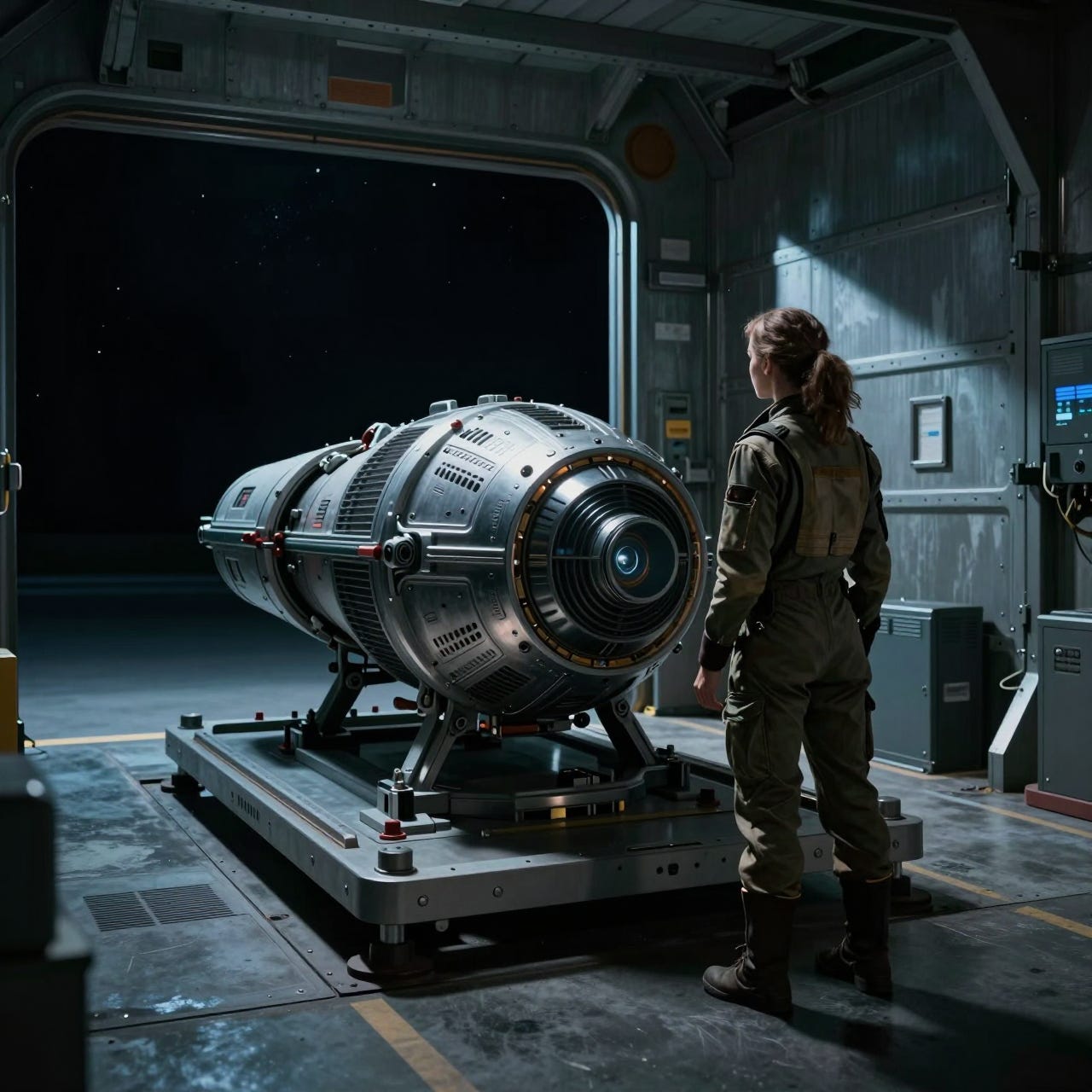
The Fold Drive sat in the cargo bay like a promise. Elena Vargas ran her scanner over the housing one more time, checking what she already knew. Clean power signature. Intact navigation arrays. No radiation leaks. The diagnostic pad showed green across every metric.
Three years salvaging the Belt. This was the first one she’d found.
Her hands didn’t shake. Former Colonial Security officers kept their nerves in check. The excitement lived deeper, where professionalism couldn’t reach it. Six months of mortgage payments. Medical supplies for Settlement 19. Real food instead of protein paste. Maybe enough left over to fix the Minerva’s port thruster, the one that rattled every time she spun up the drive.
She transmitted the find to Protocol Control before her practical side could suggest alternatives.
The confirmation came back in forty seconds. Registration accepted. Verification team dispatched. Estimated compensation: 47,000 credits. Payment processing: 6-8 months pending authentication and research priority assessment.
Elena read the message twice.
Six to eight months.
She locked down the cargo bay and headed for the cockpit. The Minerva had three weeks of supplies left. Settlement 19 needed food yesterday. Maria’s last message had been brief. Sofia’s medication would run out in five weeks. The civilian supply ships were running behind schedule. Again.
The numbers didn’t work. They never did anymore.
Settlement 19 clung to the inside of asteroid 2867-Echo like a barnacle on a ship’s hull. Elena docked at port seven, the one reserved for family. The airlock cycled. The corridor beyond smelled like recycled air and too many people breathing it.
Maria waited in the residential hub. Her sister had lost weight. The coordinator’s uniform hung loose on her frame. Dark circles under her eyes made her look fifty instead of thirty-nine.
“Elena.” Maria’s hug felt desperate. “You got my message.”
“I’m here.” Elena held her sister longer than usual. “Where’s Sofia?”
“School rotation. She doesn’t know yet.” Maria pulled back. Her eyes were red. “We’re at critical. Medical supplies, water filtration chemicals, food stocks. Everything’s running low. The supply ship was supposed to arrive three weeks ago.”
“What happened?”
“Diverted to Settlement 7. Emergency situation. Reactor leak. They needed immediate evacuation resources.” Maria’s voice went flat. “Our priority rating dropped. We’re tier three now. The next scheduled delivery is eight weeks out.”
Elena did the math automatically. Settlement populations, cargo capacity, available ships. Protocol made decisions at scale. Save a thousand people at Settlement 7 or maintain supplies for three hundred at Settlement 19. The calculus made sense.
It just didn’t help Sofia.
“How bad?” Elena asked.
Maria pulled up a data pad. The supply projections looked like a cliff edge. “Medical supplies critical in three weeks. Food stores depleted in six. We can stretch the water filtration chemicals, that’s not the immediate problem. The immediate problem is insulin.”
The word landed like a stone.
“Sofia’s prescription runs out in five weeks,” Maria continued. “I’ve requisitioned emergency medical supplies through Protocol channels. Tier two priority. They’re processing the request.”
“Processing means no.”
“Processing means maybe.” Maria’s voice cracked. “Processing means I sent my daughter’s medical records to a committee that decides which settlements get life-saving medication based on population density and strategic value.”
Elena put her hand on her sister’s shoulder. Words didn’t help. They both knew Protocol worked at scale. Three hundred people versus three thousand. The math made sense.
Sofia would understand. In twenty years. If she lived that long.
“I found a Fold Drive,” Elena said. “Registered it two hours ago. 47,000 credits, enough to buy supplies on the civilian market.”
Maria’s face transformed. Hope looked painful on someone that tired. “When do you get paid?”
“Six to eight months. Pending authentication and research priority assessment.”
The hope died. Maria’s shoulders sagged. “Right. Protocol timeline.”
“There’s always the emergency advance request,” Elena said, not believing it.
“I filed that yesterday. 15% of estimated value, available in 4-6 weeks pending approval.” Maria’s laugh was bitter. “The bureaucracy is very efficient. It just doesn’t move fast.”
They stood in silence. Around them, Settlement 19 hummed with the sounds of people living in a box bolted to a rock. Children playing in the residential corridors. Adults working double shifts to keep the life support running. Everyone making it work with less than they needed.
Elena’s communicator chimed. Private channel, encrypted. She checked the sender ID. No name. Just a contact code she recognized from her Security days.
The black market didn’t advertise.
The message was simple. Heard about your find. Interested buyer. 2x Protocol rate. Payment in 48 hours. Meet at Ouro Preto station if interested. No pressure. N.
Elena deleted it. Then recovered it from trash. Then stared at it for ten minutes.
Nakamura. She’d arrested him once, back in her Security days. Unauthorized technology transfer. He’d served six months and came out smiling. No hard feelings. Just business. He’d sent her a bottle of whiskey when she left the service. Good stuff, pre-Vethrak vintage. The note had said for the next time you need to forget something.
She’d drunk it the night Maria called to say Sofia had been diagnosed.
Elena ran the numbers again. 47,000 credits through Protocol channels. Six to eight months. 15% emergency advance in 4-6 weeks, maybe. That gave Settlement 19 about seven thousand credits in time to matter.
Versus 94,000 credits in 48 hours. Insulin cost 800 credits per month on the civilian market. Food supplies, medical equipment, water filtration chemicals. Everything Maria needed to keep three hundred people alive while they waited for Protocol to remember they existed.
The Fold Drive sat in her cargo bay. Humanity needed it for research. The Vethrak technology still held secrets. Every drive helped fill in the gaps, brought the experts closer to understanding how to build new ones. How to expand the shipping network. How to save everyone instead of just some people.
Long-term good versus immediate need.
Elena opened a secure channel to Ouro Preto station.
The bar at Ouro Preto catered to salvagers. Neutral ground. Security presence, but not oppressive. The kind of place where deals happened quietly and nobody asked questions.
Nakamura sat in a corner booth. He’d aged well. Grey hair, expensive suit, the look of someone who’d found his niche and made it profitable. He stood when Elena approached. Old-fashioned courtesy.
“Elena Vargas. You look good.” His smile seemed genuine. “I was sorry to hear you left Security. You were one of the fair ones.”
“Fairness doesn’t pay the mortgage.” Elena sat across from him. “You got my message.”
“I did. Fold Drive, authenticated, clean scan. You do good work.” Nakamura ordered two drinks from the table terminal. “I have a buyer. Private collector, research interest, fully funded. 94,000 credits, transferred to your account within 48 hours of delivery.”
“That’s twice Protocol rate.”
“Protocol rate is artificially suppressed. Committee pricing. My buyer pays market value.” Nakamura’s expression didn’t change. “I’m not going to pretend this is legal. You know what this is. The question is whether you need the money fast enough to care.”
Elena wrapped her hands around the glass. The liquor inside was amber, probably synthetic. Everything was synthetic now. “Tell me about your buyer.”
“Independent researcher. Legitimate credentials. He’s working on navigation array optimization. Not military applications, not weapons research. Pure science. He publishes his findings in open journals.” Nakamura pulled up a data pad. “His last paper was on Fold Drive power efficiency. Peer-reviewed, cited by Protocol’s own research division.”
“He could submit a research proposal to Protocol. Get authorized access.”
“He did. Denied. Insufficient strategic priority.” Nakamura’s voice stayed neutral. “He’s not working on military applications. Protocol wants weapons. He wants to make the drives we have work better. It’s not sexy enough for committee funding.”
Elena scanned the researcher’s credentials. Dr. James Park, Cambridge doctorate, fifteen years of field experience. His publication history looked solid. His research focused on civilian applications. Better navigation meant more efficient shipping routes. More efficient routes meant more cargo capacity.
The kind of work that would help Settlement 19 in five years. If they lasted that long.
“Why not just steal one?” Elena asked. “Why pay me?”
“Because theft is messy. Because I prefer willing participants. Because you’ll be able to sleep at night knowing the drive is being used for research, just not Protocol research.” Nakamura finished his drink. “I’m not trying to pressure you. You have a valid Protocol registration. You’ll get your money eventually. My offer just comes faster.”
“This would delay Protocol’s research timeline.”
“By one drive. They have forty-seven working units. Your drive might sit in a warehouse for eight months before anyone looks at it. Or it might get assigned to a military project that disappears into classified darkness.” Nakamura stood. “I’ll be here for the next six hours. If you want to deal, bring the drive to dock twelve. I’ll transfer the credits before you release the cargo. If not, no hard feelings. You were always honest with me. I’ll be honest with you.”
He left a credit chit on the table. Enough to cover the drinks and a generous tip. The kind of gesture someone makes when they can afford it.
Elena sat alone in the booth. Around her, salvagers traded stories and lies. People living on the edge of sustainability, finding value in the wreckage of a dead civilization. Everyone was getting by. Most of them weren’t stealing from Protocol.
Most of them didn’t have a niece who needed insulin.
The decision should have been harder.
Elena sat in the Minerva’s cockpit and stared at the cargo bay monitor. The Fold Drive sat secured in its cradle. Clean lines, alien technology, humanity’s lifeline. One of 212 recovered units. Forty-seven working drives sustaining forty thousand annual cargo shipments. Not enough. Never enough. Every drive mattered.
Her communicator showed Maria’s last message. Sofia’s medication schedule. The supply requisition denial. The emergency priority request, pending review. The careful bureaucratic language that meant we’re aware of your situation and processing it according to established procedures.
Protocol worked at scale. The system saved lives. The committee structure prevented corruption. The research priorities were carefully balanced to maximize strategic benefit. Everything made sense from the top down.
Sofia would die anyway.
Elena initiated the undocking sequence. The Minerva pulled away from Settlement 19’s docking array. She set course for dock twelve at Ouro Preto. The trip took forty minutes. Enough time to change her mind. Enough time to turn back.
She didn’t turn back.
Nakamura’s ship was a civilian transport. Clean, professional, legitimate enough to pass casual inspection. He met her at the airlock. Two other people with him. A woman with scanning equipment, a man with a data pad. Professional crew. They ran the authentication check in fifteen minutes.
“Everything looks good,” the woman said. “Dr. Park will be pleased.”
Nakamura pulled up his data pad. “I’m transferring 94,000 credits to your account. You’ll see the confirmation in real time.”
Elena’s communicator chimed. The bank transfer showed successful. 94,000 credits. Enough to buy six months of supplies for Settlement 19. Enough to keep Sofia alive. Enough to let Maria sleep for the first time in weeks.
“Do you need help transferring the cargo?” Nakamura asked.
Elena released the cargo bay locks remotely. The transfer took twenty minutes. Professional, efficient, no different than any other salvage deal. When the Fold Drive left her ship, something in Elena’s chest went with it.
“Pleasure doing business with you,” Nakamura said. “If you find another drive, you know how to reach me.”
Elena didn’t answer. She sealed the airlock and initiated departure protocols. The Minerva pulled away from dock twelve. She set course back to Settlement 19.
The trip took forty minutes. She spent thirty-nine of them staring at nothing.
Maria cried when she saw the bank transfer. Actual tears. She pulled up the civilian market interface and started ordering supplies before Elena could say anything. Medical equipment, insulin, food stores, water filtration chemicals. Everything Settlement 19 needed to survive until Protocol remembered they existed.
“Where did you get this?” Maria asked, fingers flying across the data pad.
“Found something valuable.”
“The Fold Drive? Protocol paid you already?”
“Something like that.”
Maria looked up. Former coordinator, current administrator, older sister who knew when Elena was lying. “What did you do?”
“I solved a problem.”
“Elena.”
“Sofia needs insulin. Settlement 19 needs supplies. I had something valuable. I sold it to someone who could pay immediately.” Elena kept her voice level. “That’s it. That’s the whole story.”
Maria’s face went through several expressions. Fear, understanding, resignation. She went back to the supply order. “We have to file the source declaration. For the settlement records.”
“File it as salvage compensation. Private sale. That’s technically accurate.”
“That’s technically evasive.” Maria finished the order. The confirmation came through. Delivery in three weeks. Priority shipping, fully paid. “I’m not going to ask questions. I’m just going to say thank you.”
“You don’t need to thank me.”
“Yes, I do.” Maria’s voice broke. “You just saved my daughter’s life. Whatever you did, whatever it cost you, thank you.”
Elena left before the crying could spread. She made her way through Settlement 19’s corridors. Children played in the residential areas. Adults worked in the gardens. Life continued in a box bolted to a rock.
Sofia found her in the observation deck. Ten years old, small for her age, bright eyes that saw too much. She hugged Elena’s waist.
“Mom said you’re staying for dinner.”
“If that’s okay with you.”
“It’s always okay.” Sofia pulled Elena toward the viewport. “Want to see the asteroid field? There’s a good view today.”
They stood together and watched rocks drift through the void. Somewhere out there, salvagers were finding things. Somewhere else, Protocol committees were making decisions. The machinery of survival turned slowly. People fell through the gaps.
Elena had pulled one person back. Maybe three hundred people, if the supplies lasted long enough. The cost was one Fold Drive. One piece of research data. One delay in humanity’s collective understanding of Vethrak technology.
Dr. Park would publish his findings. The research would continue. Different path, same destination. Maybe faster, maybe slower. The variables were too complex to calculate.
Sofia leaned against Elena’s side. “Mom seems happy today.”
“Good. She deserves to be happy.”
“She was worried about my medicine. I heard her talking to Administrator Chen.” Sofia’s voice went quiet. “I know we’re low priority. I know the big settlements get supplies first. It makes sense.”
Elena pulled Sofia closer. “You’re high priority to me.”
“I know.” Sofia went back to watching the asteroids. “That’s why you stayed.”
Davies found Elena three days later. Former Security, current Protocol investigator, old friend who looked tired. He sat across from her in the Minerva’s galley without asking permission.
“Got a weird report,” he said. “Fold Drive registration, filed and authenticated. Then the drive never showed up for the verification team. Ship departed Settlement 19, came back six hours later. Salvager suddenly has enough credits to buy six months of supplies for an entire settlement.”
Elena poured two cups of coffee. “That’s interesting.”
“That’s suspicious.” Davies accepted the coffee. “I pulled the salvager’s record. Elena Vargas, former Colonial Security, exemplary service record, early retirement to care for family. Registered two dozen finds in the past three years. Clean record. Never missed a Protocol delivery.”
“Until now.”
“Until now.” Davies drank his coffee. “Here’s what I think happened. Salvager found a Fold Drive. Real find, clean authentication. Then someone made a better offer. Black market collector, maybe. Someone with credits and a fast payment schedule. Salvager made a practical choice.”
Elena met his eyes. “What are you going to do about it?”
“My job says I should file a report. Start an investigation. Track down the drive. Prosecute everyone involved.” Davies finished his coffee. “My job also says I should consider context. Settlement 19 was facing critical shortages. Medical emergency. Protocol failed to provide adequate support. Salvager took action to prevent civilian casualties.”
“Those things aren’t mutually exclusive.”
“No, they’re not.” Davies stood. “Here’s what I’m going to do. I’m going to note in my report that the Fold Drive was damaged during salvage operations. Radiation leak. Had to be jettisoned for safety reasons. Unfortunate loss. Salvager acted appropriately given the circumstances.”
Elena didn’t move. “Why?”
“Because the system is broken. Because Protocol can’t keep up with demand. Because people are dying while committees debate priority rankings.” Davies headed for the airlock. “Because you were a good officer and you’re a good person. Because Sofia deserves to live.”
He paused at the hatch. “If you find another drive, turn it in. Whatever you did once, don’t make it a pattern. I can cover for you once. I can’t make you invisible.”
“Understood.”
Davies left. Elena sat alone in the galley. The coffee was cold. She drank it anyway.
Six weeks later, Elena visited Settlement 19. Sofia looked healthier. Color in her cheeks, energy in her movements. The insulin was working. Maria had put on weight. The settlement’s supply status showed green across the board. Three hundred people breathing easier.
Dr. Park published a paper on Fold Drive navigation optimization. Elena read it twice. The research was solid. The findings would help improve shipping efficiency. In five years, maybe fewer people would fall through the gaps.
The Protocol research timeline had been delayed by one drive. Maybe six months. Maybe a year. The variables were too complex to calculate. Someone somewhere might die because humanity’s understanding of Vethrak technology came a little slower.
Elena would never know their names.
She knew Sofia’s name. She knew Maria’s name. She knew the names of three hundred people living in Settlement 19. The math made sense. The guilt lived anyway.
In the observation deck, Sofia pressed her face against the viewport. “Mom says we’re getting a new teacher next month. Protocol approved the transfer. Settlement priority improved.”
“That’s good.”
“Do you think we’ll be okay?” Sofia asked. “Long term?”
Elena pulled her niece close. “I think we’ll figure it out.”
“That’s not the same as being okay.”
“No. It’s not.” Elena watched the asteroid field drift past. Somewhere out there, another salvager was finding something valuable. Somewhere else, another committee was making decisions. The machinery turned. “We do what we can. We save who we can. That has to be enough.”
Sofia nodded. She didn’t understand. Not yet. In ten years, maybe twenty, she’d face her own impossible choice. She’d do the math. She’d make a decision. She’d live with it.
Elena would do it again. Save Sofia, delay the research, live with the consequences. The choice felt inevitable and impossible. The guilt felt like proof she’d been human about it.
The alternative was letting Sofia die for the greater good. The alternative was faith in a system that worked at scale but failed individuals. The alternative was math without names.
Elena couldn’t do that math.
She held Sofia and watched the void. Somewhere in the darkness, forty-seven Fold Drives carried humanity’s cargo. One more drive would have been better. One more drive would have been useful. One more drive would have helped someone.
Sofia laughed at something in the asteroid field. The sound echoed in the observation deck. Real, immediate, alive.
Elena made her choice. She’d live with it. That had to be enough.
Author’s Note: This story exists in that uncomfortable space where both choices have real costs. Elena’s decision isn’t right or wrong, it’s human. Protocol serves the greater good. Sofia needs insulin. Both things are true. The black market isn’t evil, it’s just faster. The system isn’t broken, it just can’t save everyone. This is the moral landscape of the post-Vethrak world, where survival means choosing who lives and learning to sleep afterward.
If you enjoyed this story, please share it with someone who appreciates morally complex science fiction. These stories are reader-supported, and your engagement makes them possible.
If you enjoyed this story, you can follow the main story arc in The Exodus Rush, the first book in The Vethrak Requiem series.